Oct 7, 2026Ultrasonic Cleaning Solutions
Ultrasonic Rust Removal: Will an Ultrasonic Cleaner Remove Rust?
Learn when ultrasonic cleaning can help remove rust, why chemistry matters, how to avoid flash rust, and what equipment factors to check for rusty parts. Slug: ultrasonic-rust-removal-engine-blocks
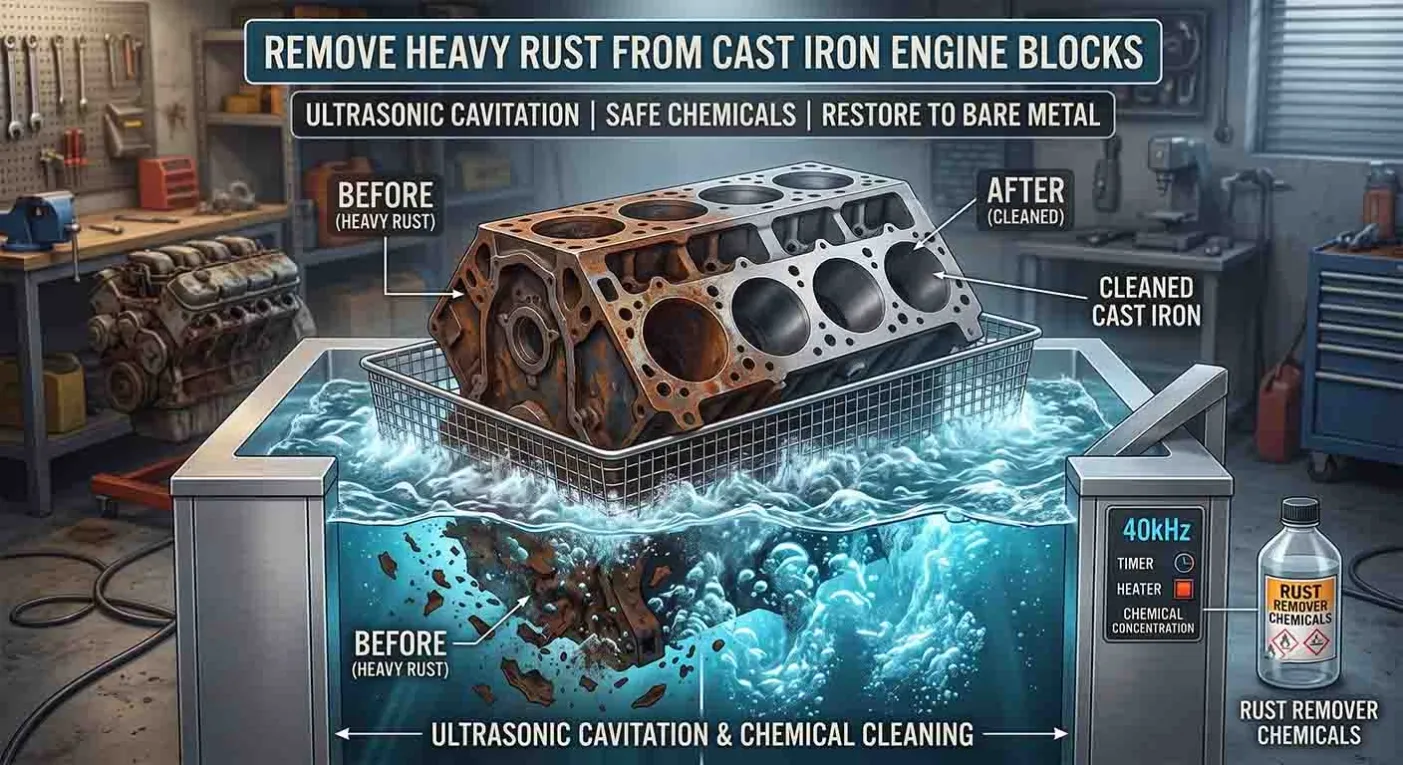
An ultrasonic cleaner can help remove rust, but not by sound waves alone. Rust removal usually depends on cavitation, suitable rust-removal chemistry, temperature control, cleaning time, rinsing, drying, and material compatibility.
For rusty tools, engine parts, cast iron components, fixtures, and metal parts with grooves or internal passages, ultrasonic cleaning may be useful because cavitation can help cleaning liquid reach areas that are difficult to scrub manually. But it is not a universal answer for every rusted part, every metal, or every level of corrosion.
This guide explains when ultrasonic rust removal makes sense, what limits to check, and how to think about equipment selection before requesting a cleaning system.
Can an Ultrasonic Cleaner Remove Rust?
Yes, ultrasonic cleaning can support rust removal when the part material, rust condition, and cleaning solution are suitable.
Ultrasonic cleaning works through cavitation. High-frequency sound waves create microscopic bubbles in the liquid. When these bubbles collapse near the part surface, they create a local scrubbing effect that can help loosen contamination from edges, holes, threads, and recesses.
For rust, cavitation is only part of the process. Rust is iron oxide, so the cleaning liquid must also be able to chemically attack, dissolve, loosen, or chelate the oxide layer. Water alone is usually not enough for meaningful rust removal.
A more accurate way to think about ultrasonic rust removal is:
Rust-removal chemistry + ultrasonic cavitation + temperature/time control + rinsing and drying = a controlled rust-removal process.
The ultrasonic cleaner helps the liquid work more effectively around the part. It does not replace the need for the right chemistry or process control.
Why Chemistry Matters More Than the Machine Alone
If the cleaning liquid is not suitable for rust, the ultrasonic tank may clean dirt or grease but leave most oxidation behind. Rust removal usually requires a rust-specific solution, acidic cleaner, chelating agent, or other chemistry designed for metal oxide removal.
The right solution depends on:
- base material
- rust severity
- surface finish
- coatings or plating
- mixed metals
- downstream requirements such as painting, assembly, or storage
This is especially important for aluminum, zinc-plated parts, polished surfaces, coated parts, and precision components. A chemical that works on cast iron may not be appropriate for another metal.
For automotive and engine parts, chemistry selection often needs to be considered together with degreasing. If the part is covered in heavy oil, sludge, or carbon deposits, a degreasing step may be needed before rust removal so the rust-removal solution can contact the oxidized surface.
For related chemistry decisions in engine cleaning, see Sonixmax’s guide to ultrasonic cleaning solution for engine parts.
Rust Removal Solution vs. Rust Inhibitor
Rust removal and rust prevention are not the same step.
A rust-removal solution is used to help loosen, dissolve, or remove oxidation from the metal surface. An ultrasonic cleaner can support this process by helping the liquid reach holes, threads, grooves, and recessed areas.
A rust inhibitor is used after cleaning to help reduce the risk of new rust forming on exposed metal surfaces.
This difference matters because many rust-related problems happen after cleaning. If steel or cast iron parts are rinsed and left wet, flash rust can appear quickly, especially in holes, grooves, or internal passages.
For rust-related ultrasonic cleaning, evaluate both:
- the rust-removal chemistry used during cleaning
- the rinse, drying, and temporary corrosion-protection step after cleaning
Do not rely on ultrasonic cavitation alone to remove rust or prevent rust from returning. Chemistry, rinsing, drying, and material compatibility all matter.
When Ultrasonic Rust Removal Makes Sense
Ultrasonic rust removal is worth evaluating when the part is serviceable, compatible with a liquid-based cleaning process, and has surfaces that benefit from liquid access into detailed areas.
It may be useful for:
- rusty tools
- cast iron parts
- engine components
- brackets, fixtures, and machined parts
- threaded holes, grooves, recesses, and internal passages
- parts where detailed liquid access is useful
Another process or further inspection may be more appropriate when:
- the part is cracked, deeply pitted, or structurally damaged
- the rust has penetrated too far into the material
- the base metal or coating is not compatible with the cleaning solution
- the part cannot be fully rinsed or dried after cleaning
- the required surface finish cannot tolerate the selected chemistry or cavitation intensity
Ultrasonic cleaning can help remove rust from accessible surfaces, but it cannot reverse metal loss. If corrosion has already damaged dimensions, sealing surfaces, threads, or load-bearing areas, cleaning will not restore the original material.
Practical Ultrasonic Rust Removal Workflow
A controlled rust-removal process should be treated as a cleaning workflow, not just a tank cycle:
Inspect → Degrease if needed → Select rust-removal chemistry → Ultrasonic clean → Rinse → Dry → Protect or finish → Inspect again
First, inspect the part to confirm whether it is worth cleaning. Look for deep pitting, cracks, damaged threads, or areas where corrosion may have changed the part’s function.
If oil, grease, or sludge is present, remove it before rust treatment. Rust-removal chemistry works best when it can reach the oxidized surface directly.
During ultrasonic cleaning, follow the cleaning solution supplier’s recommended concentration, temperature, and contact time. Avoid treating any frequency, temperature, or time setting as universal. Rust severity, part geometry, bath condition, and material compatibility all affect the result.
After cleaning, rinse the part as required to remove loosened contamination and chemical residue. Then dry it quickly and thoroughly. Freshly cleaned bare steel or cast iron can develop flash rust if moisture remains on the surface.
If the part will not be painted, assembled, or processed immediately, apply a suitable temporary corrosion protection method.
Avoiding Flash Rust After Cleaning
Flash rust is one of the most common problems after wet rust-removal processes. Once rust is removed, the exposed metal surface may oxidize quickly if it remains wet or unprotected.
The risk is higher when:
- the part is bare steel or cast iron
- rinse water remains in holes, grooves, or internal passages
- drying is slow
- humidity is high
- no suitable corrosion protection step is used after cleaning
For simple parts, a controlled drying and temporary corrosion-protection step may be enough. For heavier parts, batches, or complex components, a drying stage may need to be included in the process.
If drying is part of your cleaning requirement, compare whether a basic single-tank setup is enough or whether a system with rinsing and drying stages is more suitable. Sonixmax documents industrial configurations such as dual-tank ultrasonic cleaning with drying and multi-stage systems with filtration, rinsing, and drying.
How to Choose Equipment for Rusty Parts
The equipment choice depends on the part and process, not only the word “rust.”
Cleaning Requirement | Equipment Consideration |
|---|---|
Part dimensions | Tank size and usable working area |
Part weight | Basket, fixture, lifting, and loading method |
Rust severity | Chemistry, contact time, and process control |
Oil or grease present | Whether degreasing is needed before rust removal |
Repeated batches | Bath management and possible filtration |
Need to rinse | Separate rinse tank or manual rinse process |
Need to dry quickly | Hot air drying, compressed air, or drying workflow |
Surface sensitivity | Frequency, chemistry, and material compatibility check |
For occasional small tools or light parts, a benchtop ultrasonic cleaner may be enough if the part fits safely and the chemistry is suitable. For heavy engine blocks, large castings, repeated workshop batches, or parts that require lifting, an industrial tank is usually more realistic.
For large automotive or engine components, Sonixmax’s industrial single-tank ultrasonic cleaner with heater can be a starting point for basic cleaning evaluation. If repeated contamination affects bath condition, a single-tank ultrasonic cleaner with filtration may be relevant. If the process requires cleaning plus drying, a dual or multi-tank configuration may be more appropriate.
These product directions should not be treated as automatic recommendations. Rust removal still requires confirmation of part size, weight, material, chemistry, process sequence, and cleaning target.
Ultrasonic Rust Removal for Engine Blocks and Automotive Parts
Engine blocks, manifolds, brackets, and other automotive parts often create a mixed cleaning problem. A part may have rust, oil, carbon, coolant residue, scale, and trapped debris at the same time.
If you are evaluating ultrasonic cleaning for engine rebuilding or automotive parts restoration, it may also help to compare related process guides:
Together, these guides can help separate the cleaning problem from the equipment choice.
Discuss a Rust Removal Cleaning Process
If you are evaluating ultrasonic rust removal for engine parts, tools, cast iron components, or industrial metal parts, send Sonixmax the part dimensions, approximate weight, material, rust condition, oil or grease condition, batch quantity, and current cleaning method.
Sonixmax can help you discuss whether a single-tank, filtration, rinsing, drying, or multi-stage ultrasonic cleaning configuration is a suitable starting point.
FAQ
Will an ultrasonic cleaner remove rust?
Yes, an ultrasonic cleaner can help remove rust when used with a suitable rust-removal solution and a process that matches the part material and rust condition. Ultrasonic action alone is usually not enough; chemistry, rinsing, drying, and compatibility matter.
What solution should I use for ultrasonic rust removal?
Use a rust-removal solution that is compatible with the part material and your ultrasonic cleaner. Rust-specific acidic or chelating cleaners may be used in suitable applications, but the exact solution, concentration, temperature, and contact time should follow the chemical supplier’s guidance.