
Oct 6, 2026Buying Guides
Ultrasonic Cleaner vs Parts Washer: How to Choose for Industrial Parts Cleaning
Compare ultrasonic cleaners and parts washers by cleaning method, part geometry, contamination, workflow, and equipment selection for industrial and automotive parts cleaning.
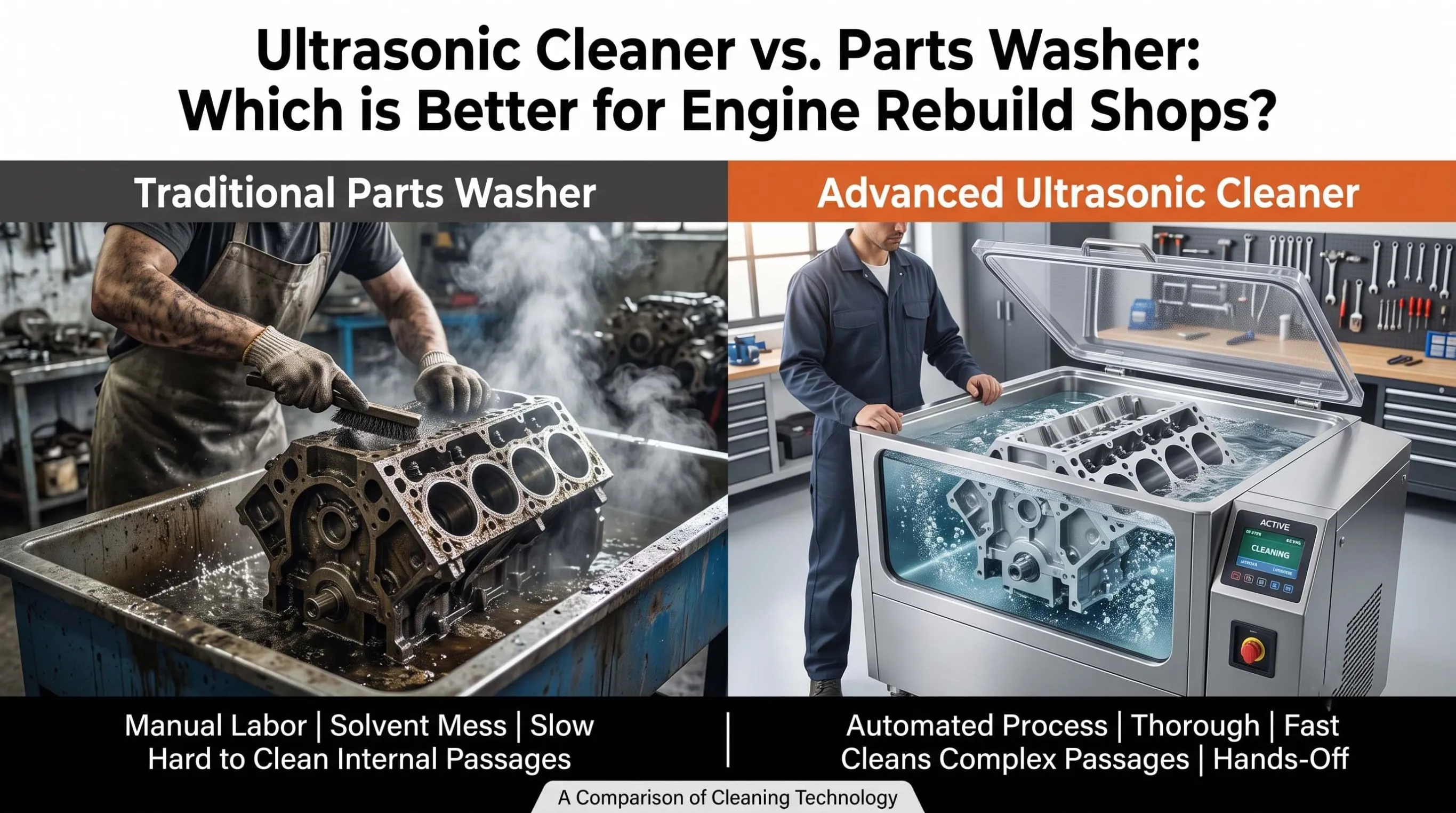
A parts washer and an ultrasonic cleaner can both clean mechanical parts, but they solve different industrial cleaning bottlenecks.
For workshop managers, maintenance teams, and production engineers, choosing the wrong cleaning process can lead to unnecessary manual labor, frequent bath changes, inconsistent cleaning results, or parts that still need rework after cleaning.
The short answer: a parts washer is usually better for bulk cleaning—removing heavy, visible contamination from accessible surfaces. An ultrasonic cleaner is better for detailed cleaning, where cleaning liquid needs to reach holes, threads, grooves, recesses, and complex part geometry that is difficult to clean by brushing or spray alone.
For many industrial facilities, this is not always an either/or decision. A parts washer may be used for rough pre-cleaning, while ultrasonic cleaning may be used afterward for more detailed cleaning.
Quick Answer: Which Process Fits Your Cleaning Bottleneck?
- Choose a parts washer if your main bottleneck is bulk oil, thick grease, mud, and loose shop debris on exterior, easy-to-reach surfaces.
- Choose an ultrasonic cleaner if your parts have blind holes, internal threads, fine passages, grooves, or complex geometry that requires more consistent liquid contact.
- Choose a combined process if your parts arrive heavily contaminated but still need more detailed cleaning before inspection, assembly, coating, or packaging.
Parts Washer vs. Ultrasonic Cleaner: Head-to-Head Comparison
Feature | Industrial Parts Washer | Ultrasonic Cleaner |
|---|---|---|
Main cleaning action | Spray, soaking, flow, solvent, aqueous detergent, or manual brushing | Ultrasonic cavitation in a liquid bath |
Primary strength | Bulk degreasing and accessible surface cleaning | Detailed cleaning of recesses, holes, threads, and complex geometry |
Common contamination | Heavy oil, grease, mud, loose debris, shop soil | Oil film, fine residues, particles, polishing compound, light carbon, and detailed contamination depending on chemistry |
Ideal part geometry | Simple, open, easy-to-reach surfaces | Complex parts, internal passages, blind holes, grooves, and detailed machined areas |
Operator role | Often more manual or spray-based | More process-controlled, but still requires correct loading, chemistry, and inspection |
Pre-cleaning value | Excellent for removing bulk contamination | May still need pre-cleaning when parts are heavily soiled |
Typical buyer question | “How do I remove heavy grease and dirt efficiently?” | “How do I clean difficult areas more consistently?” |
The real question is not which machine is better. The better question is: which cleaning method matches your part geometry, contamination level, cleanliness requirement, and daily workflow?
What a Parts Washer Does Best
A parts washer is the workhorse of general maintenance and rough cleaning. It is often the practical starting point when parts come in heavily soiled from the field, repair shop, or factory floor.
Common industrial applications include:
- engine blocks and transmission housings
- large gears and structural brackets
- general workshop tools and hardware
- bearings and housings
- maintenance parts
- heavy mechanical assemblies
A parts washer is useful when contamination is mostly on accessible surfaces. If parts are covered in heavy sludge, grease, or mud, pre-cleaning them before ultrasonic cleaning can help protect the ultrasonic bath and reduce premature solution contamination.
What an Ultrasonic Cleaner Does Best
An ultrasonic cleaner becomes more useful when the cleaning challenge shifts from bulk contamination to access and repeatability.
Ultrasonic cavitation helps cleaning liquid reach areas that are difficult to clean with a spray nozzle, brush, or manual wiping, such as:
- blind holes
- threaded areas
- grooves
- internal passages
- small cavities
- complex part geometry
- detailed machined surfaces
This is why ultrasonic cleaning is often evaluated for carburetors, fuel injectors, precision machined parts, molds, engine components, and other parts where manual cleaning is inconsistent or difficult.
Ultrasonic cleaning can also make the process more repeatable when loading, chemistry, temperature, and time are properly controlled. However, the machine does not replace process control. Cleaning result still depends on the right cleaning solution, temperature, time, frequency, loading method, and material compatibility.
Is an “Ultrasonic Parts Washer” the Same Thing?
Buyers often search for terms like ultrasonic parts washer, ultrasonic parts cleaner, and industrial ultrasonic cleaner.
In many industrial contexts, these terms refer to similar equipment: a liquid cleaning tank or system that uses ultrasonic cavitation to clean parts.
The configuration can vary widely. A basic ultrasonic parts washer may be a single heated tank. A more complete industrial system may include filtration, oil separation, rinsing, drying, lifting, or automation.
So when comparing equipment, look beyond the name and evaluate the actual configuration:
- tank size
- part size and weight
- contamination type
- ultrasonic frequency and power
- heating
- filtration
- rinsing
- drying
- loading and handling method
- required cleaning result
Using Both: When Parts Washers and Ultrasonic Cleaners Work Together
In many real cleaning workflows, parts washers and ultrasonic cleaners are not competitors. They can work together.
A typical process may look like this:
- Rough pre-cleaning: Use a parts washer to remove heavy grease, mud, loose dirt, or bulk contamination.
- Bath protection: Reduce the amount of contamination entering the ultrasonic tank.
- Ultrasonic cleaning: Use ultrasonic cavitation to reach holes, grooves, recesses, and detailed areas.
- Rinse and dry: Finish the part according to inspection, assembly, coating, or packaging requirements.
This combined process can be useful for engine rebuild shops, maintenance workshops, and industrial users handling both heavily contaminated parts and detailed components.
Equipment Direction for Industrial Buyers
The right configuration depends on your parts, contamination, batch size, and required cleaning result.
- Simple batch cleaning: An Industrial Single Tank Ultrasonic Cleaner with Heating may be suitable for general parts cleaning.
- Oily parts or repeated cleaning cycles: An Industrial Single Tank Ultrasonic Cleaner with Filtration System can help keep the cleaning liquid usable for longer.
- Cleaning + rinsing needs: An Industrial Dual-Tank Ultrasonic Cleaner may be considered when parts need a separate rinsing stage.
- Higher cleanliness or production workflow: Multi-Stage Ultrasonic Cleaning Systems may be more suitable when cleaning, rinsing, drying, and repeatability are required.
FAQ
Is an ultrasonic cleaner better than a parts washer?
Not always. An ultrasonic cleaner is usually better for complex geometry, holes, threads, and detailed surfaces. A parts washer may be better for heavy grease, mud, loose dirt, and accessible surfaces.
Can an ultrasonic cleaner replace a parts washer?
It depends on the contamination. If parts are only lightly contaminated, ultrasonic cleaning may be enough. If parts are covered with thick grease, sludge, or mud, pre-cleaning in a parts washer or manual station may still be useful.
What is an ultrasonic parts washer?
An ultrasonic parts washer is commonly used to describe an ultrasonic cleaning tank or system for mechanical or industrial parts. Depending on the application, it may be a single tank or a larger system with filtration, rinsing, drying, or automation.
Do ultrasonic cleaners require special cleaning solutions?
Yes. Ultrasonic cleaning requires a compatible cleaning solution for the part material and contamination type. Chemistry, temperature, time, loading, and material compatibility all affect the cleaning result.
Need Help Choosing the Right Cleaning Process?
If you are deciding between a parts washer, an ultrasonic cleaner, or a combined cleaning process, send Sonixmax your application details:
- part dimensions and weight
- material
- contamination type
- daily batch quantity and throughput
- current cleaning method
- current cleaning bottleneck or failure point
- required cleaning result
- rinsing, drying, filtration, or automation needs
Sonixmax can help evaluate whether your process is better suited for a simple parts washer, a standalone ultrasonic cleaner, or a more complete ultrasonic cleaning system configuration.