
Oct 7, 2026Ultrasonic Cleaning Solutions
Best Ultrasonic SMT Stencil Cleaner Guide: Remove Solder Paste & Reduce Defects
Learn how to clean SMT stencils safely with an ultrasonic cleaner. Reduce solder defects, protect stencil tension, and calculate your ROI with aqueous solvents
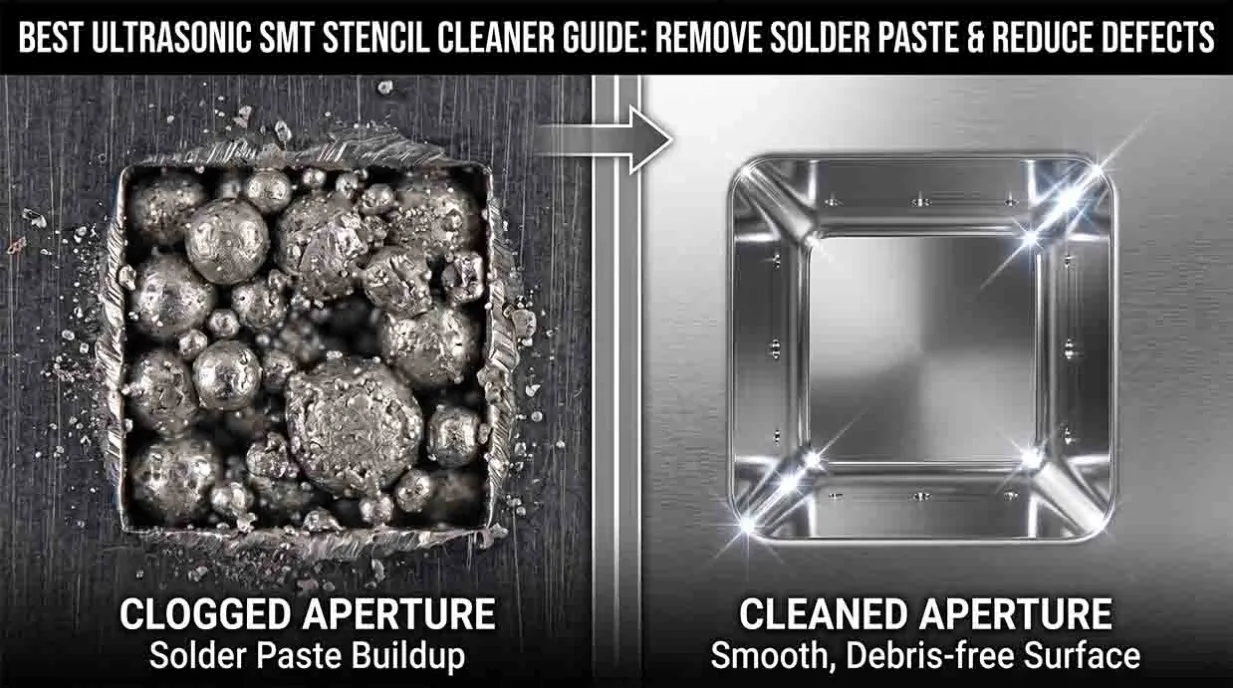
In Surface Mount Technology (SMT) assembly, many soldering defects, such as solder bridging, insufficient solder, and tombstoning, can originate from the solder paste printing process. One common root cause is clogged stencil apertures.
Manual wiping with lint-free wipes and IPA may clean the surface of the stencil, but it can be slow, inconsistent, and less effective at clearing paste from the inner walls of fine-pitch apertures. It may also expose operators to solvent fumes and repeated manual handling.
For high-yield SMT production, an industrial ultrasonic SMT stencil cleaner can provide a more controlled and repeatable process for removing solder paste and adhesive residue from fine apertures.
In this guide, we explain how ultrasonic stencil cleaning works, how to reduce the risk of damaging delicate foils, and what to consider before upgrading your cleaning process.
Why Manual Wiping Fails on Laser-Cut Stencils
How do you clean SMT stencils effectively? If you are still relying entirely on manual wiping, you may be cleaning the 2D surface of the stencil while leaving the 3D volume of the apertures partially contaminated.
Modern PCBs use fine-pitch components such as 01005 packages, QFNs, and micro-BGAs. The laser-cut apertures for these components are extremely small. When solder paste dries inside these openings, manual wiping may smear residue across the surface or leave paste on the inner aperture walls.
If the aperture walls remain partially blocked, paste release becomes less predictable during the next print cycle. This can contribute to insufficient solder joints, dry joints, solder bridging, and post-reflow rework.
Ultrasonic cavitation helps by creating microscopic bubbles in the cleaning liquid. These bubbles can reach into fine openings and help loosen solder paste, flux residue, and uncured SMT adhesive from aperture walls. This supports more consistent paste release for the next production run.
Can Ultrasonic Cleaners Damage SMT Stencils?
Yes, they can if the wrong equipment, frequency, chemistry, or positioning method is used.
SMT stencils are precision tools. The stainless steel foil is thin, and the laser-cut webs between fine-pitch apertures can be delicate. The goal is not simply to clean more aggressively, but to clean with a controlled process.
For SMT stencils, 40kHz is commonly preferred over lower frequencies such as 28kHz because it provides finer cavitation that is more suitable for delicate openings and thin foil structures. The stencil should also be suspended in a dedicated rack rather than placed directly on the tank bottom.
Chemistry is just as important. The cleaning liquid must be compatible with the solder paste, stainless steel foil, frame structure, and adhesive materials. Cleaning time and temperature should be tested before routine use, especially if the stencil uses bonded frame components.
SMT Stencil Cleaning vs. Stencil Underside Cleaning
These two terms are often confused, but they serve different purposes in the SMT workflow.
Stencil underside cleaning usually happens inside the screen printer during production. It wipes the bottom of the stencil to reduce paste smear and maintain print stability. However, it is not always enough to deep-clean dried paste, red glue, or residue inside fine laser-cut apertures.
Offline SMT stencil cleaning is a separate cleaning process. The stencil is removed from the printer and cleaned outside the printing line. This is more suitable when solder paste has dried inside apertures, fine-pitch openings are repeatedly blocked, red glue needs to be removed, or the stencil needs deeper cleaning before storage or reuse.
An ultrasonic SMT stencil cleaner should be selected based on stencil size, aperture design, solder paste type, cleaning chemistry, rinsing method, drying method, and handling process.
Choosing the Right Chemistry for Solder Paste
What is the best solvent for cleaning solder paste? The answer depends on the solder paste type, residue condition, stencil material, and facility safety requirements.
IPA and other solvents may be used in some manual wiping processes, but highly volatile or flammable solvents can create safety, odor, handling, and consumption concerns, especially in open cleaning processes.
For many ultrasonic stencil cleaning applications, aqueous cleaning solutions are preferred. These water-based cleaning solutions are formulated to help break down solder paste residue, flux residue, or red glue while reducing the need for highly volatile solvents.
Before selecting chemistry, confirm whether the process needs to remove lead-free solder paste, leaded solder paste, water-soluble flux residue, no-clean flux residue, or uncured SMT adhesive. The cleaning temperature, concentration, rinsing method, drying method, and wastewater handling should follow the chemical supplier’s instructions.
Sensitive stencils should be tested with the planned chemistry before routine batch cleaning.
The ROI of Automated Stencil Cleaning
Manual stencil cleaning may seem inexpensive because it only requires wipes and solvent, but the hidden cost can be higher than expected.
A controlled ultrasonic stencil cleaning process may help reduce rework caused by inconsistent paste release, operator time spent manually wiping stencils, consumable waste from wipes and solvents, and handling damage from aggressive scrubbing.
The actual return on investment depends on production volume, stencil changeover frequency, labor cost, defect rate, chemistry cost, and how often stencils need to be cleaned.
If an SMT line is already experiencing downtime, repeated aperture blockage, or rework related to poor paste release, offline stencil cleaning is worth reviewing as part of the print process improvement plan.
Sonixmax Industrial Stencil Cleaning Solutions
Sonixmax manufactures industrial ultrasonic cleaning systems for electronics manufacturing and SMT cleaning applications.
Depending on stencil size and facility workflow, Sonixmax can help evaluate suitable tank dimensions, 40kHz ultrasonic configuration, stencil suspension rack design, heating requirement, filtration, rinsing, drying, and workflow fit for the SMT production area.
For basic offline stencil cleaning, an Industrial Single-Tank Ultrasonic Cleaner may be used as the base cleaning unit. If solder paste particles accumulate quickly in the bath, a filtration configuration may be more suitable.
If the process requires washing, rinsing, and drying in sequence, a Multi-Stage Ultrasonic Cleaning System may be considered.
Need Help Evaluating an SMT Stencil Cleaner?
If you are evaluating an ultrasonic cleaning system for SMT stencils, send Sonixmax your application details.
Useful information includes maximum stencil frame size, aperture type, finest pitch level, solder paste type, red glue usage, current cleaning method, cleaning frequency, and available workshop space.
Sonixmax can help evaluate whether an ultrasonic stencil cleaning system fits your process and recommend a practical configuration for your stencil size, residue type, and production workflow.
FAQ
Is SMT stencil cleaning the same as stencil underside cleaning?
No. Stencil underside cleaning usually happens inside the screen printer during production to reduce paste buildup on the bottom of the stencil. Offline SMT stencil cleaning is a separate cleaning process used after the stencil is removed from the printer.
When should an SMT factory use an offline ultrasonic stencil cleaner?
An offline ultrasonic stencil cleaner is useful when solder paste has dried inside apertures, fine-pitch openings are repeatedly blocked, manual wiping is inconsistent, red glue needs to be removed, or the stencil needs deeper cleaning before storage or reuse.
Can ultrasonic cleaning damage SMT stencils?
It can if the wrong process is used. To reduce risk, the stencil should be suspended in a rack, the cleaning frequency and chemistry should be suitable, and cleaning time and temperature should be tested before routine use.
What frequency is usually preferred for ultrasonic SMT stencil cleaning?
For SMT stencils, 40kHz is commonly preferred because it provides finer cavitation than lower-frequency cleaning. The final process should still be confirmed based on stencil type, residue, cleaning chemistry, and required cleaning result.