Oct 7, 2026Ultrasonic Cleaning Solutions
Ultrasonic Fuel Injector Cleaning: What It Can Do and How to Choose Equipment
Learn how to safely clean diesel and gas fuel injectors using an ultrasonic cleaner. Discover why 40kHz is the best frequency to prevent nozzle damage.
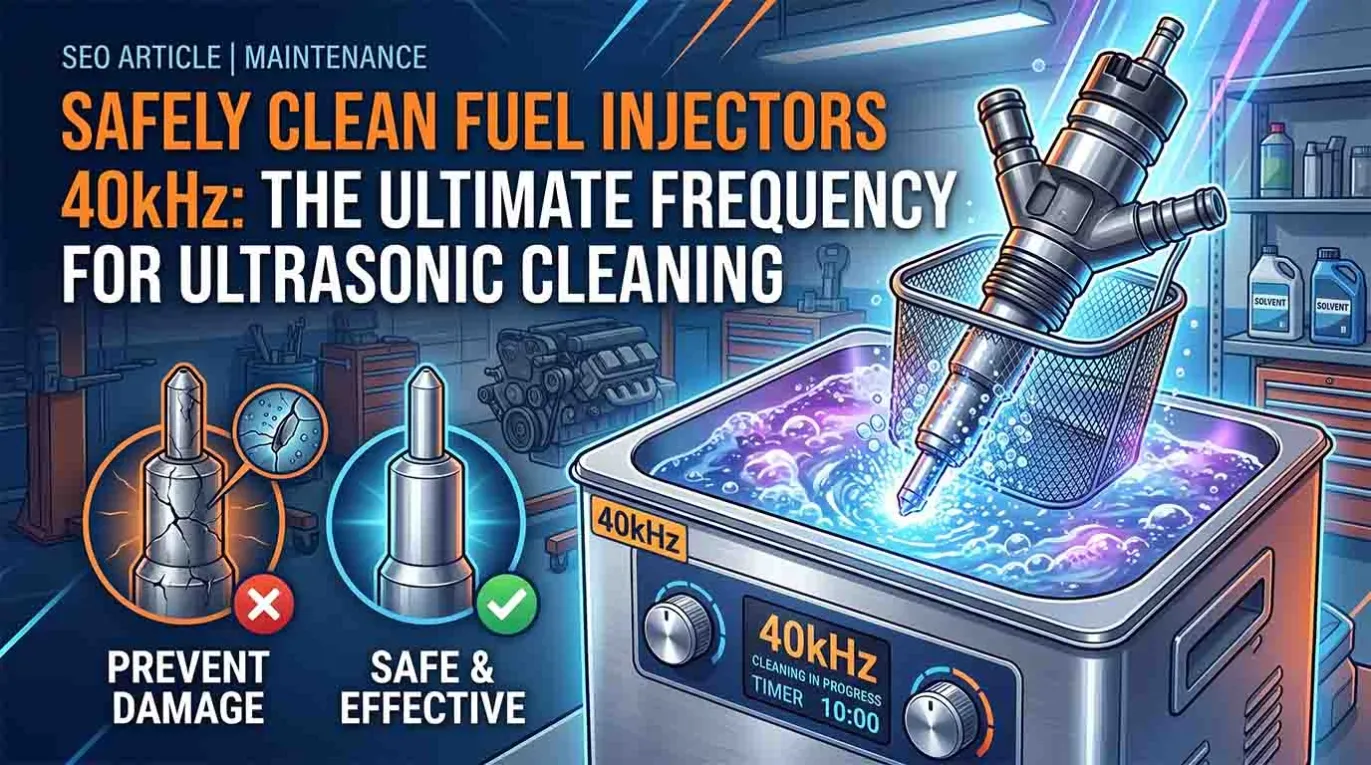
Can fuel injectors be cleaned with an ultrasonic cleaner? Yes, ultrasonic cleaning can be part of an off-car fuel injector cleaning workflow, especially when injectors need cleaning around small passages, nozzle areas, and external surfaces.
But an ultrasonic cleaner is not the same as a complete fuel injector testing system. For repair shops, remanufacturers, and workshops, the real question is not only “Can ultrasonic cleaning work?” It is “What role should ultrasonic cleaning play in the full injector service process?”
This guide explains what ultrasonic cleaning can do, where its limits are, and what to consider when choosing equipment for fuel injector cleaning.
What Fuel Injector Cleaning Needs to Solve
Fuel injectors are precision components. Depending on the injector type and service condition, contamination may include fuel varnish, carbon deposits, oil residue, particles, and deposits around small spray openings.
These problems matter because fuel injectors are not judged only by surface appearance. A professional injector service workflow may also need to consider spray pattern, flow rate, leakage, electrical condition, internal restriction, and before-and-after testing.
Ultrasonic cleaning can help remove contamination, but it does not automatically verify whether the injector performs correctly after cleaning. That is why fuel injector cleaning is often discussed together with flow testing, pulsing, inspection, and documentation.
What Ultrasonic Cleaning Can Do
Ultrasonic cleaning uses cavitation in a liquid bath. Cavitation creates repeated microscopic activity in the cleaning solution, helping loosen contamination from surfaces, small features, and areas that are difficult to reach manually.
For fuel injectors, ultrasonic cleaning may be useful for cleaning external injector bodies, helping loosen deposits around nozzle areas, supporting small-parts batch cleaning, and reducing manual brushing or solvent soaking.
It should not be treated as a complete injector diagnostic process by itself. If a shop needs to prove injector performance, cleaning alone is not enough. The injector may still need flow testing, spray pattern testing, leak testing, electrical checks, or injector pulse control before it can be reused or delivered.
Typical Ultrasonic Fuel Injector Cleaning Workflow
A basic ultrasonic fuel injector cleaning workflow may include:
- Inspect the injectors
- Remove parts that should not be exposed to the bath, such as O-rings or sensitive removable components
- Choose a cleaning solution compatible with the injector materials
- Place injectors in a basket or fixture so they do not rest directly on the tank bottom
- Run the ultrasonic cleaning cycle
- Rinse if required by the cleaning chemistry
- Dry thoroughly
- Inspect and test the injectors before reuse or delivery
The exact process depends on injector type, contamination, cleaning chemistry, and workshop requirements.
For broader automotive parts cleaning where parts are larger or heavier than injectors, see Sonixmax’s guide on industrial ultrasonic cleaners for engine parts.
Frequency: Is 40kHz Always the Best Choice?
Frequency should not be reduced to one universal rule.
In general ultrasonic cleaning, lower frequencies tend to produce stronger cavitation effects, while higher frequencies are often used when a finer cleaning action is desired. For precision parts such as injectors, many buyers compare 28kHz and 40kHz because they are common ultrasonic cleaner options.
For fuel injector cleaning, the correct frequency depends on injector material, injector construction, contamination type, cleaning target, and risk tolerance for precision surfaces.
A 40kHz cleaner may be a reasonable starting point for many precision cleaning tasks, but Sonixmax should not claim that one frequency is always correct for every injector type unless the specific application has been confirmed.
Cleaning Solution, Fluid, and Temperature
The cleaning liquid matters as much as the ultrasonic cleaner itself.
For fuel injectors, buyers often search for “ultrasonic fuel injector cleaning solution” or “cleaning fluid for fuel injectors.” The key point is that the fluid should be compatible with the injector materials, contamination type, and service process.
Fuel injectors may include metal bodies, filters, seals, plastic parts, and electrical components. A solution that works for heavy engine parts may not be suitable for every injector type.
In general, avoid assuming that stronger chemistry is always better. Aggressive chemicals, excessive temperature, or incompatible solvents can damage sensitive materials or create residue problems.
A suitable injector cleaning process should consider:
- injector material and construction
- fuel varnish, carbon, oil, or particle contamination
- seal and plastic compatibility
- whether removable seals or parts should be taken off before cleaning
- rinse and drying needs after cleaning
- whether flow testing or spray testing is required after cleaning
If you are unsure which cleaning fluid to use, follow the chemical supplier’s instructions and confirm compatibility with the injector type before production use.
For general engine-part cleaning chemistry, see Best Ultrasonic Cleaning Solution for Engine Parts. Injector cleaning should still be evaluated separately because injectors are more precise than many larger engine parts.
How to Choose an Ultrasonic Cleaner for Fuel Injectors
When choosing ultrasonic cleaning equipment for fuel injectors, start with the process rather than the model number.
Cleaning Requirement | Equipment Consideration |
|---|---|
Injector size and quantity | Tank dimensions and basket capacity |
Cleaning target | External cleaning, nozzle-area cleaning, or process support |
Contamination type | Chemistry, temperature, and cycle control |
Precision part risk | Frequency, fixturing, and process control |
Workflow volume | Benchtop batch cleaning vs larger process setup |
Residue control | Rinsing and drying requirements |
Service proof | Need for separate testing or inspection equipment |
A benchtop ultrasonic cleaner may be useful when the buyer needs a compact bath for small parts, controlled time and temperature, and repeatable cleaning cycles. A professional injector service setup may need more than the ultrasonic bath, especially if the shop must document flow rate, spray pattern, leakage, or before-and-after performance.
Sonixmax’s digital benchtop ultrasonic cleaner series can be considered when the need is controlled ultrasonic cleaning for small parts. If the buyer also cleans larger automotive components or needs higher-volume workflow support, the discussion may move toward industrial ultrasonic cleaning systems or multi-stage cleaning concepts.
This does not mean every Sonixmax ultrasonic cleaner is automatically suitable for every injector type. Injector type, cleaning method, compatibility, and testing requirements should be confirmed before final equipment selection.
Need Help Choosing Equipment for Injector Cleaning?
If you are evaluating ultrasonic cleaning for fuel injectors, send us the injector type, approximate quantity per batch, current cleaning method, required testing process, and whether you also clean other automotive parts.
FAQ
Can fuel injectors be cleaned in an ultrasonic cleaner?
Yes, fuel injectors can be cleaned with ultrasonic cleaning as part of an off-car cleaning process. The injector should be properly prepared, cleaned with compatible chemistry, rinsed or dried as required, and inspected or tested afterward.
Does ultrasonic cleaning replace fuel injector flow testing?
No. Ultrasonic cleaning can help remove contamination, but it does not verify flow rate, spray pattern, leakage, or electrical condition. Professional injector service may still require separate testing equipment.
Is 40kHz required for fuel injector cleaning?
Not universally. 40kHz is commonly considered for precision cleaning, but the right frequency depends on injector type, material, contamination, and process requirements. Avoid treating any single frequency as correct for every injector.
What cleaning solution should be used for ultrasonic fuel injector cleaning?
Use a cleaning solution that is compatible with the injector material, seals, plastic parts, and contamination type. Do not assume that a stronger degreaser or solvent is automatically better. Follow the cleaning chemical supplier’s instructions and confirm compatibility before cleaning a full batch.