
Aug 10, 2026Buying Guides
How to Choose an Industrial Ultrasonic Cleaner for Engine Parts (Avoid Costly Mistakes)
Looking for the best industrial ultrasonic cleaner for engine parts? Learn how to choose the right 28kHz machine, avoid costly mistakes, and save labor costs.
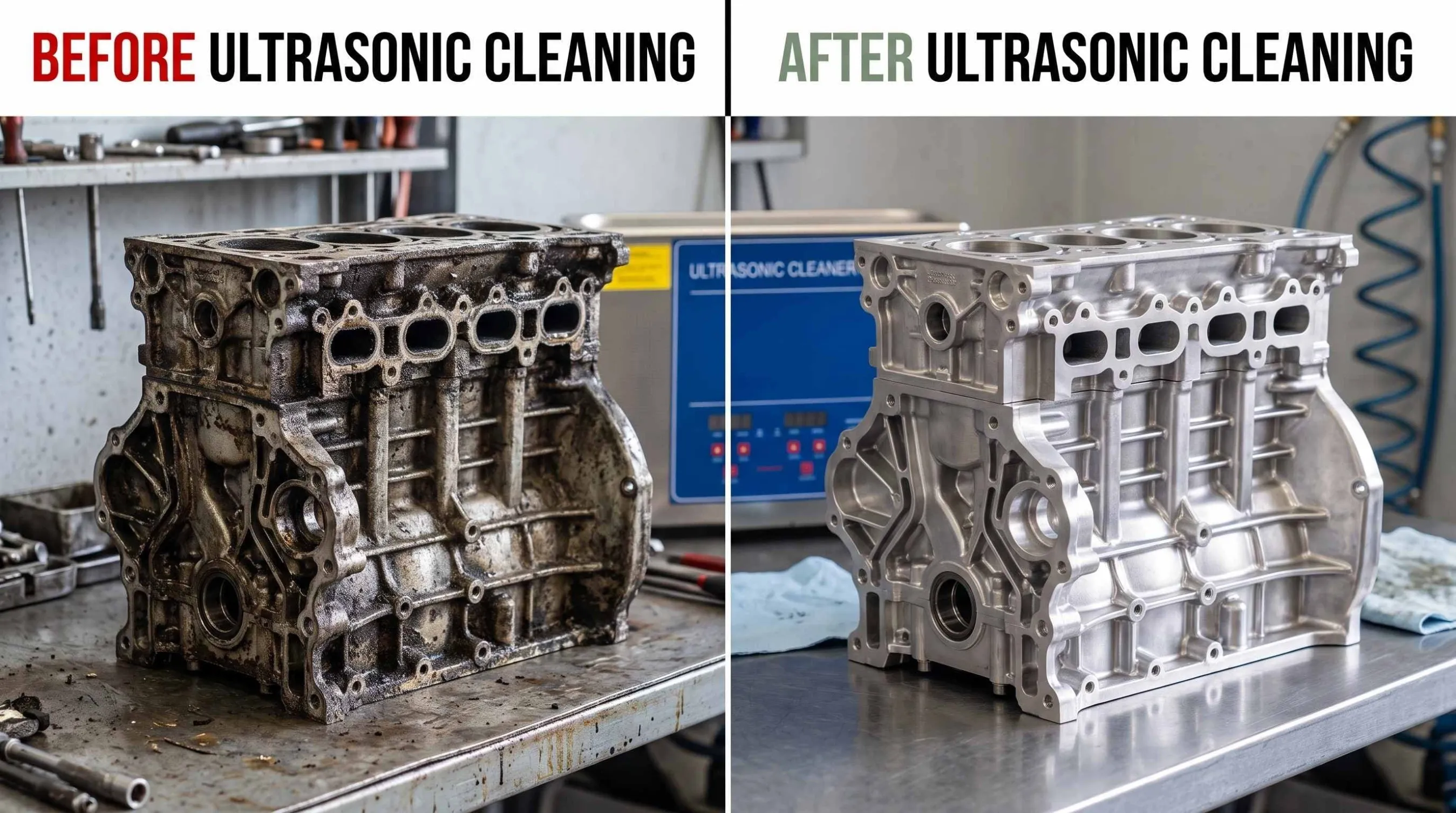
If you run an engine rebuild shop or an automotive repair center, you know the struggle. Removing baked-on carbon deposits, heavy grease, and rust from engine blocks is a nightmare.
Manual scrubbing with harsh solvents not only takes hours of valuable labor but also fails to clean deep blind holes and complex oil passages. Worse, aggressive wire brushing can scratch precision machined surfaces, leading to engine failure and angry customers.
The ultimate solution? An industrial ultrasonic cleaner for engine parts. It cleans faster, safer, and deeper than any manual method. But buying the wrong machine can cost you thousands of dollars. In this guide, we will show you exactly how to choose the right equipment and avoid costly purchasing mistakes.
Why Engine Rebuild Shops Need an Industrial Ultrasonic Cleaner
Before diving into the specs, let’s look at why upgrading to ultrasonic technology is a game-changer for your business.
1. Reach Blind Holes and Complex Geometries
Engine parts like carburetors, cylinder heads, and fuel injectors have intricate internal channels. Traditional spray washers only clean the surface. Ultrasonic cavitation creates millions of microscopic bubbles that implode, blasting away dirt from every hidden corner and blind hole that brushes simply cannot reach.
2. Save Labor Costs and Boost ROI
Hiring a mechanic to manually wash parts costs at least 40 per hour. An industrial ultrasonic cleaner allows your mechanics to simply drop the parts in the tank, press a button, and walk away to work on profitable engine assembly.
Financial Fact: A heavy-duty ultrasonic cleaner can often pay for itself in less than 3 months just in saved labor hours.
Key Specifications to Look For When Buying
Not all ultrasonic cleaners are created equal. When dealing with heavy automotive parts, you need industrial-grade specs. Here is what you must look for:
1. Frequency: Why 28kHz is Mandatory for Heavy Carbon
Lower frequencies create larger, more powerful cavitation bubbles. For heavy engine blocks, cast iron parts, and thick carbon buildup, 28kHz is the golden standard. If you buy a 40kHz machine (which is better for delicate electronics), it will lack the "punching power" to remove baked-on grease, resulting in rework and wasted time.
Want to dive deeper into the science of ultrasonic frequencies? Read our comprehensive comparison on What Frequency is Best for Cleaning Engine Parts: 28kHz vs 40kHz Guide
2. Tank Capacity & Load Bearing
Don't just look at the volume (Liters). Look at the internal dimensions (L x W x H) to ensure your largest V8 engine block can fit. More importantly, check the basket weight capacity. Engine blocks are heavy. If the stainless steel basket is flimsy, the heavy metal parts will crush the transducers at the bottom of the tank, destroying the machine.
3. Built-in Filtration & Oil Skimmer
Engine parts release massive amounts of oil and grease into the water. Choosing a machine with an auxiliary tank, a circulation filtration system, and an oil skimmer will extend the life of your cleaning solution by 3 to 5 times. This saves you thousands of dollars annually on chemical costs and waste disposal fees.
Costly Mistakes to Avoid When Buying
Mistake 1: Falling for "Peak Power" Traps
Many cheap suppliers play word games by advertising "Peak Power" instead of "RMS / Effective Ultrasonic Power." A machine might claim 2000W peak power, but its actual cleaning power is only 500W. Always ask the manufacturer for the Effective Ultrasonic Power. Insufficient power means your 15-minute cleaning cycle will drag on for 2 hours, killing your workshop's productivity.
Mistake 2: Ignoring Tank Material Thickness
Beware of low-priced machines using thin 201 stainless steel. Engine cleaning requires strong alkaline solutions and high temperatures. A thin 201 tank will corrode, pit, and leak within a few months. Always insist on 2mm thick SUS304 or SUS316L stainless steel for industrial durability.
What is the Best Cleaning Solution for Engine Parts?
Water alone won't remove grease. You need the right chemistry:
- For Aluminum Parts (Cylinder heads, pistons): Use a mild alkaline, non-caustic ultrasonic cleaning solution. High pH (caustic) solutions will turn aluminum black and cause pitting.
- For Cast Iron/Steel: You can use stronger alkaline degreasers to aggressively strip away rust and heavy carbon.
- Pro Tip: Always heat the solution to 60°C - 70°C (140°F - 158°F). Heat melts the grease, allowing the ultrasonic waves to do their job 50% faster.
Customize Your Heavy-Duty Ultrasonic Cleaner with SONIXMAX
At sonixmax, we understand that every automotive workshop has different needs. We don't just sell standard machines; we manufacture custom industrial ultrasonic cleaners tailored to your exact specifications.
Whether you need a 200L single-tank cleaner for V8 engine blocks, a multi-stage automated system with filtration, or reinforced load-bearing baskets, we have you covered. Our machines are built with premium 2mm SUS304/316L stainless steel and true industrial-grade 28kHz transducers.
Stop wasting time on manual scrubbing.
Contact our engineering team today for a free consultation and let us design the perfect ultrasonic cleaning solution for your engine parts!