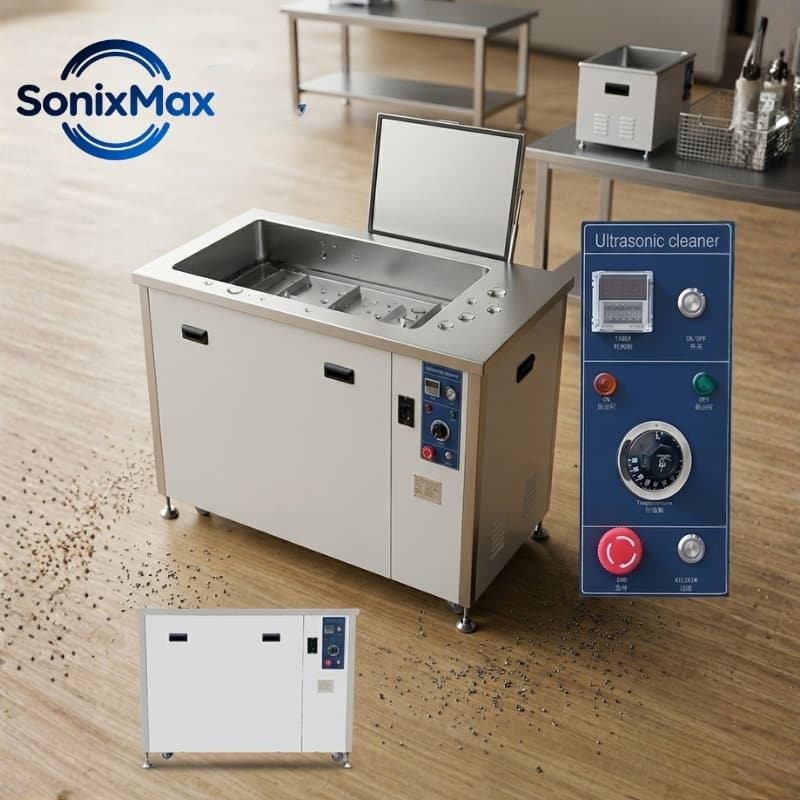
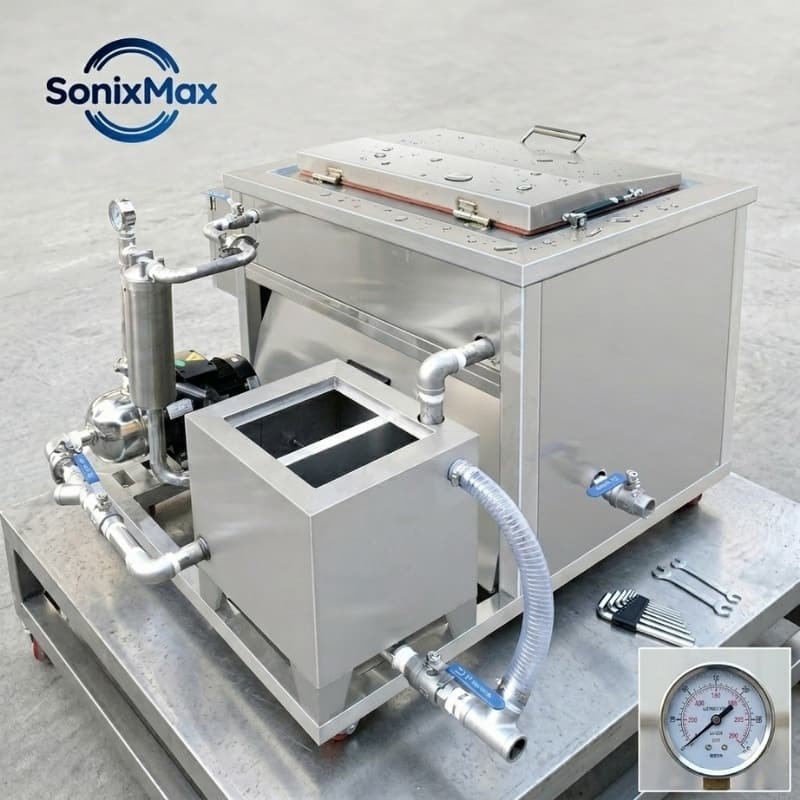
Single tank series
45L–1500L Industrial Single Tank Ultrasonic Cleaner with Filtration System
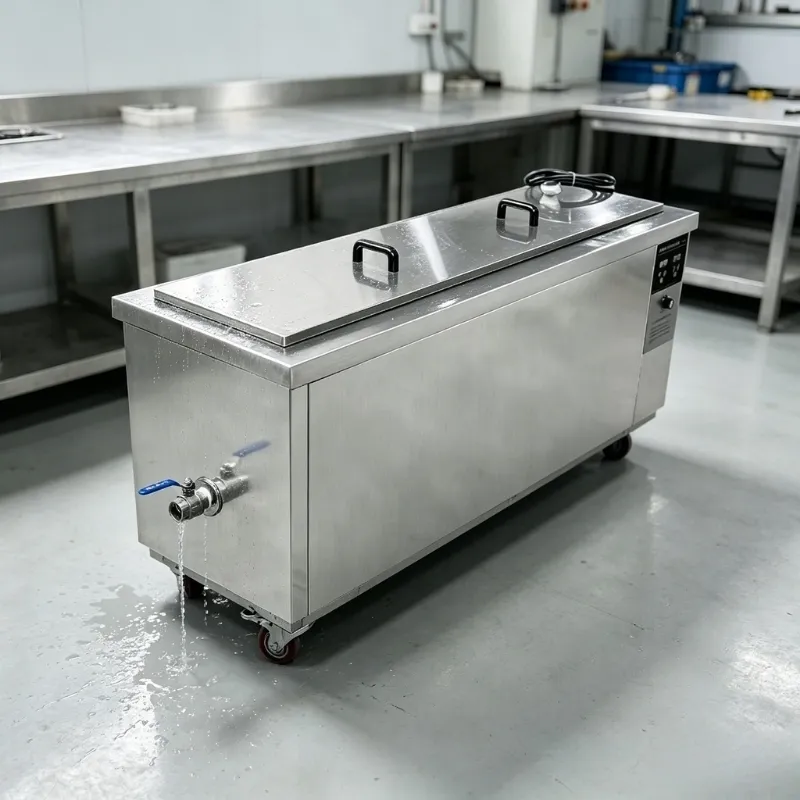
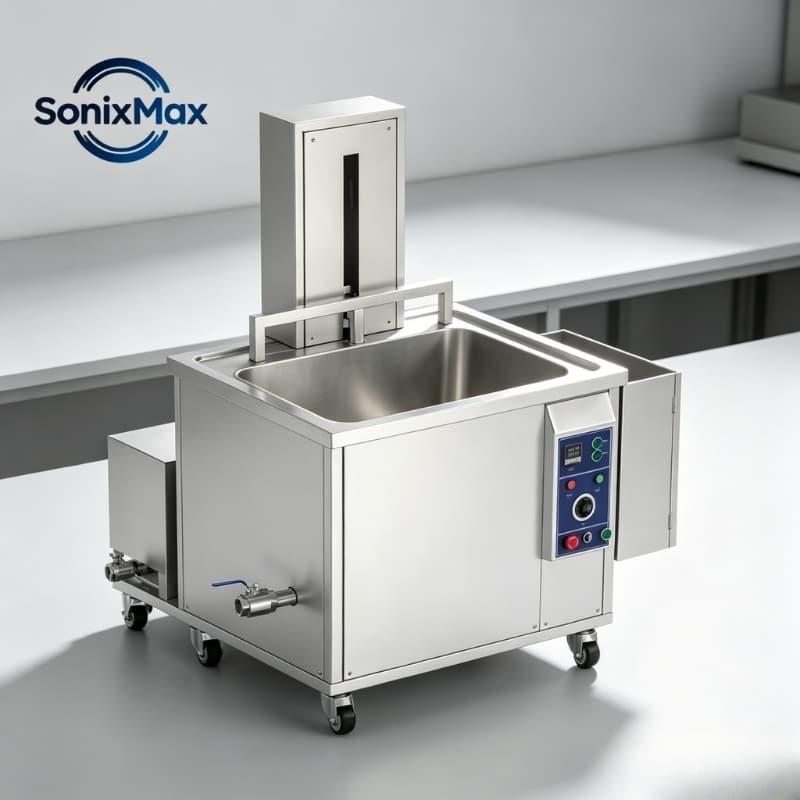
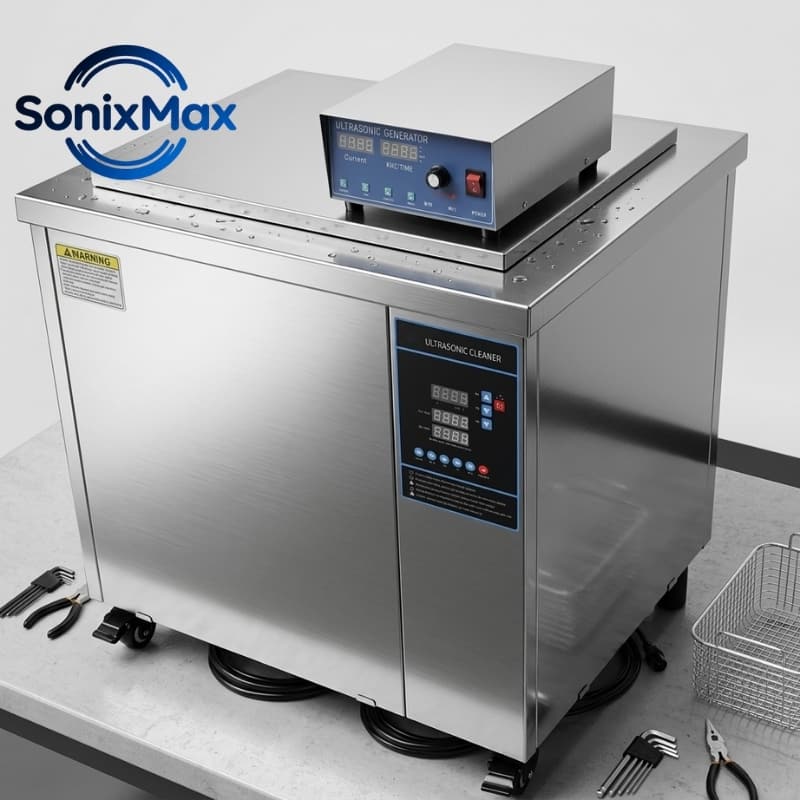
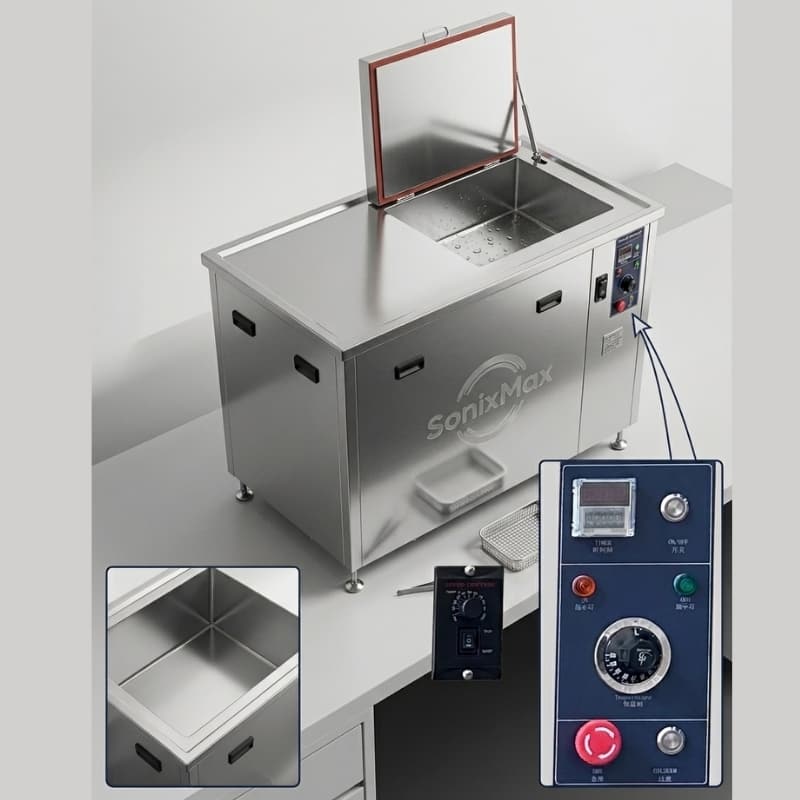
The Single Tank Ultrasonic Cleaner Series is available in flexible capacities from 45L to 1500L, with customized configurations available for specific industrial cleaning requirements. Equipped with adjustable ultrasonic power, heating control, and an integrated filtration system, it provides stable cleaning performance while maintaining solution cleanliness during operation. It is designed for industrial applications where particles and suspended contamination need to be removed from the cleani
Product Overview
During repeated ultrasonic cleaning, oil, particles, chips, polishing residue, and other removed contamination can gradually accumulate in the cleaning liquid.
For applications where this contamination needs to be controlled between cleaning batches, the filtration system circulates the cleaning liquid through a filter to remove suspended particles before returning the liquid to the cleaning tank.
This makes the system particularly useful for repetitive batch cleaning, where maintaining cleaner process liquid is more important than in occasional one-off cleaning.
The machine retains the straightforward structure of a single-tank ultrasonic cleaner while adding liquid filtration, without requiring a separate rinsing or multi-stage cleaning line.
Standard capacities range from 45L to 1500L, allowing the equipment to be selected according to workpiece dimensions, batch quantity, contamination, and production requirements.
Best suited for: repetitive batch cleaning where particulate contamination needs to be removed from the cleaning liquid.
Consider another system if: the process requires a dedicated rinsing stage, drying, multiple cleaning liquids, or automated part transfer.
Typical Parts & Cleaning Applications
Parts / Applications | Typical Contamination | Why Filtration Helps |
|---|---|---|
CNC-machined parts | Cutting oil, coolant, fine chips and particles | Helps remove suspended machining particles from the cleaning liquid |
Precision metal components | Oil, fine particles and process residue | Supports cleaner process liquid during repeated batches |
Gears, shafts & bearings | Oil, grease and metallic particles | Useful when contamination is repeatedly released from mechanical components |
Valves & fittings | Machining residue, particles and oil | Helps control suspended contamination during batch cleaning |
Automotive components | Oil, grease, carbon-related residue and particles | Suitable for repeated cleaning where the bath becomes contaminated over time |
Molds & tooling | Oil, polishing compound and production residue | Filtration can help remove loosened particles and residue from the circulating liquid |
The standard 10 μm filtration system is primarily intended for suspended particulate contamination.
Actual cleaning performance depends on the workpiece, contamination, cleaning chemistry, temperature, ultrasonic settings, filtration conditions, and batch load.
Key Features & Cleaning Benefits
Integrated Cleaning-Liquid Filtration
A circulation pump moves cleaning liquid through the filtration system and returns the filtered liquid to the cleaning tank.
This helps remove suspended particles released during ultrasonic cleaning and reduces their continued circulation in the working bath.
Standard 10 μm Filter Accuracy
The standard configuration uses 10 μm filtration, providing particulate filtration for compatible industrial cleaning applications.
The filtration system should not be interpreted as a replacement for rinsing where the process requires removal of cleaning-agent residue or higher final cleanliness.
Adjustable Ultrasonic Power
Ultrasonic output ranges from 0–600W to 0–10800W, depending on model.
Adjustable power allows cleaning intensity to be matched more closely to the workpiece and contamination rather than applying the same ultrasonic output to every application.
28kHz / 40kHz Frequency Options
The series supports 28kHz or 40kHz configurations.
28kHz can be considered for robust components and heavier contamination, while 40kHz can be considered for finer geometries and comparatively more sensitive cleaning requirements.
Final frequency selection should be based on the actual workpiece, surface condition, and contamination.
Heated Cleaning up to 95°C
Integrated heating provides temperature control from ambient temperature up to 95°C.
For compatible applications, heated cleaning can assist with oil and grease removal and improve the performance of suitable cleaning chemistry.
1–99 Minute Time Control
Adjustable cleaning time allows the cycle to be set according to contamination level, part geometry, chemistry, temperature, and required cleaning result.
SUS304 Industrial Cleaning Tank
The standard inner tank uses SUS304 stainless steel with T2.0 construction, providing a practical structure for repeated industrial batch-cleaning applications.
45L–1500L Capacity Range
Sixteen standard configurations are available from 45L to 1500L, allowing the system to be selected according to actual workpiece dimensions and production batch requirements.
Technical Specifications
Model | Inner Tank Size (mm) | Capacity | Material | Transducers | Adjustable Ultrasonic Power | Frequency | Timer | Heating Power | Cleaning Temperature | Filter Pump | Filter Accuracy | Power Supply |
|---|---|---|---|---|---|---|---|---|---|---|---|---|
SNXS-1012F | 500 × 300 × 300 | 45L | SUS304 | 12 pcs | 0–600W | 28/40kHz | 1–99 min | 1.5kW | Ambient–95°C | Standard | 10 μm | Single-Phase 220V |
SNXS-1018F | 500 × 350 × 350 | 61L | SUS304 | 18 pcs | 0–900W | 28/40kHz | 1–99 min | 1.5kW | Ambient–95°C | Standard | 10 μm | Single-Phase 220V |
SNXS-1024F | 550 × 400 × 400 | 88L | SUS304 | 24 pcs | 0–1200W | 28/40kHz | 1–99 min | 3kW | Ambient–95°C | Standard | 10 μm | Single-Phase 220V |
SNXS-1030F | 600 × 450 × 400 | 108L | SUS304 | 30 pcs | 0–1500W | 28/40kHz | 1–99 min | 3kW | Ambient–95°C | Standard | 10 μm | Single-Phase 220V |
SNXS-1036F | 600 × 500 × 450 | 135L | SUS304 | 36 pcs | 0–1800W | 28/40kHz | 1–99 min | 4.5kW | Ambient–95°C | Standard | 10 μm | Three-Phase 380V |
SNXS-1048F | 700 × 500 × 500 | 175L | SUS304 | 48 pcs | 0–2400W | 28/40kHz | 1–99 min | 6kW | Ambient–95°C | Standard | 10 μm | Three-Phase 380V |
SNXS-1060F | 800 × 600 × 550 | 264L | SUS304 | 60 pcs | 0–3000W | 28/40kHz | 1–99 min | 6kW | Ambient–95°C | Standard | 10 μm | Three-Phase 380V |
SNXS-1072F | 1000 × 600 × 600 | 360L | SUS304 | 72 pcs | 0–3600W | 28/40kHz | 1–99 min | 9kW | Ambient–95°C | Standard | 10 μm | Three-Phase 380V |
SNXS-1084F | 1200 × 700 × 500 | 420L | SUS304 | 84 pcs | 0–4200W | 28/40kHz | 1–99 min | 9kW | Ambient–95°C | Standard | 10 μm | Three-Phase 380V |
SNXS-1090F | 1200 × 800 × 500 | 480L | SUS304 | 90 pcs | 0–4500W | 28/40kHz | 1–99 min | 9kW | Ambient–95°C | Standard | 10 μm | Three-Phase 380V |
SNXS-1096F | 1200 × 800 × 600 | 560L | SUS304 | 96 pcs | 0–4800W | 28/40kHz | 1–99 min | 18kW | Ambient–95°C | Standard | 10 μm | Three-Phase 380V |
SNXS-10108F | 1000 × 900 × 600 | 540L | SUS304 | 108 pcs | 0–5400W | 28/40kHz | 1–99 min | 18kW | Ambient–95°C | Standard | 10 μm | Three-Phase 380V |
SNXS-10120F | 1000 × 800 × 800 | 640L | SUS304 | 120 pcs | 0–6000W | 28/40kHz | 1–99 min | 18kW | Ambient–95°C | Standard | 10 μm | Three-Phase 380V |
SNXS-10132F | 1000 × 1000 × 800 | 800L | SUS304 | 132 pcs | 0–6600W | 28/40kHz | 1–99 min | 18kW | Ambient–95°C | Standard | 10 μm | Three-Phase 380V |
SNXS-10144F | 1200 × 1000 × 800 | 960L | SUS304 | 144 pcs | 0–7200W | 28/40kHz | 1–99 min | 24kW | Ambient–95°C | Standard | 10 μm | Three-Phase 380V |
SNXS-10216F | 1500 × 1000 × 1000 | 1500L | SUS304 | 216 pcs | 0–10800W | 28/40kHz | 1–99 min | 36kW | Ambient–95°C | Standard | 10 μm | Three-Phase 380V |
Specifications shown are standard reference configurations. Final filtration arrangement, electrical configuration, overall dimensions, basket design, drainage, and other project-specific requirements should be confirmed according to the final equipment configuration.
Do You Need a Filtration System?
The main reason to choose this series instead of a standard single-tank cleaner is the condition of the cleaning liquid during repeated production cycles.
Choose Single Tank + Filtration When:
- Parts are cleaned repeatedly in batches.
- Cleaning releases visible or suspended particles into the liquid.
- Machining chips, polishing residue, carbon-related particles, or similar contamination accumulates in the bath.
- Controlling particulate contamination in the cleaning liquid is important to the process.
- One primary ultrasonic cleaning stage is still sufficient.
A Standard Single Tank May Be Enough When:
Cleaning is occasional, contamination loading is relatively low, or frequent bath replacement is already acceptable to the process.
In these applications, adding filtration may provide limited practical benefit.
Filtration Does Not Replace Rinsing
Filtration and rinsing solve different process problems.
Filtration removes suspended contamination from the circulating cleaning liquid.
Rinsing removes residual cleaning solution and loosened contamination from the workpiece after the washing stage.
If the required process is:
Ultrasonic Cleaning → Rinsing
a dual-tank cleaning and rinsing system should be considered instead.
If the process requires:
How to Select the Right Model
Once filtration has been confirmed as useful for the application, model selection should begin with the workpiece and batch, not nominal tank capacity alone.
Workpiece & Basket Dimensions
The largest workpiece or loaded basket must fit comfortably within the usable cleaning area.
Quantity per Batch
Determine how many parts need to be cleaned during each production cycle. This helps establish the required tank dimensions and ultrasonic capacity.
Contamination Load
Filtration becomes more relevant when each batch releases significant particulate contamination into the cleaning liquid.
The type and quantity of contamination should therefore be considered together with tank size.
Required Filtration
The standard series is specified with 10 μm filtration.
If the process has different filtration requirements, these should be discussed according to the actual contamination and cleaning process.
Production Throughput
For high-volume applications, tank capacity alone may not solve the production requirement. Loading, unloading, filtration, liquid management, and possible automation should be considered together.
For model selection, send us your part photos or drawings, dimensions, material, contamination, quantity per batch, and required cleaning result.
Custom Engineering Options
Standard models provide a starting point for equipment selection. Final configuration can be evaluated according to the actual cleaning process.
Project Requirement | Available Direction |
|---|---|
Tank Size | Standard or application-specific dimensions |
Basket / Fixture | Evaluated according to workpiece geometry and batch loading |
Ultrasonic Frequency | 28kHz / 40kHz |
Ultrasonic Power | Selected according to tank size and cleaning requirements |
Heating | Configured according to cleaning process |
Filtration | Evaluated according to contamination and process requirements |
Electrical Configuration | Adapted to equipment size and destination requirements |
Additional Process Stages | Rinsing, drying or other stages evaluated separately |
For applications requiring more than one treatment stage, we may recommend a different system configuration rather than adding unnecessary functions to a single tank.
Why Work with SonixMax?
The decision between a standard single tank, single tank with filtration, dual tank, or multi-tank system should be based on the actual cleaning process.
SonixMax evaluates the workpiece, contamination, batch quantity, cleaning-liquid condition, required cleanliness, and production requirements before recommending a configuration.
For applications where one ultrasonic cleaning stage is sufficient but particulate contamination accumulates during repeated batches, a filtration-equipped single tank can provide a practical solution without moving directly to a more complex multi-stage system.
Project support can include equipment selection, configuration discussion, customization coordination, technical communication, export packaging and delivery coordination, and after-sales communication.
FAQ
What is the main difference between this item and a standard single-tank ultrasonic cleaner?
Both use one tank for ultrasonic cleaning. This series adds a cleaning-liquid circulation and filtration system, making it more suitable when suspended particulate contamination accumulates during repeated batch cleaning.
What does the 10 μm filter remove?
The standard filtration configuration is intended to remove suspended particulate contamination from the circulating cleaning liquid. Actual filtration performance depends on the contamination and operating conditions.
Can the filtration system remove oil from the cleaning liquid?
The listed 10 μm filtration specification refers to particulate filtration. If the application requires oil separation or another type of liquid treatment, the contamination and process requirements should be evaluated separately.
Does filtration eliminate the need to replace the cleaning liquid?
No. Filtration helps control suspended particulate contamination, but cleaning chemistry can still become loaded or degraded during use. Bath maintenance and replacement should be determined according to the actual cleaning process.
Can filtration replace a rinsing tank?
No. Filtration cleans the circulating process liquid, while rinsing is a separate treatment applied to the workpiece after washing. If post-cleaning rinsing is required, a dual-tank or multi-tank system should be considered.
Request an Industrial Ultrasonic Cleaning Solution
If your process involves repetitive batch cleaning with particulate contamination accumulating in the cleaning liquid, send us your application requirements for configuration evaluation.
Please provide your part type, material, dimensions, contamination, quantity per batch, required cleaning result, and current cleaning process.