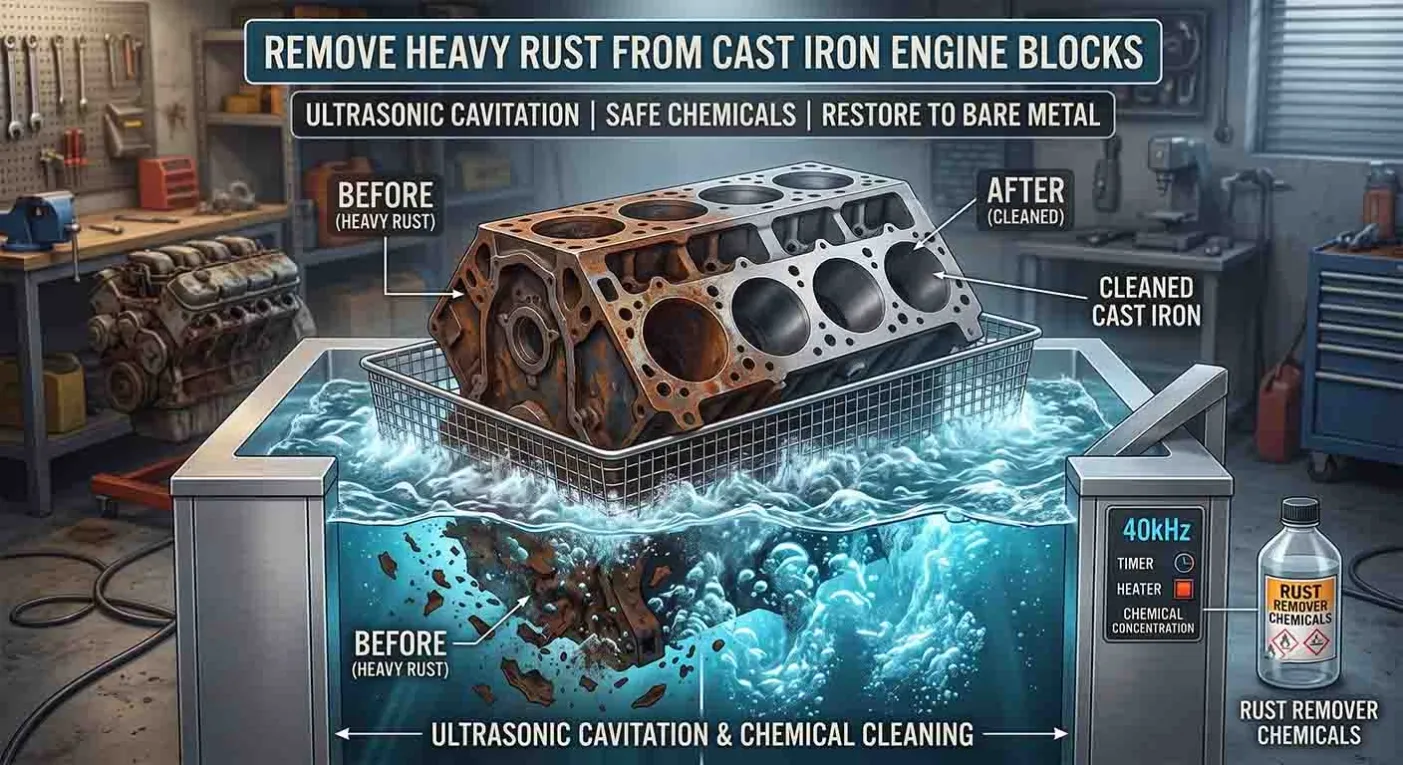
Aug 17, 2026Ultrasonic Cleaning Solutions
Best Ultrasonic Cleaning Solution for Engine Parts (Aluminum vs. Cast Iron)
What liquid should you use in an ultrasonic cleaner for engine parts? Learn the best solutions for aluminum vs cast iron, correct temperatures, and mistakes to avoid.
You have invested in a high-quality industrial ultrasonic cleaner, selected the right frequency, and are ready to blast away years of baked-on carbon. But there is one critical piece of the puzzle left: What liquid should you put in the tank?
Using the wrong ultrasonic cleaning solution is a recipe for disaster. The wrong chemistry can quickly discolor expensive aluminum cylinder heads, cause severe pitting, or create a serious fire hazard in your workshop.
In this guide, we will break down exactly what cleaning solutions to use for different engine parts, the correct temperatures, and the dangerous mistakes you must avoid.
Why Plain Water Isn't Enough
Can you just use water and dish soap? Absolutely not.
While the ultrasonic machine provides the "scrubbing" action through cavitation, water alone has high surface tension and cannot break down heavy automotive grease.
A professional industrial degreaser does three things:
- Lowers surface tension: Allowing the microscopic cavitation bubbles to penetrate deep into blind holes.
- Emulsifies oil: Breaking down heavy grease so it floats away from the part.
- Prevents rust: Leaving a temporary anti-corrosion layer on steel parts after cleaning.
The Golden Rule: Match the Chemistry to the Metal
Engine rebuild shops deal with two main types of metals, and they require completely different cleaning solutions.
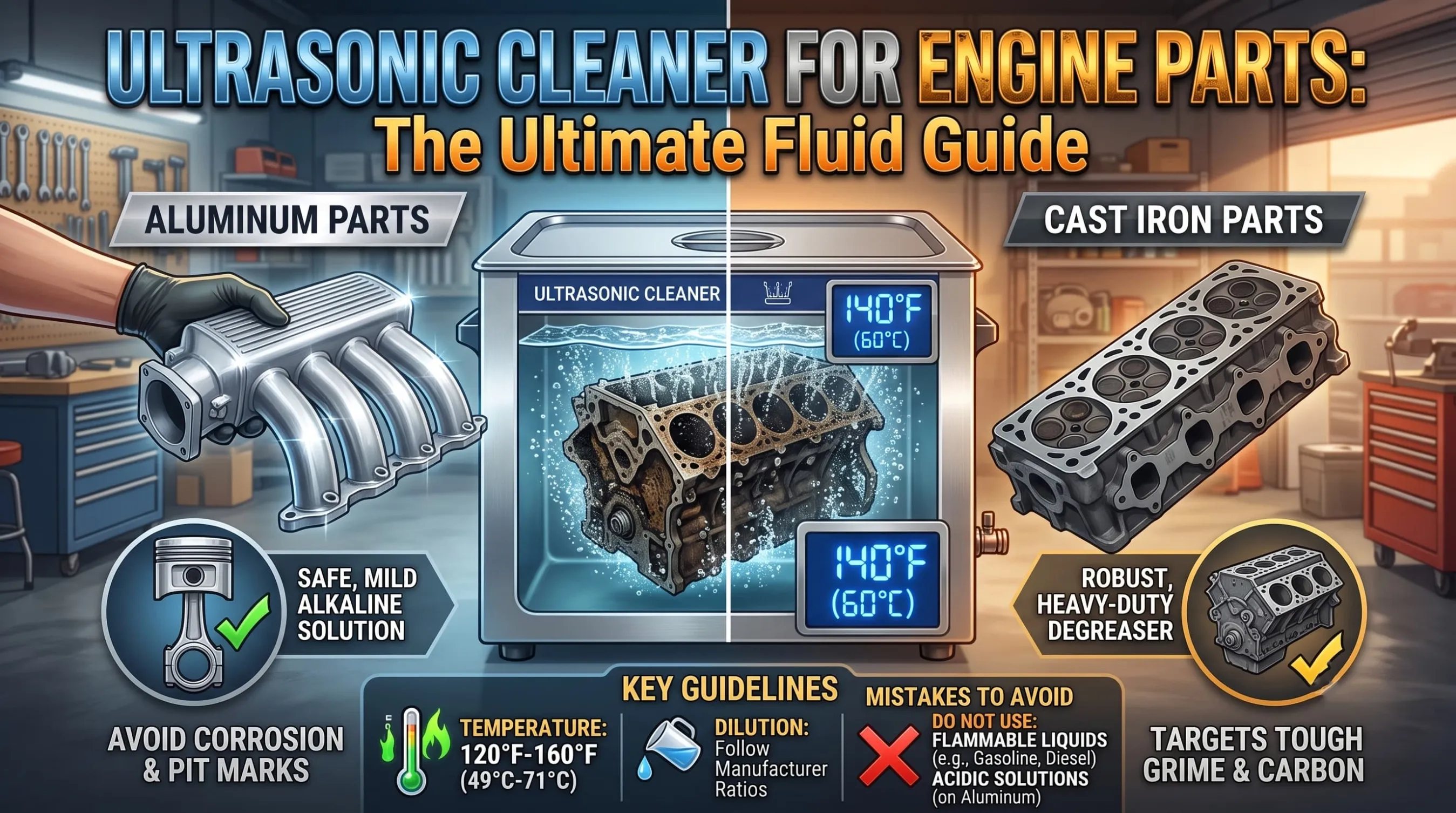
1. For Aluminum Parts (Cylinder Heads, Pistons, Carburetors)
Aluminum is a soft, highly reactive metal.
- The Solution: You must use a mild alkaline, non-caustic ultrasonic cleaning solution (pH level between 9 and 11).
- The Danger: If you use a highly caustic (high pH) solution, it will chemically react with the aluminum. Within minutes, your shiny carburetor will turn dark gray or black, and the surface will suffer from irreversible pitting.
- Pro Tip: Delicate aluminum parts also require a gentler ultrasonic frequency. (Read our deep dive on What Frequency is Best for Cleaning Engine Parts: 28kHz vs 40kHz to learn why 40kHz is safer for carburetors).
2. For Cast Iron and Steel Parts (V8 Engine Blocks, Crankshafts)
Cast iron can take a beating, and the carbon baked onto it is incredibly stubborn.
- The Solution: Use a heavy-duty, caustic alkaline degreaser (pH level 12 or higher).
- The Benefit: These aggressive chemicals, combined with the punching power of a 28kHz ultrasonic cleaner, will strip away heavy rust, paint, and baked-on carbon deposits that manual scrubbing could never remove.
The Secret Weapon: Temperature
Even the best chemical solution will fail if the liquid is cold. Heat is the catalyst that makes the chemistry work.
Always set your ultrasonic cleaner's built-in heater to 60°C - 70°C (140°F - 158°F). At this temperature, heavy grease naturally begins to melt, allowing the ultrasonic cavitation to work 50% faster and more efficiently.
⚠️ Deadly Mistake: Never Use Flammable Solvents
Many mechanics are used to cleaning parts with diesel, kerosene, brake cleaner, or Isopropyl Alcohol (IPA). Never put these in an open ultrasonic tank.
Ultrasonic transducers generate heat during operation. As the flammable solvent heats up, it creates a cloud of explosive vapor above the tank. A single spark from a nearby tool or electrical switch can cause a catastrophic explosion. Always use water-based (aqueous) alkaline solutions for safety.
How to Make Your Cleaning Solution Last Longer
Industrial cleaning chemicals are expensive. If you are washing greasy engine blocks all day, your tank will quickly fill with floating oil, ruining the solution.
(If you haven't bought a machine yet, read our ultimate guide on How to Choose an Industrial Ultrasonic Cleaner for Engine Parts to understand tank sizing).
To save money on chemicals, you need a machine equipped with an Oil Skimmer and Filtration System.
For the ultimate cleaning line, explore our Industrial Quadruple-Tank Ultrasonic Cleaner (Cleaning & Filtration + Dual Rinsing + Drying). The integrated 10μm filtration system continuously removes suspended oils, extends cleaning solution life, and helps reduce residue on engine parts when followed by proper rinsing.
At Sonixmax, our heavy-duty automotive ultrasonic cleaners come standard with auxiliary tanks and weir systems. The floating oil is automatically skimmed off the top, and the liquid is filtered and pumped back into the main tank. This extends the life of your cleaning solution by up to 5 times, saving you thousands of dollars a year!
👉 Ready to upgrade your engine rebuilding process?
Contact our engineering team today to get a customized quote on an industrial ultrasonic cleaner built for your exact needs!