Aug 17, 2026Ultrasonic Cleaning Solutions
How to Remove "No-Clean" Flux from High-Reliability PCBs (Ultrasonic Guide)
how ultrasonic cleaning and saponifiers can support high-reliability PCB cleaning
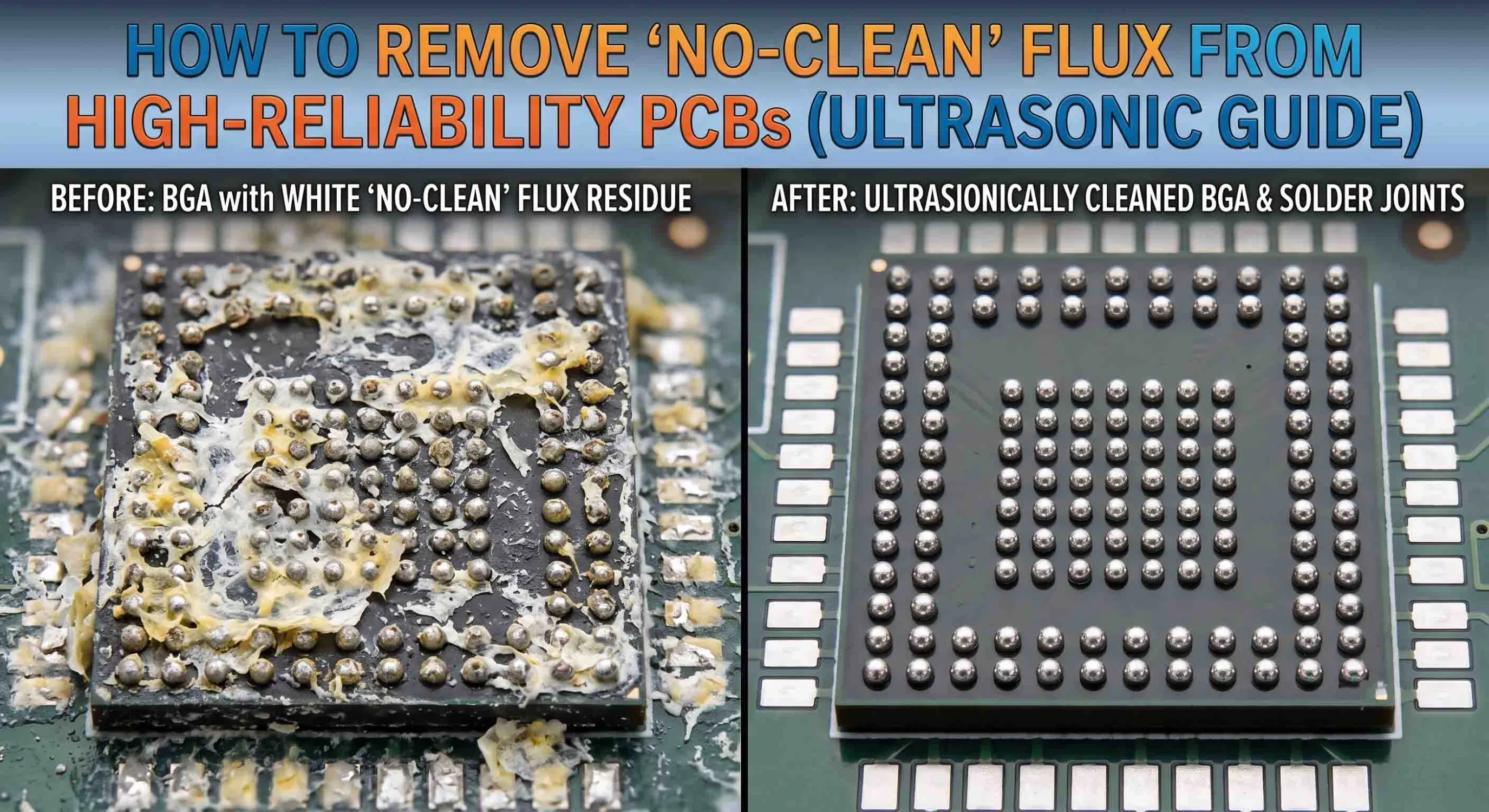
In the world of electronics manufacturing, "no-clean" flux was supposed to be a miracle solution that saved time and money by eliminating the cleaning process. For cheap consumer electronics, it works fine.
However, if you are manufacturing high-reliability PCBs for aerospace, medical devices, or automotive ECUs, leaving no-clean flux on the board is a ticking time bomb. The residue can prevent conformal coating from adhering properly, leading to delamination. Worse, in humid environments, the active acids in the flux can trigger Electrochemical Migration (ECM), causing catastrophic short circuits.
Removing baked-on no-clean flux is notoriously difficult. In this guide, we will explain why traditional cleaning can fail and how an industrial ultrasonic cleaner can support demanding cleanliness requirements for high-reliability PCB processing.
Do You Really Need to Clean "No-Clean" Flux?
The name "no-clean" is highly misleading. While it leaves less residue than traditional rosin flux, it still leaves a chemical footprint.
For IPC Class 1 and Class 2 products (like toys or basic consumer goods), you can usually leave it on. However, for IPC Class 3 high-reliability electronics, cleaning is almost always mandatory.
If your PCB requires conformal coating to protect it from harsh environments, any leftover no-clean flux will act as a barrier, preventing the coating from bonding to the FR4 board. This leads to peeling, moisture ingress, and eventual board failure.
Why is No-Clean Flux So Hard to Remove?
The difficulty lies in its chemical design and the reflow process.
No-clean fluxes are formulated with low solid contents and synthetic resins. During the high heat of the reflow oven, the solvents evaporate, and the remaining flux bakes into a hard, glass-like acrylic shell around the solder joints.
Manual brushing with Isopropyl Alcohol (IPA) simply smears this hard resin around. Furthermore, modern PCBs feature low-standoff components like BGAs and QFNs. The gap between the chip and the board is often less than 2 mils (0.05mm), making it physically impossible for sprays or brushes to reach the trapped flux.
The Ultrasonic Solution: Heat, Chemistry, and 40kHz Power
To break through the hardened acrylic shell of no-clean flux, you need a combination of mechanical energy, heat, and specialized chemistry.
- The Mechanical Energy (40kHz & Sweep Technology):Ultrasonic cavitation creates microscopic vacuum bubbles that can easily penetrate the tiny gaps under BGA chips. When these bubbles implode, they physically shatter the hard flux shell. Crucially, you must use a generator with a Sweep function to prevent standing waves from damaging delicate traces and components. (Note: Always use 40kHz or higher to protect delicate components. Read our Safe PCB Ultrasonic Cleaning Guide for frequency safety rules).
- The Chemistry (Saponifiers):You cannot use standard degreasers. You must use a specialized aqueous saponifier. Saponifiers chemically react with the rosin/resin in the flux, turning it into a water-soluble soap that can be washed away.
- The Heat:The saponification process requires heat to activate. Set your ultrasonic tank to 60°C - 65°C (140°F - 149°F) for optimal flux removal.
Troubleshooting: How to Prevent White Residue on PCBs
This is the most common nightmare when trying to clean no-clean flux. You pull the board out of the cleaner, it looks fine, but once it dries, a stubborn white powdery residue appears around the solder joints.
This white residue is usually partially dissolved flux salts or hard water minerals. It happens for two primary reasons:
- Saturated Chemistry: Your saponifier bath has absorbed too much flux and needs to be changed.
- Improper Rinsing: You cannot rinse saponifiers with tap water. You must use hot Deionized (DI) water.To reduce white residue, the PCB should move from the heated wash tank into a heated DI water ultrasonic rinse tank, followed by a final pure DI water spray and hot air drying.
Support High-Reliability PCB Cleanliness with SonixMa
Removing no-clean flux requires more than just a single tank; it requires a highly controlled, multi-stage process.
At SonixMax, we design and manufacture Industrial Multi-Tank Ultrasonic Cleaning Systems specifically for high-reliability electronics manufacturing. Our quadruple-tank systems integrate heated ultrasonic washing, dual DI water rinsing, and HEPA-filtered hot air drying into one automated line.
With built-in 10μm filtration and digital PLC controls, our machines are engineered to help you achieve zero white residue and optimal conformal coating adhesion for your most critical PCBs.
Don't let no-clean flux ruin your high-reliability boards. Contact our engineering team today to design a custom cleaning line for your SMT facility!