Oct 14, 2026Ultrasonic Cleaning Technology
Ultrasonic Cleaner Basket Loading Guide: How to Avoid Ultrasonic Shadowing
Learn how basket loading, part spacing, orientation, racks, fixtures, and ultrasonic shadowing affect ultrasonic cleaning results in industrial parts cleaning.
If an ultrasonic cleaner is running normally but some parts still come out dirty, the problem may not be the machine, the detergent, or the bath temperature.
It may be the way the parts are loaded into the basket.
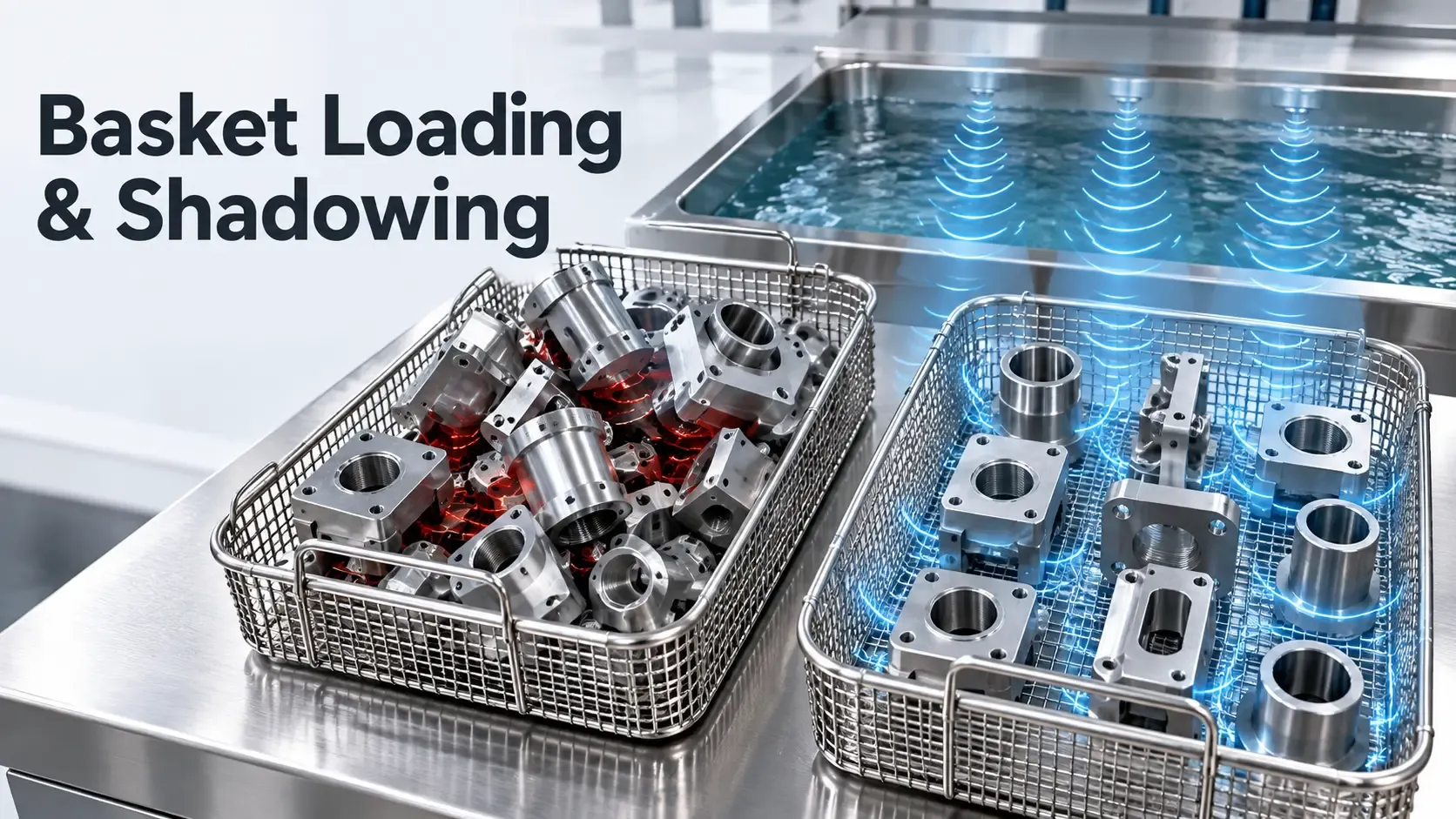
In ultrasonic cleaning, cavitation must reach the surface that needs to be cleaned. If parts are stacked, nested, pressed tightly together, or positioned in a way that traps air, certain surfaces may be shielded from ultrasonic activity. This is often called ultrasonic shadowing.
For industrial production, basket loading is not a minor operator detail. It directly affects cleaning consistency, batch capacity, cycle time, part damage risk, and whether the selected tank size is practical for daily workflow.
This guide explains how basket loading affects ultrasonic cleaning results, how to avoid ultrasonic shadowing, and when racks, fixtures, lifting systems, or drum cleaning may be needed.
Quick Answer
To load parts correctly in an ultrasonic cleaner basket, keep parts separated, avoid flat-on-flat stacking, prevent direct contact with the tank bottom, and orient complex geometries so liquid can enter and air can escape.
Good basket loading should allow:
- cleaning solution to fully wet all target surfaces
- cavitation to reach contaminated areas
- blind holes, threads, and cavities to fill with liquid
- trapped air to escape during immersion
- loosened contamination to drain away from the part surface
- parts to be lifted out without passing through heavy oil or sludge layers
If parts are packed too tightly, outer surfaces may look clean while contact points, internal threads, blind holes, and recessed pockets remain dirty.
Why Basket Loading Affects Ultrasonic Cleaning Results
Ultrasonic cleaning works through cavitation in liquid. The ultrasonic transducers create high-frequency sound waves in the bath, forming microscopic bubbles that collapse near the part surface and help loosen contamination.
However, cavitation cannot clean a surface that is physically blocked, trapped in air, or shielded by another component.
Basket loading affects four things at the same time.
First, it affects liquid access. If a surface is pressed against another part, the basket floor, or a fixture, cleaning liquid may not fully reach that area.
Second, it affects air release. Blind holes, cavities, tubes, and recessed areas can trap air when submerged. If air remains inside, ultrasonic cleaning cannot work effectively in that space.
Third, it affects contamination removal. Even when soil is loosened, it still needs a path to leave the part surface. Tight stacking can trap loosened oil, particles, or sludge between parts.
Fourth, it affects ultrasonic energy distribution. A very dense load can absorb, reflect, or block ultrasonic energy, reducing cleaning consistency across the batch.
Two operators using the same machine, bath temperature, and cleaning solution can get different cleaning results simply because they load the basket differently.
What Is Ultrasonic Shadowing?
Ultrasonic shadowing happens when one part, basket surface, fixture, or dense load blocks ultrasonic activity from reaching another surface.
A simple example is a pile of metal parts stacked together in a basket. The outside surfaces may be exposed to the bath, but the surfaces touching each other are hidden. Cavitation cannot work properly at those contact points.
Shadowing can also happen when:
- flat parts lie directly against the basket floor
- heavy parts block smaller parts
- small parts nest inside each other
- parts are packed too tightly
- blind holes face in a direction that traps air
- tubes or channels are not oriented for filling and draining
- baskets or trays have too much solid surface area
- parts rest directly on the bottom of the ultrasonic tank
Air trapping is another common problem. If air remains inside a blind hole or cavity, cleaning liquid cannot fully contact the internal surface.
The result is often confusing. The machine sounds normal. The bath may look active. Some surfaces may be clean. But certain areas remain oily, stained, dusty, or covered with particles.
This can look like a detergent problem, temperature problem, or weak ultrasonic power. In reality, the part may simply be shielded from effective cavitation.
Common Basket Loading Mistakes
One common mistake is overloading the basket. When too many parts are placed into one batch, they begin to touch, overlap, or compress into each other. This reduces liquid movement and creates shadowed surfaces.
Another mistake is stacking flat parts. Washers, plates, stamped components, covers, and flat machined parts may seem easy to stack, but the contact surfaces between them may not clean properly.
Small parts can also create problems. Screws, clips, pins, fittings, and small machined components may settle together at the bottom of the basket. If they nest tightly, inner contact points may stay dirty.
For complex parts, orientation is often the issue. Blind holes, threaded holes, deep pockets, oil channels, internal cavities, and tubes need to fill with cleaning liquid. If the part is positioned poorly, air may remain trapped inside.
Another serious mistake is placing parts directly on the tank bottom. The tank bottom is part of the ultrasonic system. Heavy parts resting on it can interfere with ultrasonic transmission and may increase wear risk over time. Parts should normally be supported by a suitable basket, rack, or fixture.
Basket design can also become a hidden problem. A basket with too much solid surface area or very tight mesh may block liquid movement and reduce ultrasonic exposure. The basket should support the load without acting like a barrier between the ultrasonic field and the parts.
How to Load Parts for Better Cleaning Results
Good basket loading starts with spacing.
Parts do not always need large gaps, but they should not be tightly pressed together. The cleaning liquid should be able to move around the parts, and the target surfaces should be exposed to the bath.
For flat parts, avoid stacking them face-to-face. Use spacing, slots, racks, or separators when possible. If flat parts must be cleaned in quantity, consider whether a fixture or custom rack is needed.
For parts with holes or cavities, orient them so liquid can enter and air can escape. A blind hole that traps air may not clean well, even if the outside of the part looks clean.
For parts with internal passages, tubes, or channels, positioning should support both filling and draining. If liquid cannot enter or leave the passage, cleaning will be inconsistent.
For fragile or precision parts, avoid part-to-part contact that could cause scratching, denting, or edge damage during ultrasonic activity or handling.
For oily or greasy parts, consider how the parts are removed from the bath. If floating oil is sitting on the surface, cleaned parts may pass through that oil layer during removal and become coated again.
Usable Basket Size vs. Nominal Tank Size
A common mistake when choosing an ultrasonic cleaner is looking only at the tank volume.
For real cleaning work, usable basket space matters more than nominal tank capacity.
A tank may be listed as 30L, 60L, or 100L, but the usable basket area may be smaller. The basket needs clearance from the tank walls and bottom. Parts also need enough working depth to remain submerged during cleaning.
Before selecting a machine, buyers should check:
- largest part dimensions
- basket internal dimensions
- working liquid depth
- part height after loading
- clearance around the part
- whether parts need to lie flat, stand upright, or hang
- whether the batch must be single-layer or can be loosely grouped
- whether a fixture, rack, or basket divider is needed
If the part barely fits inside the tank, it may not clean properly in real operation. There must still be space for liquid movement, part handling, and safe loading.
This is especially important for long parts, rectangular parts, baskets with handles, irregular castings, and parts with protruding features.
When You Need Racks, Fixtures, or Custom Baskets
A simple basket is enough for many general cleaning tasks. But some parts need controlled positioning.
Racks or fixtures may be useful when parts must remain separated, oriented, or protected from contact damage.
Fixtures can help when cleaning:
- precision machined parts
- parts with blind holes or internal channels
- thin plates or flat components
- parts that scratch easily
- parts that nest together
- long parts that need stable support
- parts that must be loaded the same way every cycle
A good fixture should support repeatable loading without blocking the surfaces that need cleaning. The fixture should not create large shadowed areas, trap air, or prevent liquid flow.
For production cleaning, repeatable loading is important. If operators load the same parts differently each shift, cleaning results may vary even when the equipment settings are unchanged.
When a Rotating Drum May Be Better
For small loose parts, a standard basket may not always give the best result.
Screws, pins, fittings, small metal parts, clips, stamped pieces, and other loose components can settle together and form dense piles. If these parts remain packed in one position during cleaning, some contact areas may be shadowed.
A rotating drum ultrasonic cleaner can help keep small parts moving during the cleaning cycle. This improves exposure across different surfaces and reduces the chance that the same contact points stay hidden throughout the process.
A drum system may be useful when:
- parts are small and loose
- parts can tolerate gentle movement
- the batch volume is high
- manual separation is impractical
- cleaning consistency is more important than fixed positioning
- parts tend to nest or settle together in a basket
However, a rotating drum is not suitable for every part. Delicate, polished, sharp-edged, or easily scratched parts may require racks, trays, or protected fixtures instead.
When Lifting or Agitation Helps
Some industrial parts are heavy, awkward, or difficult to load manually. In these cases, the loading problem is not only about cleaning quality. It is also about handling, safety, and production efficiency.
A lifting system can help operators lower and raise baskets more consistently. This reduces manual handling and makes it easier to drain parts after cleaning.
Agitation or vertical basket movement can also improve liquid exchange around the parts. This may help loosened contamination move away from the surface and reduce stagnant areas inside the basket.
Lifting or agitation may be worth considering when:
- parts are heavy
- baskets are difficult to move manually
- batches are repeated throughout the day
- operators need better handling consistency
- liquid drainage affects the next process
- parts need more movement during wash or rinse stages
How to Test Whether Loading Is the Problem
If cleaning results are inconsistent, do not immediately assume the ultrasonic cleaner is weak.
First, test whether loading is causing the issue.
Try reducing the number of parts in the basket. If a lighter load cleans better, the original batch may have been too dense.
Try increasing spacing between parts. If the same parts clean better with more separation, shadowing or poor liquid access may be involved.
Try changing part orientation. For parts with holes, recesses, or cavities, rotate the part so air can escape and liquid can enter.
Try cleaning one problem part by itself. If a single part cleans well but the full basket does not, the issue is likely related to loading density, basket design, or part-to-part contact.
Try checking the specific dirty area. If only hidden contact surfaces, blind holes, or inner faces remain dirty, ultrasonic shadowing may be the cause.
These tests do not require changing the entire process. They help isolate whether the problem is caused by loading before adjusting detergent, temperature, time, or machine configuration.
Loading vs. Process Problems
Basket loading is important, but it is not the only reason parts fail to clean.
Observation | Possible Cause | What to Check |
|---|---|---|
Outer parts clean, inner parts dirty | Ultrasonic shadowing or overloaded batch | Reduce batch size and increase spacing |
Blind holes still contain oil or chips | Air trapping or poor orientation | Angle the holes so liquid can enter and air can escape |
Flat contact marks remain dirty | Flat-on-flat stacking | Use separators, racks, or vertical orientation |
Small parts remain dirty in the center of the pile | Dense nesting in a static basket | Use dividers, smaller batches, or rotating drum cleaning |
One part cleans well, but the full basket does not | Load density or basket design problem | Test lighter loads and review usable basket space |
Parts remain dirty even with good spacing | Process issue may be involved | Review bath condition, detergent, temperature, time, and cavitation |
For example, if parts feel oily after cleaning, floating oil or bath contamination may be the problem. If parts show white residue after drying, detergent concentration, rinsing, or water quality may need review. If the bath has been used too long, solution replacement may be required.
Related guides:
What Information to Send Sonixmax for Loading Evaluation
If you are not sure whether your cleaning issue is caused by basket loading, tank size, part orientation, or equipment configuration, send Sonixmax your application details.
Useful information includes:
- part dimensions
- part material
- part weight
- contamination type
- number of parts per basket
- photos of the current loading method
- photos of the basket or rack
- tank size and working liquid depth
- cleaning time and temperature range
- cleaning solution type
- where the part remains dirty after cleaning
- whether the issue happens every batch or only with full loads
Photos are especially useful. A picture of the loaded basket often reveals whether parts are stacked, shadowed, nested, overloaded, or positioned in a way that traps air.
Need Help Improving Ultrasonic Cleaner Basket Loading?
If your parts clean well in small batches but fail in full loads, the problem may be related to basket loading, ultrasonic shadowing, part orientation, or fixture design.
Sonixmax can help evaluate whether your application needs a different basket layout, custom rack, rotating drum, lifting system, filtration, or a different ultrasonic cleaning system configuration.
Send your part details, contamination type, loading photos, batch quantity, and current cleaning problem.