Oct 14, 2026Ultrasonic Cleaning Technology
Bonded Transducers vs Immersible Transducer Plates: Which Ultrasonic Tank Design Should You Choose?
Compare bonded ultrasonic transducers and immersible transducer plates for industrial ultrasonic cleaning tanks, including space, maintenance, side mounting, and custom project suitability.
When choosing an industrial ultrasonic cleaning tank, buyers often focus on tank size, frequency, heating power, and cleaning capacity.
But one configuration decision can strongly affect maintenance, usable tank space, ultrasonic distribution, and long-term service: the transducer design.
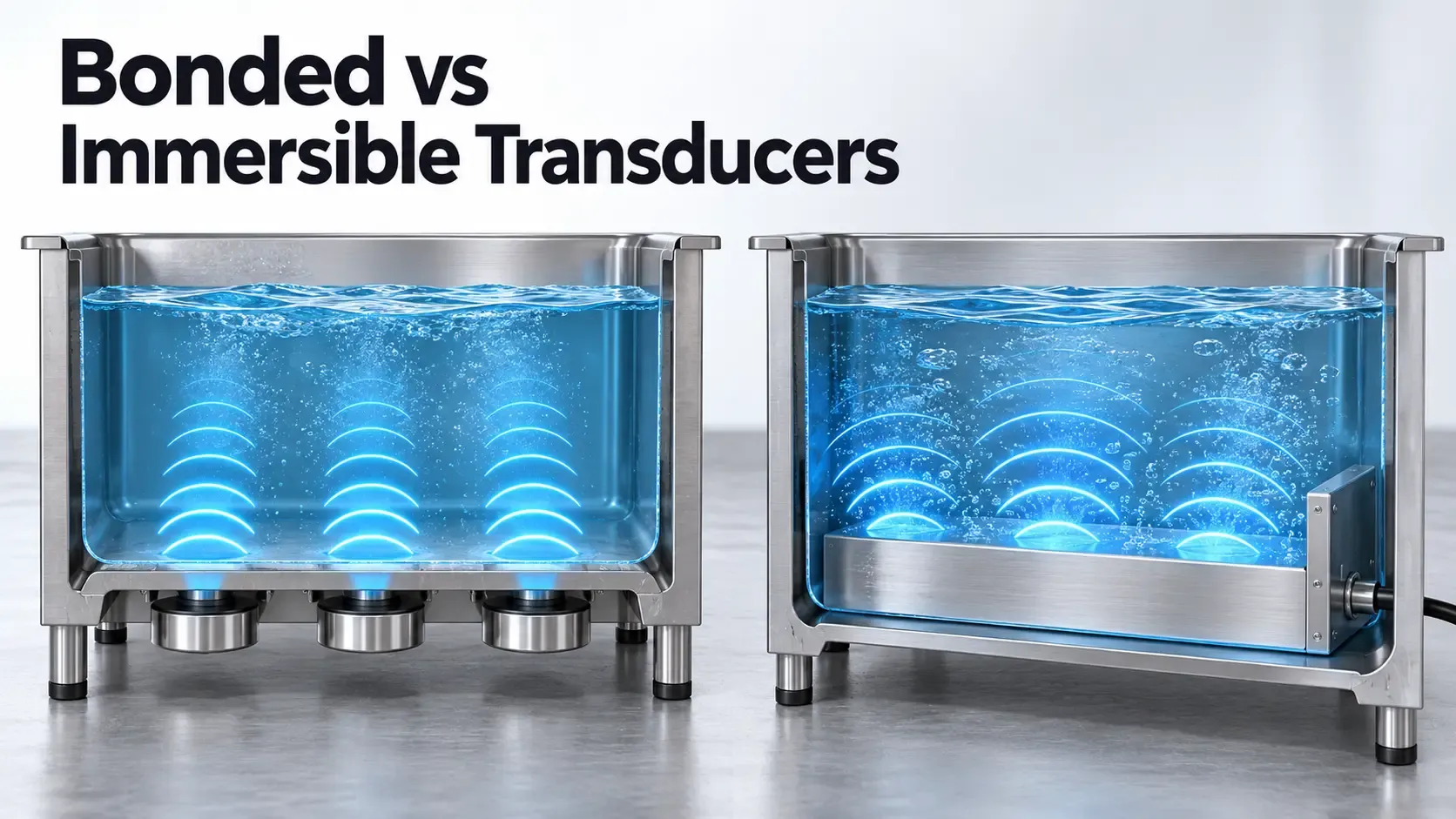
Most ultrasonic cleaning tanks use one of two ultrasonic energy structures:
- bonded ultrasonic transducers attached to the outside of the tank
- immersible transducer plates installed inside the tank as sealed ultrasonic modules
Both designs can be used successfully. The right choice depends on tank size, cleaning load, maintenance expectations, installation space, budget, and whether the system is a standard tank or a custom industrial project.
This guide explains the difference between bonded transducers and immersible transducer plates, where each design is commonly used, and what buyers should confirm before choosing an industrial ultrasonic cleaning tank.
Quick Answer
Bonded ultrasonic transducers are usually attached to the outside of the tank bottom or tank wall. They are compact, do not occupy space inside the cleaning tank, and are common in small to medium ultrasonic cleaning tanks.
Immersible transducer plates are sealed stainless steel ultrasonic modules installed inside the tank, usually on the bottom or side walls. They are more modular and can be useful for large tanks, custom systems, heavy-duty industrial projects, or existing tank upgrades.
Neither design is automatically better in every situation.
Choose bonded transducers when you need a compact standard tank, no internal ultrasonic module, and the application does not require special transducer placement.
Consider immersible transducer plates when the tank is large, the cleaning load is heavy, side-mounted ultrasonic energy is needed, or modular maintenance is important.
Understanding the Physical Structure
The core difference between bonded and immersible transducers is how ultrasonic energy is built into the tank.
With bonded transducers, the tank wall or tank bottom becomes the sound-radiating surface. The transducers are attached to the dry outside surface of the tank.
With immersible transducer plates, the ultrasonic source is a sealed module placed inside the liquid bath. The plate itself becomes the sound-radiating surface.
This structural difference affects usable tank space, cleaning layout, maintenance access, side-mounted ultrasonic energy, and retrofit possibilities.
What Are Bonded Ultrasonic Transducers?
Bonded ultrasonic transducers are installed on the outside surface of the cleaning tank.
In many ultrasonic cleaning machines, the transducers are attached to the underside of the tank bottom. In some designs, they may also be mounted on the outer side walls. The transducers convert electrical energy from the ultrasonic generator into mechanical vibration, and that vibration passes through the stainless steel tank wall into the cleaning liquid.
Because the transducers are outside the tank, the inside of the tank remains open and easy to use.
This design is common in:
- small benchtop ultrasonic cleaners
- standard commercial tanks
- small and medium industrial single-tank cleaners
- applications where internal tank space should remain fully usable
- systems where a compact, integrated design is preferred
For many standard cleaning applications, bonded transducers are practical and cost-effective.
Advantages of Bonded Ultrasonic Transducers
Bonded transducers keep the tank interior open.
Because the ultrasonic elements are outside the tank, there is no internal transducer box taking up space. This can be useful when the tank size is limited or when parts, baskets, or racks need clear internal space.
Bonded transducers also allow a simple tank interior. This can make daily cleaning easier because there are fewer internal modules, corners, cables, or protective structures inside the bath.
For standard small and medium tanks, bonded transducers are often more economical. The tank and ultrasonic system are built as one integrated unit, without needing extra internal housings.
Bonded transducers may be suitable when:
- the tank is small or medium size
- the cleaning load is not unusually heavy
- the required ultrasonic direction is mainly from the bottom
- internal tank space should remain open
- the system is a standard model rather than a complex custom project
- lower equipment complexity is preferred
For many common industrial cleaning tasks, this design is enough.
Limitations of Bonded Ultrasonic Transducers
Bonded transducers are less modular.
If transducer performance drops or a failure occurs, inspection and repair usually involve the tank structure itself. The transducers are attached to the tank wall, so service may be less convenient than replacing a separate transducer module.
Bonded transducers also offer less flexibility when a project needs ultrasonic energy from multiple directions. Bottom-mounted transducers may be enough for many applications, but some deep tanks, tall parts, complex geometries, or high-load baskets may need side-mounted ultrasonic energy as well.
For large tanks, custom systems, or applications where future maintenance access is a priority, bonded transducers may not always be the best fit.
They may be less suitable when:
- the tank is very large
- side-wall ultrasonic energy is required
- the cleaning load is heavy
- the project needs modular maintenance
- the system may need future transducer upgrades
- an existing tank needs to be converted into an ultrasonic tank
This does not mean bonded transducers are poor quality. It means they are less flexible in some industrial project conditions.
What Are Immersible Transducer Plates?
Immersible transducer plates are sealed ultrasonic modules placed inside the cleaning tank.
The transducer elements are housed inside a stainless steel box or plate. This plate is submerged in the cleaning liquid and connected to the ultrasonic generator by cables. Depending on the project, the plate may be installed on the tank bottom, side wall, or another suitable position.
This design makes the ultrasonic energy source more modular.
Immersible plates are common in:
- large industrial tanks
- custom ultrasonic cleaning systems
- heavy-duty cleaning applications
- tanks that need side-mounted ultrasonic energy
- systems where transducer modules may need to be serviced or replaced separately
- existing tanks that are being upgraded with ultrasonic capability
A transducer plate does occupy space inside the tank, so tank layout, basket size, part clearance, and plate protection must be considered.
Advantages of Immersible Transducer Plates
Immersible transducer plates are modular.
Because the ultrasonic energy source is a separate sealed module, it can be positioned based on the tank design and cleaning requirement. Plates can be installed on the bottom, side walls, or in multiple locations when the project requires broader ultrasonic coverage.
This can be useful for large tanks, deep tanks, heavy loads, or parts with complex geometry.
Immersible plates can also be easier to service in some systems. If a plate needs inspection or replacement, it may be handled as a module instead of working directly on the bonded tank surface.
Immersible plates may be suitable when:
- the tank is large
- the parts are heavy or bulky
- side-mounted ultrasonic energy is needed
- bottom-only ultrasonic energy may not be enough
- the tank is part of a custom industrial system
- the customer wants more modular maintenance
- an existing stainless steel tank needs ultrasonic capability
- the system may require multiple ultrasonic zones
For custom industrial ultrasonic cleaning systems, immersible plates can give the supplier more configuration flexibility.
Limitations of Immersible Transducer Plates
Immersible transducer plates occupy space inside the tank.
This means the usable cleaning area may become smaller. Buyers need to check whether the basket, parts, racks, and plates can fit safely inside the tank without blocking each other.
Plates also need protection. Heavy parts, baskets, or fixtures should not hit or rest directly against the transducer plate. The system layout should prevent mechanical damage during loading and unloading.
Immersible plates may also increase equipment cost and installation complexity compared with a simple bonded-transducer tank.
Other considerations include:
- cable routing
- sealing reliability
- plate position
- basket clearance
- cleaning dead zones around the plate
- whether the plate interferes with part loading
- whether the plate surface is easy to keep clean
Immersible plates are flexible, but they must be designed into the tank layout properly.
Bonded vs Immersible Transducers: Decision Table
Project Situation | Usually Better Fit | Why |
|---|---|---|
Small standard tank | Bonded transducers | Compact design and open tank interior |
Commercial benchtop cleaner | Bonded transducers | Simple integrated structure |
Medium single-tank industrial cleaner | Bonded or immersible | Depends on load, tank size, and maintenance needs |
Large industrial cleaning tank | Immersible transducer plates | More modular ultrasonic placement |
Deep tank or tall parts | Immersible transducer plates | Side or multi-position ultrasonic energy may help |
Existing stainless tank upgrade | Immersible transducer plates | Can add ultrasonic capability without rebuilding the tank |
Application needing open tank interior | Bonded transducers | No internal transducer module occupying space |
Project prioritizing modular service | Immersible transducer plates | Plate can be treated as a separate ultrasonic module |
Heavy baskets or rough handling | Depends on layout | Plates need protection; bonded design keeps modules outside the tank |
This table is a starting point, not a fixed rule. The correct choice depends on part size, contamination, cleaning target, basket design, tank volume, and maintenance expectations.
How Transducer Position Affects Cleaning
The type of transducer is only one part of the decision. Position also matters.
Bottom-mounted ultrasonic energy is common and works well for many cleaning applications. However, some parts are tall, heavy, complex, or loaded densely in baskets. In those cases, ultrasonic energy from the bottom alone may not reach all surfaces consistently.
Side-mounted energy may help when:
- parts are tall
- baskets are deep
- the tank has a large liquid volume
- parts have vertical surfaces
- the load blocks bottom-up ultrasonic energy
- cleaning uniformity is difficult with bottom-only energy
This is one reason immersible plates are sometimes used in large industrial systems. They can be installed on side walls or in multiple positions to support better energy distribution.
However, adding side plates does not automatically solve every cleaning problem. Basket loading, part spacing, bath condition, detergent, temperature, and rinsing still matter.
Maintenance and Service Considerations
Maintenance expectations should be discussed before choosing the transducer design.
For bonded transducers, maintenance is tied more closely to the tank body. The design is compact, but if a transducer issue occurs, troubleshooting may involve the integrated tank structure.
For immersible plates, the ultrasonic module is more separate. In some cases, this can make replacement or service more flexible. However, the plate, cable, seal, and mounting method also need to be protected and maintained.
Buyers should ask:
- How will the transducer system be inspected?
- Can damaged modules be serviced or replaced?
- Are parts or baskets likely to hit the ultrasonic surface?
- Is the tank used in heavy-duty production?
- Will operators need to remove baskets frequently?
- Is the cleaning process likely to change later?
The best choice is not only about initial cost. It is also about long-term service, downtime risk, and how the machine will actually be used.
What Information to Send Sonixmax Before Choosing
If you are not sure whether bonded transducers or immersible transducer plates are more suitable, send Sonixmax your project details.
Useful information includes:
- tank size or expected tank dimensions
- part dimensions and weight
- basket size and loading method
- contamination type
- cleaning target
- required production volume
- whether the tank is new or existing
- whether side-mounted ultrasonic energy is needed
- whether the process requires filtration, rinsing, or drying
- available workshop space
- maintenance preference
- photos or drawings of the parts if available
With this information, Sonixmax can help evaluate whether a bonded-transducer tank, an immersible transducer plate system, or a custom industrial ultrasonic cleaning configuration is more suitable.
Need Help Choosing the Right Ultrasonic Tank Design?
If your project requires an industrial ultrasonic cleaning tank, the transducer structure should match the tank size, part geometry, cleaning load, maintenance expectations, and available space.
Bonded transducers can be practical for compact standard tanks. Immersible transducer plates can be useful for larger or more customized industrial systems.
Send Sonixmax your part details, tank requirements, cleaning process, and photos or drawings.
Sonixmax can help evaluate a suitable ultrasonic tank design and cleaning system configuration for your application.