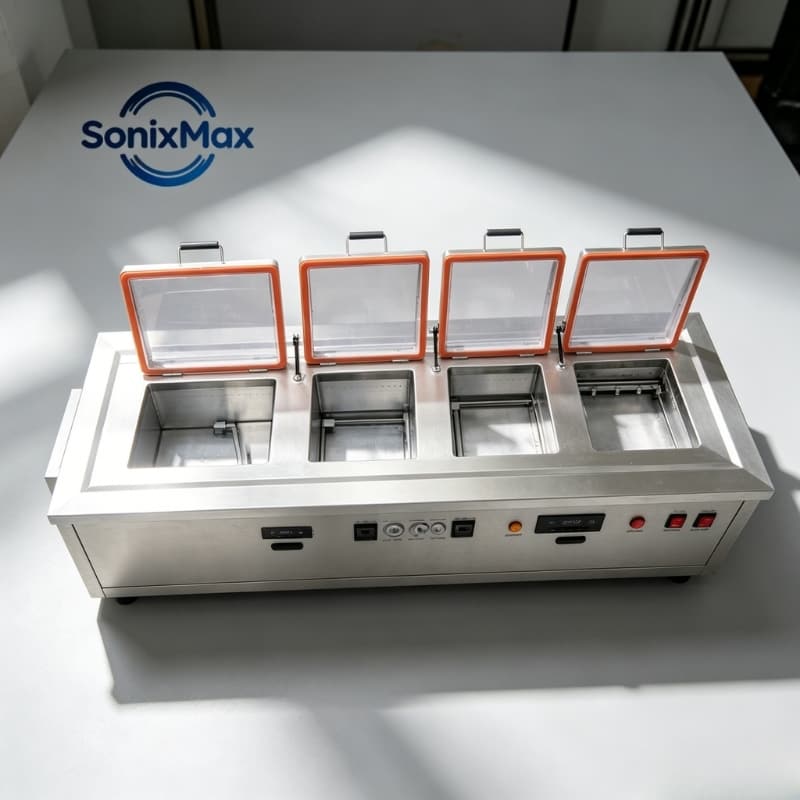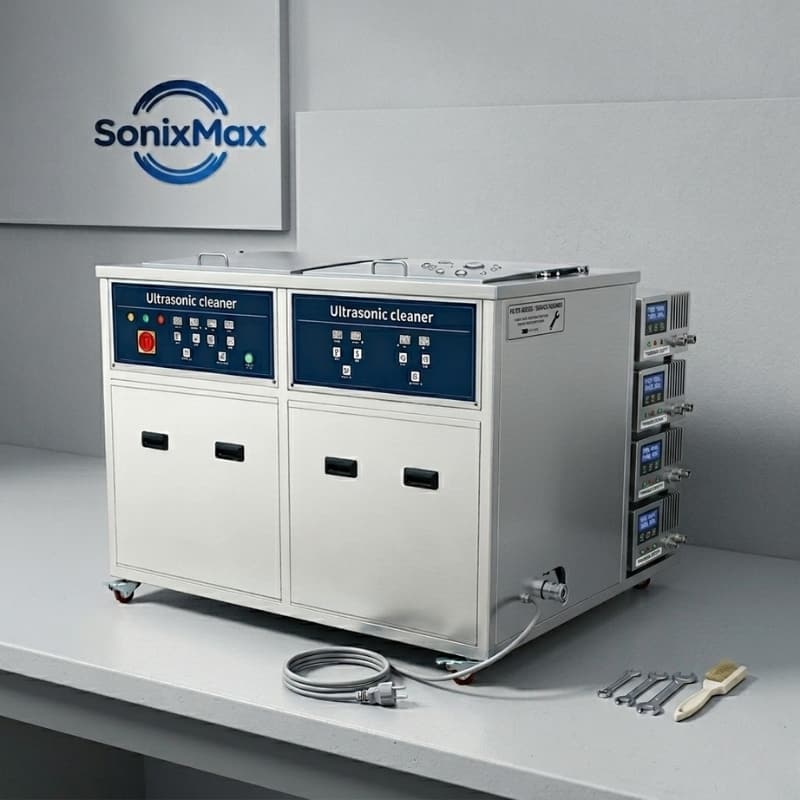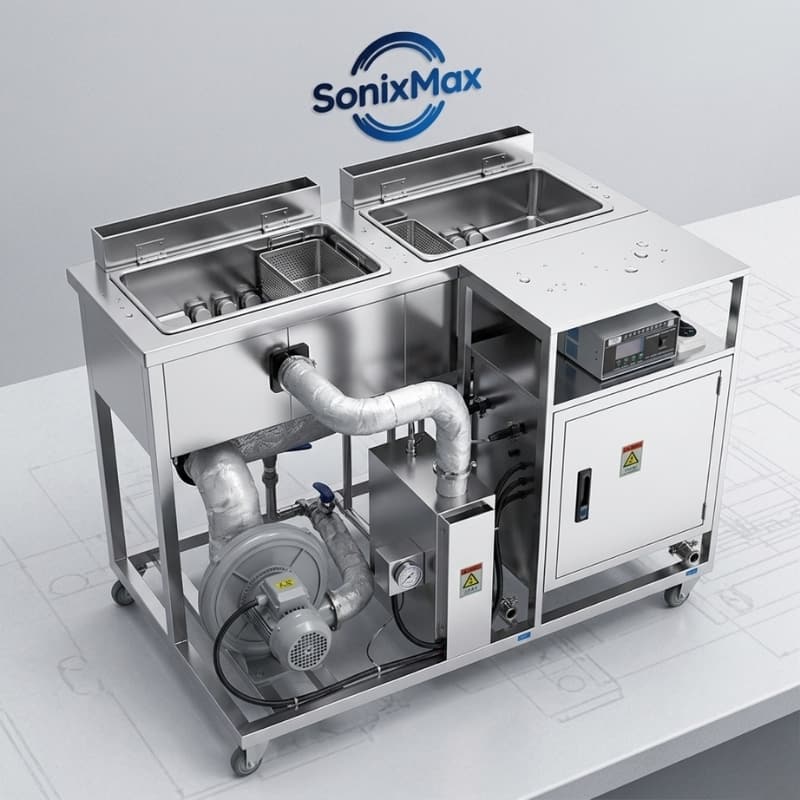
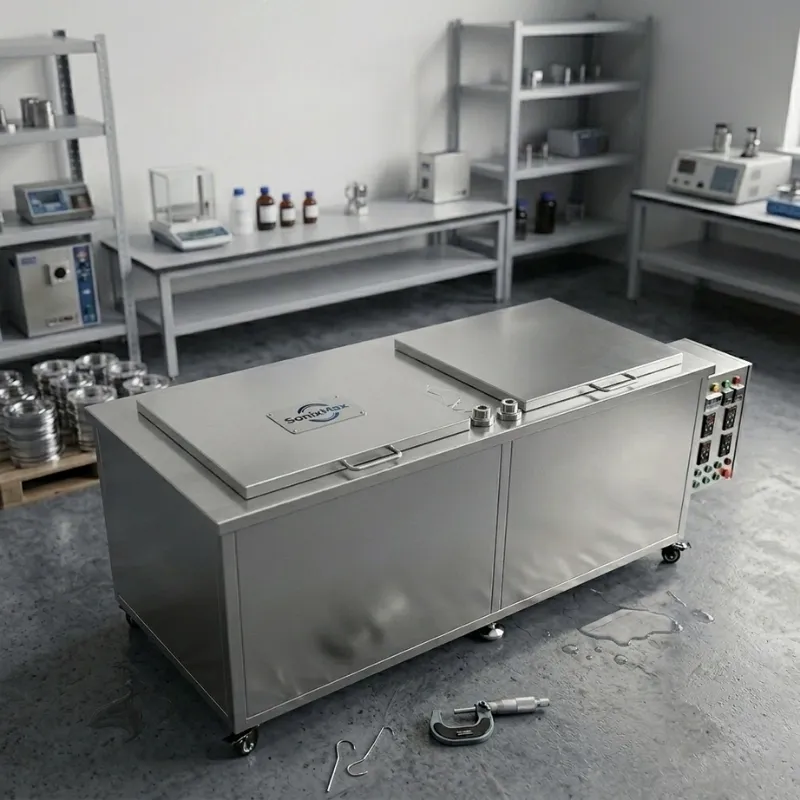
Multi-tank series
45L–360L Dual-Tank Drum Ultrasonic Cleaner for Batch Parts Cleaning
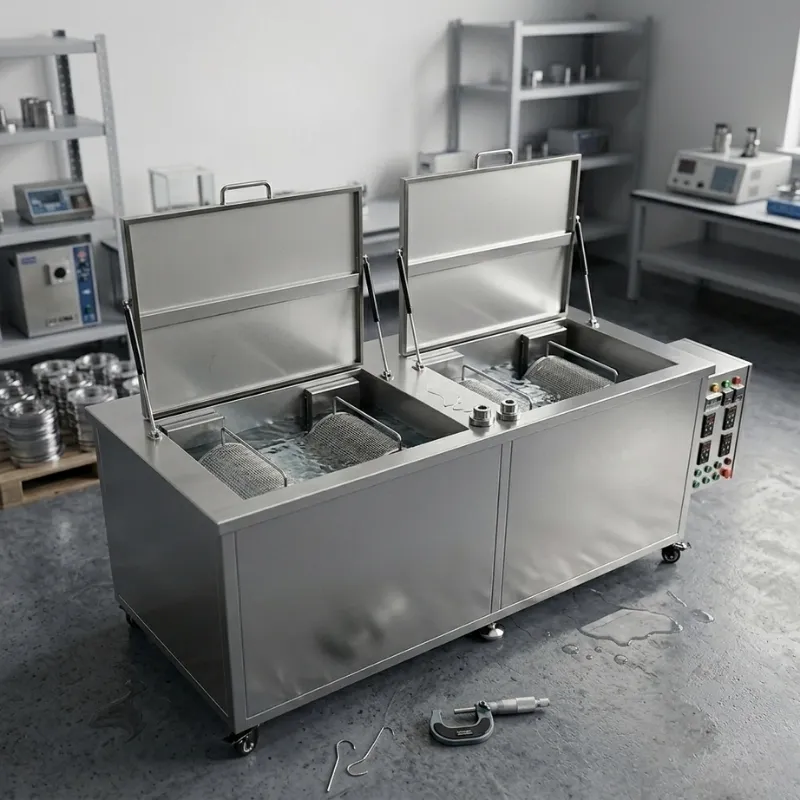
Dual-tank drum ultrasonic cleaning system designed for batch cleaning of small and medium-sized parts. The rotating drum keeps workpieces moving during ultrasonic cleaning for more consistent exposure across complex surfaces and recessed areas. Available in 45–360L configurations with adjustable ultrasonic power, 28/40kHz frequency options, heating, and customizable drum and process configurations.
Product Overview
When many small components are cleaned together in a conventional basket, parts may overlap, stack together, or remain in relatively fixed positions throughout the cleaning cycle.
The rotating drum provides a different handling method. As the drum rotates, the loaded parts continuously change position and orientation in the cleaning solution. This helps expose different surfaces, threads, recesses, and detailed geometries to the cleaning process while reducing the need to manually reposition individual parts.
Combined with ultrasonic cleaning, the drum configuration is particularly useful for manufacturers processing repetitive batches of small components where individual loading or positioning would be inefficient.
The dual-tank design also provides a flexible platform for building the cleaning process around the actual workpiece and production requirements.
Best suited for: small to medium-sized parts that can safely tolerate tumbling and part-to-part contact during cleaning.
Consider another cleaning system if: the parts are large, highly delicate, easily scratched, have sensitive surface finishes, or must remain separated during processing.
Typical Parts & Cleaning Applications
The drum configuration is primarily intended for batch processing rather than individual precision positioning.
Parts | Typical Contamination | Why Drum Cleaning Fits |
|---|---|---|
Fasteners & hardware | Oil, grease, machining residue, loose particles | Multiple small parts can be processed together in the drum |
Machined components | Cutting fluid, chips and process residue | Continuous movement changes part orientation during cleaning |
Fittings & connectors | Oil and manufacturing residue | Helps expose threads, recesses and different external surfaces |
Stamped metal parts | Forming oil and surface residue | Suitable for repetitive batch cleaning of similar components |
Small precision metal parts | Light oil and process contamination | Provides a controlled way to handle multiple small parts |
General small components | Production residue and particulate contamination | Reduces the need to position individual parts separately |
Actual cleaning performance depends on the part material, geometry, contamination, loading quantity, cleaning chemistry, temperature, and process settings.
Core Features
Rotating Drum for Batch Parts
The drum keeps loaded workpieces moving during cleaning, continuously changing their position instead of leaving them stationary in a basket. This makes the machine particularly suitable for batches of small components.
Dual-Tank Configuration
The two-tank structure provides additional flexibility when designing the cleaning process compared with a single-tank system. The final process arrangement can be discussed according to the required application.
Adjustable Ultrasonic Power
Ultrasonic output can be adjusted across the available models, allowing the cleaning settings to be matched more closely to the workpiece and contamination.
28/40kHz Frequency Options
The series supports 28kHz or 40kHz configurations. Frequency selection can be based on the part material, geometry, contamination, and required cleaning process.
Heated Cleaning
Integrated heating provides temperature control from normal temperature up to 95°C, allowing heated cleaning processes to be used where appropriate for the selected cleaning chemistry and workpiece.
45L–360L Capacity Range
Eight standard configurations cover tank capacities from 45L to 360L, providing options for different part sizes and batch-processing requirements.
Technical Specifications
Model | Inner Tank Size (mm) | Capacity | Material | Transducers | Adjustable Ultrasonic Power | Frequency | Timer | Heating Power | Temperature | Power Supply |
|---|---|---|---|---|---|---|---|---|---|---|
SNXM-2012DC | 500 × 300 × 300 | 45L | SUS304 | 12 | 0–600W | 28/40kHz | 1–99 min | 1.5kW | Normal–95°C | Single-Phase 220V |
SNXM-2018DC | 500 × 350 × 350 | 61L | SUS304 | 18 | 0–900W | 28/40kHz | 1–99 min | 1.5kW | Normal–95°C | Single-Phase 220V |
SNXM-2024DC | 550 × 400 × 400 | 88L | SUS304 | 24 | 0–1200W | 28/40kHz | 1–99 min | 3.0kW | Normal–95°C | Single-Phase 220V |
SNXM-2030DC | 600 × 450 × 400 | 108L | SUS304 | 30 | 0–1500W | 28/40kHz | 1–99 min | 3.0kW | Normal–95°C | Single-Phase 220V |
SNXM-2036DC | 600 × 500 × 500 | 150L | SUS304 | 36 | 0–1800W | 28/40kHz | 1–99 min | 4.5kW | Normal–95°C | Three-Phase 380V |
SNXM-2048DC | 700 × 550 × 500 | 192L | SUS304 | 48 | 0–2400W | 28/40kHz | 1–99 min | 6.0kW | Normal–95°C | Three-Phase 380V |
SNXM-2060DC | 800 × 600 × 550 | 264L | SUS304 | 60 | 0–3000W | 28/40kHz | 1–99 min | 7.5kW | Normal–95°C | Three-Phase 380V |
SNXM-2072DC | 1000 × 600 × 600 | 360L | SUS304 | 72 | 0–3600W | 28/40kHz | 1–99 min | 9.0kW | Normal–95°C | Three-Phase 380V |
Specifications shown are standard reference configurations. Final equipment configuration should be confirmed according to the cleaning project.
How to Select the Right Drum Ultrasonic Cleaning System
Tank capacity should not be the only factor when selecting a drum ultrasonic cleaner.
The first question is whether the workpieces are suitable for tumbling.
Small, durable components that can safely contact one another during processing are generally better candidates. Parts with delicate finishes, sensitive coatings, easily damaged edges, or surfaces that must remain separated may require baskets, racks, dedicated fixtures, or another handling method.
After confirming that drum cleaning is suitable, the system can be selected according to:
- Part size and geometry — determines the required drum and tank dimensions.
- Batch quantity — affects the required working capacity and throughput.
- Contamination — influences frequency, power, temperature, and cleaning process.
- Part material and surface condition — helps determine whether tumbling and the selected cleaning parameters are appropriate.
- Required cleaning result — determines whether additional process stages or a customized configuration should be considered.
For project selection, sending actual part photos or drawings together with contamination and batch information is more useful than selecting a machine based only on tank capacity.
Customization for Industrial Cleaning Projects
Standard models provide a starting point for equipment selection. For applications that require a different configuration, SonixMax can evaluate the system around the actual parts and cleaning process.
Customization can include:
Project Requirement | Available Direction |
|---|---|
Tank Size | Standard or application-specific dimensions |
Drum Configuration | Evaluated according to part size and batch requirements |
Ultrasonic Frequency | 28kHz / 40kHz options |
Ultrasonic Power | Selected according to system size and cleaning requirements |
Heating | Configured according to the cleaning process |
Cleaning Process | Dual-tank arrangement based on project requirements |
Power Supply | Configured according to equipment size and destination requirements |
System Configuration | Additional requirements can be evaluated for customized projects |
Final configuration should be confirmed according to the workpiece, contamination, required process, and production conditions.
Why Work with SonixMax?
A drum ultrasonic cleaner should not be selected simply because the workpieces are small.
SonixMax evaluates whether continuous tumbling is appropriate for the actual parts before recommending the equipment configuration. Part material, surface condition, geometry, contamination, batch quantity, and cleaning requirements are considered together when selecting the system.
If drum cleaning is not suitable for the workpiece, other handling methods such as baskets, racks, dedicated fixtures, or different industrial ultrasonic cleaning configurations can be considered instead.
This approach allows the equipment to be selected around the cleaning application and production process, rather than relying only on tank capacity or standard machine specifications.
FAQ
What parts are suitable for a drum ultrasonic cleaner?
Drum systems are particularly suitable for batches of relatively small parts that can safely move and contact one another during cleaning. Typical examples include certain fasteners, fittings, machined components, stamped parts, and general metal hardware.
Why use a rotating drum instead of a standard cleaning basket?
A conventional basket keeps most workpieces relatively stationary. A rotating drum continuously changes their position and orientation, making it useful when batches of small components would otherwise overlap or remain in similar positions during cleaning.
Can delicate or finished parts be cleaned in the drum?
It depends on the workpiece. Parts with delicate finishes, sensitive coatings, easily scratched surfaces, or features that may be damaged through part-to-part contact may not be suitable for tumbling. Another handling method should be considered for these applications.
Discuss Your Drum Ultrasonic Cleaning Project
If you need to clean batches of small or medium-sized components, send us information about your application so we can evaluate whether a drum-type ultrasonic cleaning system is suitable.
For configuration recommendations, please provide your part type and material, dimensions, contamination, approximate quantity per batch, and required cleaning result.