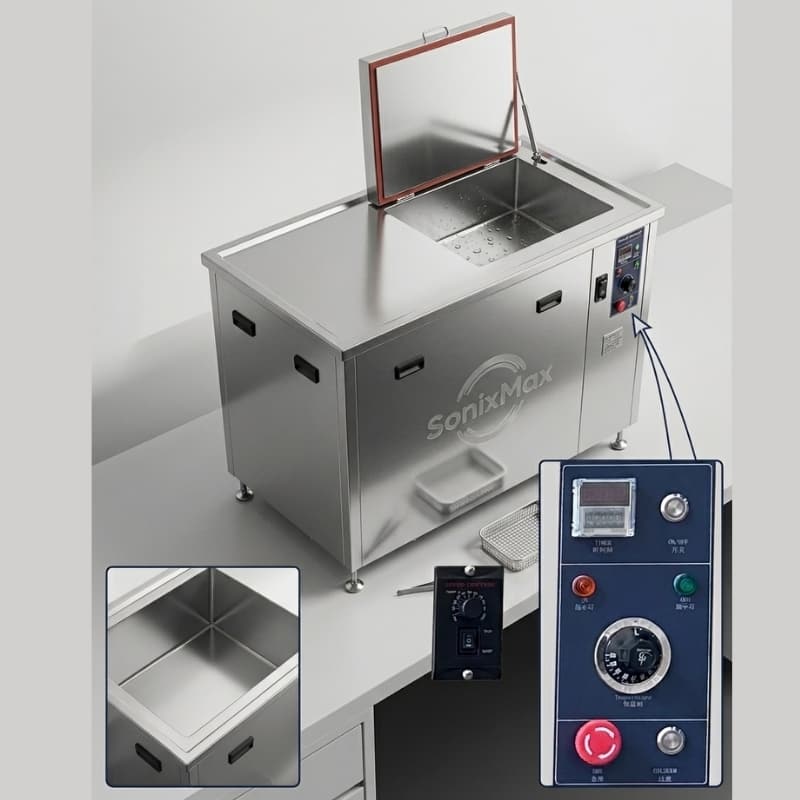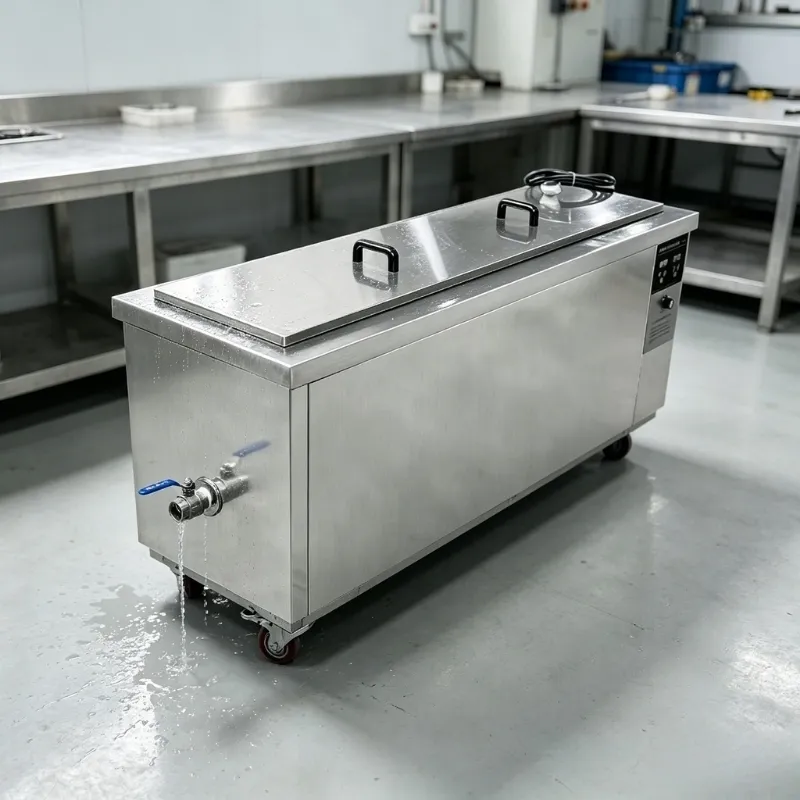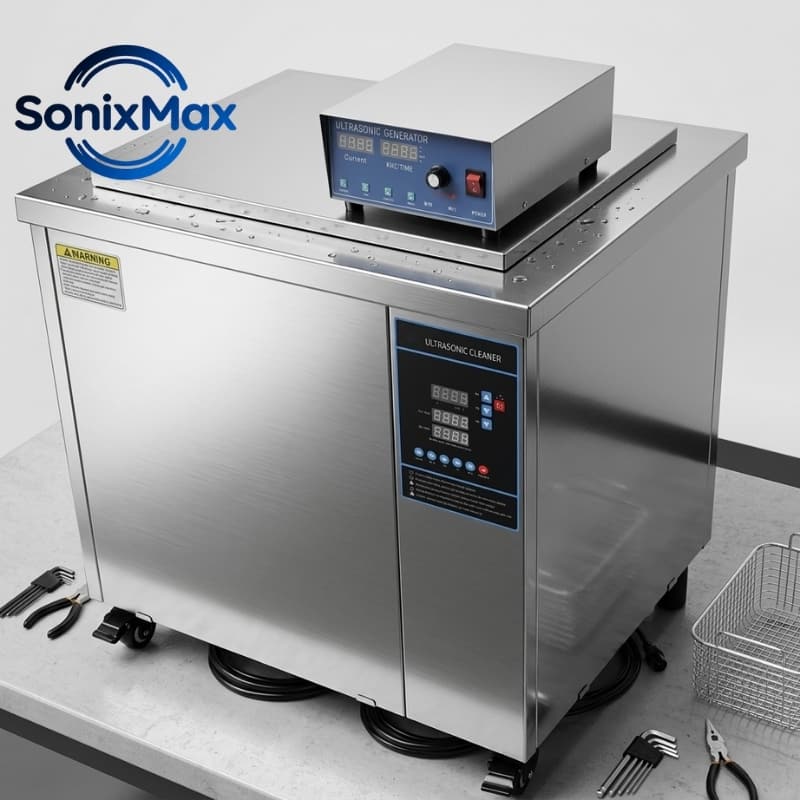
Single tank series
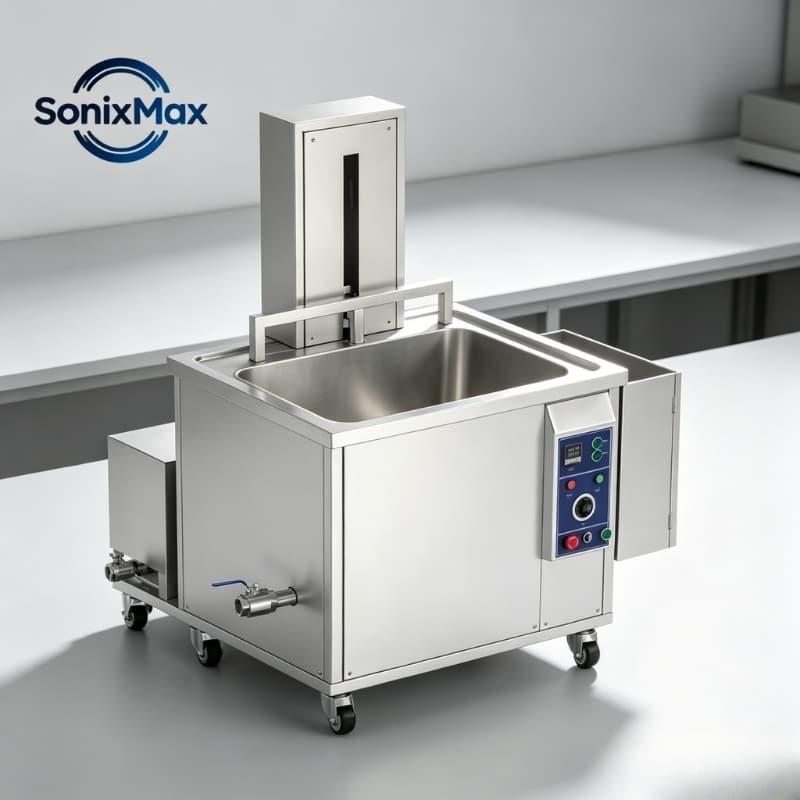
Industrial Single-Tank Ultrasonic Cleaner with Automated Lifting & Agitation
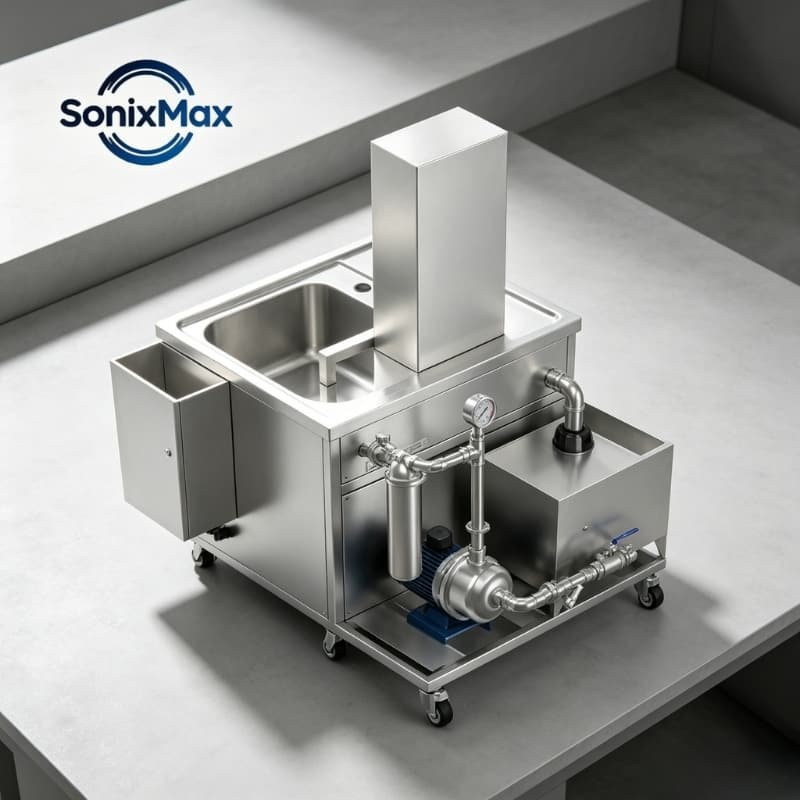
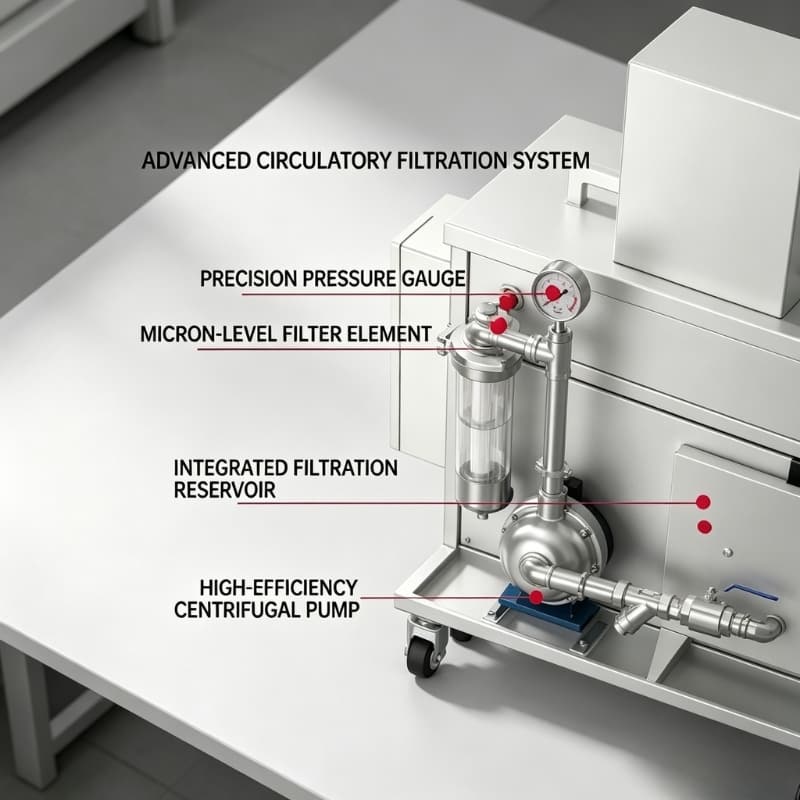
Available in capacities from 38L to 360L. Featuring a powerful Lifting & Agitation System and an integrated Filtration System, this unit is the solution for removing heavy oil, carbon, and rust from large-scale machinery components. One-button lifting and lowering saves labor, replaces manual basket lifting, and speeds up water draining.
Product Overview
In a standard ultrasonic cleaning process, the workpieces normally remain stationary inside the cleaning tank throughout the cycle.
For some industrial parts and batch-loading conditions, controlled vertical movement of the basket or workpieces can be introduced during ultrasonic cleaning.
The agitation system moves the load through the cleaning liquid while ultrasonic cavitation acts on the immersed surfaces. This creates a cleaning process that combines ultrasonic action with mechanical movement of the workpiece load rather than relying on stationary immersion alone.
This configuration can be considered for parts with complex geometries, overlapping contact areas, recesses, or batch arrangements where movement during the cleaning cycle is beneficial to the process.
Standard models range from 45L to 360L, with larger or application-specific configurations evaluated according to project requirements.
Best suited for: batch ultrasonic cleaning where controlled movement of the workpieces or basket is required during the cleaning cycle.
Consider another system if: your main requirement is cleaning-liquid filtration, integrated rinsing and drying, multiple treatment stages, or automated transfer between tanks.
Typical Parts & Cleaning Applications
Parts / Applications | Typical Contamination | Why Agitation Can Help |
|---|---|---|
Machined components | Cutting oil, coolant, chips and particles | Movement changes the position of parts in the cleaning liquid during the cycle |
Gears & mechanical components | Oil, grease and particles | Suitable for durable parts requiring repetitive batch cleaning |
Valves & fittings | Machining residue, oil and particles | Useful for parts with recesses, threads and more complex external geometry |
Metal hardware & small components | Oil, polishing residue and particles | Agitation can be useful when multiple parts are processed together in a basket |
Automotive components | Oil, grease and production residue | Combines ultrasonic cleaning with controlled load movement |
Complex metal parts | Process residue in grooves and recessed areas | Movement can complement ultrasonic action during immersion |
Whether agitation is beneficial should be evaluated according to the part geometry, loading arrangement, contamination, material, batch weight, and required cleaning result.
Key Features & Cleaning Benefits
Agitation During Ultrasonic Cleaning
The main difference from a standard single-tank machine is the addition of controlled movement during the ultrasonic cleaning cycle.
Instead of keeping the loaded basket completely stationary, the system moves the load through the cleaning liquid according to the configured mechanism.
This provides another process variable for applications where stationary immersion alone is not preferred.
Suitable for Complex Batch Loading
When multiple components are loaded together, their position and contact conditions can affect how the cleaning liquid interacts with the parts.
Controlled agitation can be considered for suitable batch applications where movement of the loaded basket is beneficial during cleaning.
Adjustable Ultrasonic Power
Ultrasonic output can be adjusted according to the selected model and cleaning requirements.
This allows the ultrasonic intensity to be matched more closely to the workpiece, contamination, and cleaning process.
28kHz / 40kHz Frequency Options
The series supports 28kHz or 40kHz configurations.
28kHz can be considered for robust industrial parts and heavier contamination, while 40kHz can be considered for finer geometries and comparatively more sensitive cleaning requirements.
Final frequency selection should be based on the actual application.
Heated Cleaning up to 95°C
Integrated heating provides cleaning-temperature control from ambient temperature up to 95°C.
For compatible applications, heating can assist with oil and grease removal and improve the performance of suitable cleaning chemistry.
1–99 Minute Time Control
Cleaning duration can be adjusted according to the workpiece, contamination, chemistry, temperature, and required cleaning result.
SUS304 Industrial Cleaning Tank
The standard inner tank uses SUS304 stainless steel with T2.0 construction, designed for repeated industrial batch-cleaning applications.
Optional Lifting & Filtration
Depending on the project, additional lifting and filtration configurations can be evaluated.
These options should be selected according to the actual loading method, workpiece weight, contamination, and cleaning-liquid management requirements rather than added automatically to every system.
Technical Specifications
Model | Inner Tank Size (mm) | Capacity | Material | Transducers | Adjustable Ultrasonic Power | Frequency | Timer | Heating Power | Cleaning Temperature | Power Supply |
|---|---|---|---|---|---|---|---|---|---|---|
SNXS-1012L | 500 × 300 × 300 | 45L | SUS304 | 12 pcs | 0–6000W* | 28/40kHz | 1–99 min | 1.5kW | Ambient–95°C | Single-Phase 220V |
SNXS-1018L | 500 × 350 × 350 | 61L | SUS304 | 18 pcs | 0–900W | 28/40kHz | 1–99 min | 1.5kW | Ambient–95°C | Single-Phase 220V |
SNXS-1024L | 550 × 400 × 400 | 88L | SUS304 | 24 pcs | 0–1200W | 28/40kHz | 1–99 min | 3.0kW | Ambient–95°C | Single-Phase 220V |
SNXS-1030L | 600 × 450 × 400 | 108L | SUS304 | 30 pcs | 0–1500W | 28/40kHz | 1–99 min | 3.0kW | Ambient–95°C | Single-Phase 220V |
SNXS-1036L | 600 × 500 × 500 | 150L | SUS304 | 36 pcs | 0–1800W | 28/40kHz | 1–99 min | 4.5kW | Ambient–95°C | Three-Phase 380V |
SNXS-1048L | 700 × 550 × 500 | 192L | SUS304 | 48 pcs | 0–2400W | 28/40kHz | 1–99 min | 6.0kW | Ambient–95°C | Three-Phase 380V |
SNXS-1060L | 800 × 600 × 550 | 264L | SUS304 | 60 pcs | 0–3000W | 28/40kHz | 1–99 min | 7.5kW | Ambient–95°C | Three-Phase 380V |
SNXS-1072L | 1000 × 600 × 600 | 360L | SUS304 | 72 pcs | 0–3600W | 28/40kHz | 1–99 min | 9.0kW | Ambient–95°C | Three-Phase 380V |
The source specification sheet lists 0–6000W for SNXS-1012L. This value should be confirmed before publication.
Specifications shown are standard reference configurations. Final agitation mechanism, lifting arrangement, basket design, filtration, electrical configuration and overall dimensions should be confirmed according to the final project requirements.
When Is an Agitation System Useful?
Agitation should not be treated as an upgrade that every ultrasonic cleaning application automatically needs.
Its value depends on how the workpieces behave inside the cleaning tank.
Choose Single Tank + Agitation When:
- Workpieces benefit from controlled movement during ultrasonic cleaning.
- Multiple parts are processed together in a basket.
- Parts have complex geometries, recesses or contact areas.
- Stationary immersion does not match the intended cleaning process.
- One primary ultrasonic cleaning stage is still sufficient.
Choose a Standard Single Tank When:
The parts can be cleaned effectively while remaining stationary and there is no process reason to move the basket during cleaning.
A standard single-tank system keeps the equipment simpler when agitation provides no practical benefit.
Choose Single Tank + Filtration When:
The main problem is not workpiece movement but particles accumulating in the cleaning liquid during repeated batches.
In that situation, a filtration-equipped single tank may be more appropriate.
Consider a Multi-Stage System When:
The required process includes:
Cleaning → Rinsing
Cleaning → Drying
or
Cleaning → Rinsing → Drying
Agitation does not replace these additional process stages.
How to Select the Right Configuration
Selecting this system involves more than choosing between 45L and 360L.
The workpiece dimensions, basket arrangement, batch weight, geometry, contamination, and movement requirements should be evaluated together.
Workpiece & Basket Dimensions
The basket and workpieces must fit within the usable tank dimensions while leaving sufficient space for the intended movement.
This becomes particularly important in an agitation system because the load is not completely stationary.
Batch Weight
The total loaded weight affects the design of the agitation or lifting mechanism.
For heavier batches, provide the approximate weight per basket or per cleaning cycle when requesting a configuration.
Movement Requirements
The required movement should be evaluated according to the part geometry and cleaning process rather than using the same agitation configuration for every application.
Contamination
Oil, grease, machining residue, polishing compound, particles, and other contaminants may require different combinations of frequency, ultrasonic power, temperature, chemistry, cleaning time, and movement.
Production Requirements
If manual basket handling becomes inefficient because of batch weight or production volume, an assisted lifting or more automated handling configuration may need to be considered.
For configuration evaluation, send us your part photos or drawings, dimensions, material, contamination, quantity per batch, loaded basket weight, and required cleaning result.
Custom Engineering Options
The standard models provide a starting point. The final agitation and handling configuration should be matched to the actual workpiece and production process.
Project Requirement | Available Direction |
|---|---|
Tank Size | Standard 45L–360L or application-specific dimensions |
Basket / Fixture | Designed according to workpiece geometry and batch loading |
Agitation System | Evaluated according to part geometry, load and cleaning process |
Lifting Assistance | Can be evaluated for heavier baskets or handling requirements |
Filtration | Optional according to contamination and liquid-management requirements |
Ultrasonic Frequency | 28kHz / 40kHz |
Ultrasonic Power | Selected according to tank size and cleaning requirements |
Heating | Configured according to the cleaning process |
Electrical Configuration | Adapted to equipment size and destination requirements |
Additional Process Stages | Rinsing, drying or additional tanks evaluated separately |
The objective is not to add every available option, but to configure the machine around the actual cleaning and handling requirements.
Why Work with SonixMax?
Different single-tank configurations solve different process problems.
A standard single tank may be sufficient for straightforward batch cleaning. Filtration can be added when cleaning-liquid contamination needs to be controlled, while agitation can be considered when controlled workpiece movement is useful during the cleaning cycle.
SonixMax evaluates the workpiece, geometry, contamination, basket arrangement, batch weight, cleaning requirements, and production process before recommending a configuration.
If the application requires more than one treatment stage or more extensive automation, a dual-tank, multi-tank, or automated cleaning system can be evaluated instead.
Project support can include equipment selection, configuration discussion, customization coordination, technical communication, export packaging and delivery coordination, and after-sales communication.
FAQ
What is the difference between agitation and ultrasonic cleaning?
Ultrasonic cleaning uses cavitation generated in the cleaning liquid. The agitation system adds physical movement of the loaded basket or workpieces during the cleaning cycle. The two functions work together but perform different roles.
What is the difference between agitation and lifting?
Agitation generally refers to controlled movement during the cleaning process. A lifting mechanism can also be used to assist with raising or lowering a loaded basket. The final mechanism should be confirmed according to the required process and load.
Can filtration be added?
Yes. The source configuration indicates that filtration can be customized. Whether it is useful depends mainly on the type and amount of contamination entering the cleaning liquid.
What information is needed to configure the agitation system?
Provide the part dimensions, material, geometry, quantity per batch, contamination, basket dimensions if available, and especially the approximate total loaded weight. These details help determine the appropriate tank and handling configuration.
Request an Industrial Ultrasonic Cleaning Solution
If your parts require ultrasonic cleaning with controlled movement during the cleaning cycle, send us your application details for configuration evaluation.
Please provide your part type, material, dimensions, contamination, quantity per batch, approximate batch weight, and required cleaning result.