Oct 13, 2026Ultrasonic Cleaning Technology
How Often Should You Change Ultrasonic Cleaning Solution? Bath Life and Maintenance Guide
Learn when to change ultrasonic cleaning solution, how to judge bath life, why topping off detergent can cause residue, and when filtration or rinsing may be needed.
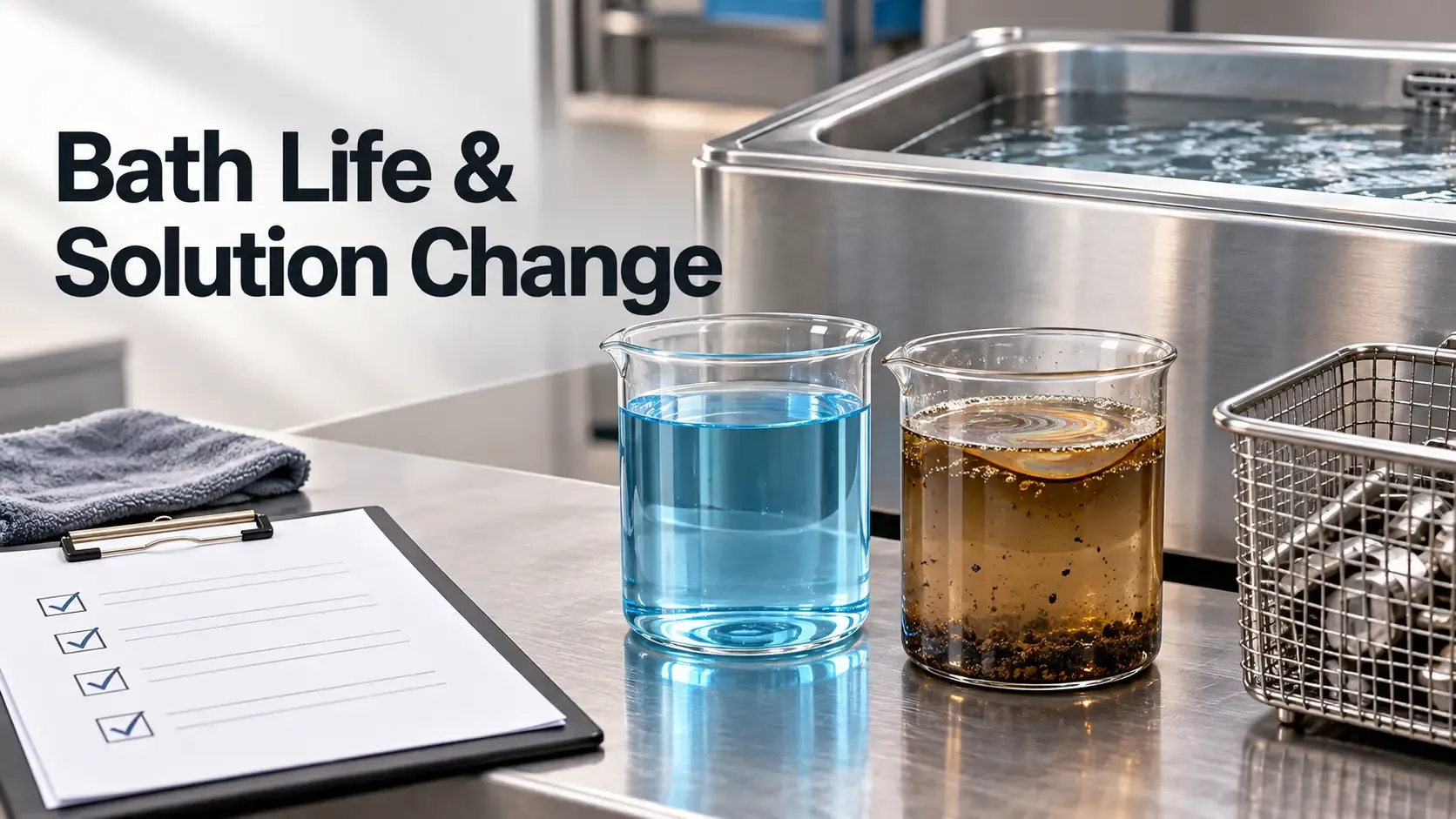
An ultrasonic cleaner does not keep the same cleaning performance forever if the bath is not managed properly.
In many workshops and production facilities, operators know when the cleaning liquid looks dirty, but they are not always sure when it should actually be replaced. Some teams change the solution too early and waste detergent, water, and heating energy. Others keep using an exhausted bath until parts come out oily, stained, cloudy, or inconsistent.
There is no universal replacement schedule that works for every ultrasonic cleaning process.
Bath life depends on the contamination type, part material, soil load, daily throughput, detergent selection, rinsing requirements, and whether the system includes filtration or oil separation.
This guide explains how to judge ultrasonic cleaning solution life, when to change the bath, why simply adding more detergent can make problems worse, and when filtration or a multi-stage process may be needed.
Quick Answer
You should change ultrasonic cleaning solution when the bath can no longer produce stable cleaning results.
Common signs include:
- cleaning performance drops on parts that were previously cleaned successfully
- parts feel oily, sticky, or slippery after cleaning
- white residue, cloudy marks, or redeposited soil appears after drying
- the bath has heavy sludge, floating oil, or strong discoloration
- metal chips or fine particles remain suspended in the liquid
- adding fresh detergent no longer improves cleaning performance
- downstream inspection, coating, assembly, or quality checks begin to fail
Filtration and oil separation can help extend bath life, but they do not make a cleaning bath last forever. Once the chemistry is saturated, contaminated, or no longer producing repeatable results, the bath should be replaced.
Why Ultrasonic Cleaning Solution Does Not Last Forever
Ultrasonic cavitation helps loosen contamination from the surface of a part. But once oil, grease, particles, polishing compound, carbon, coolant, or other soils enter the bath, the cleaning liquid has to hold and separate those contaminants.
Over time, the bath changes.
Oils and greases may dissolve, emulsify, or float on the surface. Metal chips, carbon, grinding dust, and other particles may settle at the bottom or remain suspended in the liquid. Active cleaning chemistry can be consumed as it reacts with contamination. Water evaporation can also change the working concentration of the bath.
When the bath becomes overloaded, ultrasonic energy may still be present, but the liquid can no longer support effective cleaning. Instead of removing contamination and carrying it away, the bath may start moving dirty liquid around the tank and redepositing soil back onto the parts.
This is why bath condition matters as much as machine power, cleaning time, or temperature.
Signs the Bath Should Be Changed
A cleaning bath should not be judged by color alone. Some solutions become dark but still clean acceptably. Others may look relatively clear but already contain enough dissolved oil, detergent imbalance, or fine contamination to affect results.
The most useful signal is whether the bath still produces stable, repeatable cleaning results.
A bath is likely near the end of its useful life when parts that were previously cleaned successfully begin to show problems.
For example, parts may look clean while they are still underwater, but feel oily after removal. This can happen when floating oil recoats the surface as the part is lifted out of the bath.
White residue or cloudy marks may also appear after drying. This can come from excess detergent, poor rinsing, mineral content, or contaminants left behind as water evaporates.
If parts come out with fine particles in holes, threads, blind cavities, or internal features, the bath may contain too much suspended contamination.
A dirty bath can also force operators to increase cleaning time or temperature just to achieve the same result. When a process starts needing longer and longer cycles, the bath condition should be checked before assuming the machine is too weak.
The Top-Off Trap: Why Adding More Detergent Can Make Problems Worse
When cleaning performance drops, some operators simply add more detergent concentrate into the existing bath.
This can be useful only if the bath is still fundamentally clean and the chemical concentration has fallen below the intended working range. But if the bath is already overloaded with oil, sludge, particles, or dissolved contamination, adding more detergent does not remove those contaminants.
It may actually create new problems.
Too much detergent can leave chemical film on parts, make rinsing more difficult, increase foaming, and create white residue after drying. In some cases, an over-concentrated bath may reduce cleaning stability instead of improving it.
The better question is not only:
“Do we need more detergent?”
It is:
“Is the bath still clean enough to keep using?”
If concentration correction does not restore normal cleaning performance, the bath should be drained, the tank should be cleaned, and fresh solution should be prepared according to the detergent supplier’s instructions.
How Soil Load Affects Bath Life
Bath life is strongly affected by what you are removing from the parts.
Light dust, fingerprints, or minor handling contamination may allow a bath to remain useful longer, especially when the process is controlled and the parts are rinsed properly.
Machined metal parts usually create a heavier load because they may bring cutting oil, coolant, metal fines, and chips into the bath. If these contaminants are not filtered or separated, the bath can degrade quickly.
Engine parts, maintenance parts, molds, and heavily used mechanical components may bring grease, carbon, sludge, rust inhibitor, or old deposits into the tank. These applications often require stronger bath management, pre-cleaning, filtration, or more frequent replacement.
Polishing compound, lapping paste, and abrasive residues can also shorten bath life because fine particles may remain in suspension and return to the part surface.
In short, a bath used for light cleaning and a bath used for heavy oil removal should not be managed with the same replacement rule.
Can Filtration Extend Ultrasonic Cleaning Solution Life?
Yes, filtration can help extend bath life and improve process stability.
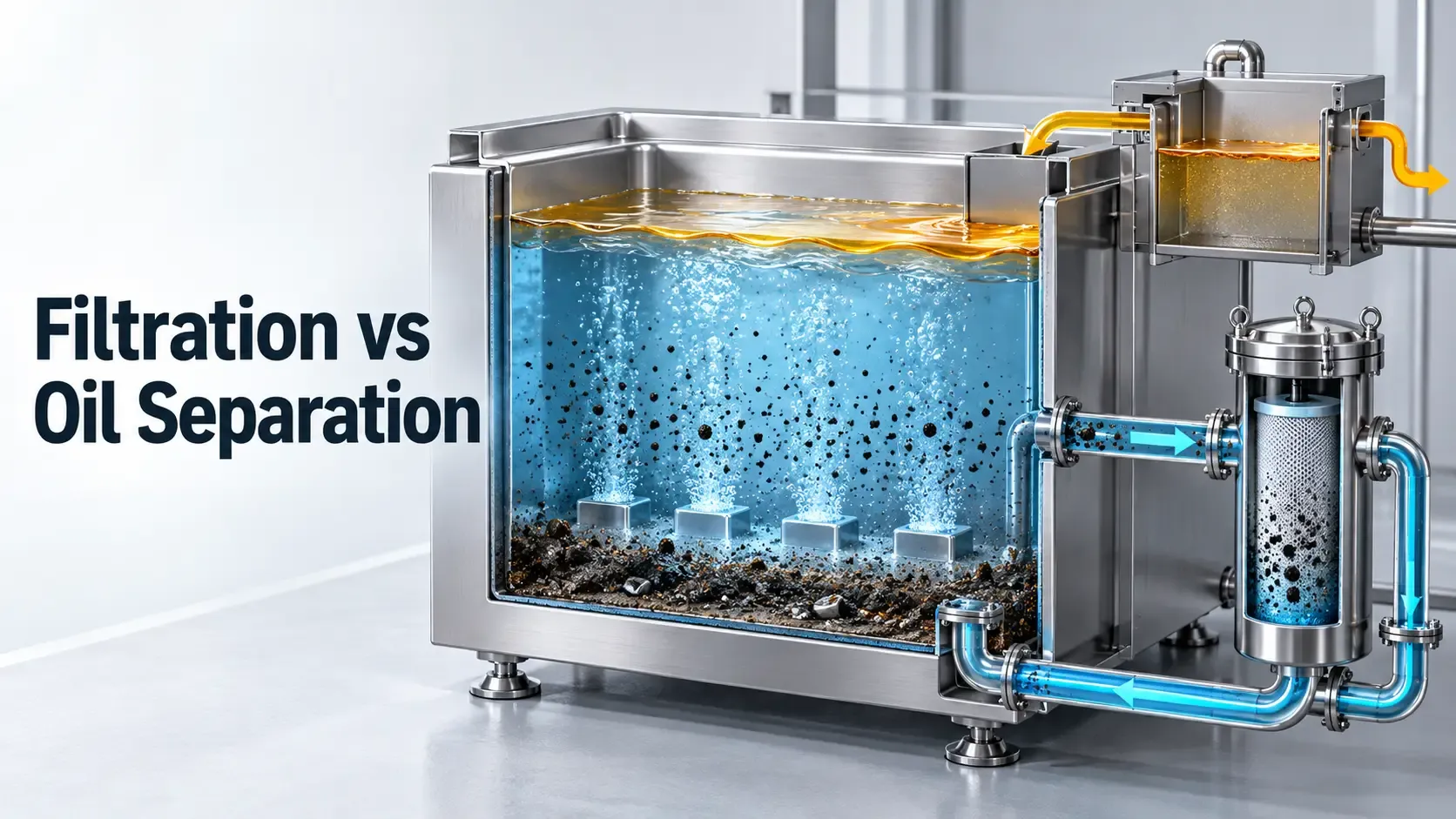
A filtration system can remove suspended particles, metal fines, chips, and some insoluble contamination from the cleaning liquid. This helps prevent dirt from settling at the tank bottom or returning to the parts.
Oil separation or surface overflow can also help when the process produces floating oil. If oil stays on the surface, parts may pass through that oil layer during removal and become coated again.
However, filtration has limits.
Filtration cannot fully restore exhausted chemistry. It cannot remove all dissolved contamination. It cannot replace consumed surfactants or correct every chemical imbalance. It also cannot replace proper rinsing when detergent or dissolved soils remain on the part surface.
Filtration should be understood as a bath-life and stability tool, not a permanent substitute for changing the bath.
When a Single Tank Is No Longer Enough
If your facility constantly struggles with oily parts, white residue, dirty bath conditions, or unstable cleaning results, the problem may not be operator discipline alone.
The process may be asking one tank to do too much.
A single tank is often expected to remove oil, hold contamination, rinse away detergent, and deliver final cleanliness. For light-duty work, this may be acceptable. For heavier industrial cleaning, it can become unstable.
A more controlled workflow may separate the process into stages:
Wash
↓
Rinse
↓
Optional second rinse
↓
Dry
For heavy oil or high-throughput production, a pre-wash stage, filtration, overflow, oil separation, or drying stage may also be needed.
This type of workflow helps keep the main cleaning bath more stable and reduces the chance that contaminants removed from one batch will affect the next batch.
Practical Bath Maintenance Routine
A good bath maintenance routine should be simple enough for operators to follow every day.
Before production starts, check the liquid level, visible contamination, surface oil, and tank bottom condition. If fresh solution has just been prepared, run the machine through a degassing step according to the equipment and chemistry instructions before loading parts.
During operation, watch for changes in cleaning result, foam, odor, sludge, floating oil, and residue on finished parts. If parts begin to require longer cycles or extra rework, check the bath condition before changing the entire cleaning process.
When changing the bath, do not only drain the liquid. Clean out sludge, chips, and residue from the tank bottom. If these contaminants remain, they can immediately contaminate the next fresh bath.
If your detergent supplier provides a concentration control method, use it. Depending on the chemistry, this may involve refractometer checks, titration, pH reference checks, or another supplier-recommended method. Do not rely only on appearance or operator guesswork.
Bath Replacement Decision Guide
Situation | What It Usually Means | Recommended Action |
|---|---|---|
Bath is slightly discolored but parts clean consistently | Normal soil accumulation | Continue monitoring |
Parts require longer cleaning time than before | Bath may be losing effectiveness | Check concentration, contamination, and bath age |
Floating oil recoats parts during removal | Oil separation is insufficient | Skim oil, review overflow or filtration options |
White film appears after drying | Detergent, rinsing, minerals, or residue issue | Check concentration, rinse process, and bath condition |
Heavy sludge or particles collect in the tank | Soil load is too high for current maintenance | Drain, clean tank, consider filtration or pre-cleaning |
Adding detergent no longer improves cleaning | Bath may be exhausted | Replace bath and clean tank |
Quality results vary batch to batch | Process stability is weak | Review bath life, loading, rinsing, filtration, and workflow |
This table is a practical guide, not a fixed rule. The correct replacement point depends on your cleaning standard and production requirements.
What Information to Send Sonixmax for Bath Life Diagnosis
If your ultrasonic cleaning bath becomes dirty too quickly or cleaning results are inconsistent, send Sonixmax your application details.
Useful information includes:
- part material
- part size and geometry
- contamination type
- current detergent or cleaning solution
- approximate bath volume
- current cleaning time and temperature range
- daily or weekly cleaning volume
- whether filtration or oil separation is used
- photos of the bath condition
- photos of parts before and after cleaning
- the main problem after cleaning, such as oil, residue, stains, particles, or rust
With this information, Sonixmax can help evaluate whether the problem is related to bath life, detergent concentration, soil load, rinsing, filtration, oil separation, drying, or overall system configuration.
Need Help Managing Ultrasonic Cleaning Bath Life?
If your cleaning bath becomes dirty quickly, parts are coming out oily or stained, or your team is unsure when to replace the solution, Sonixmax can help review the process.
Send your part details, contamination type, current bath condition, cleaning method, and photos.
Sonixmax can help evaluate whether your process needs a better bath maintenance routine, filtration, oil separation, rinsing, drying, or a more suitable ultrasonic cleaning system configuration.