
Aug 17, 2026Buying Guides
How to Choose the Right Industrial Ultrasonic Cleaner for Your Parts and Production Needs
Learn how to choose an industrial ultrasonic cleaner based on parts, contamination, tank size, frequency, filtration, and production requirements.
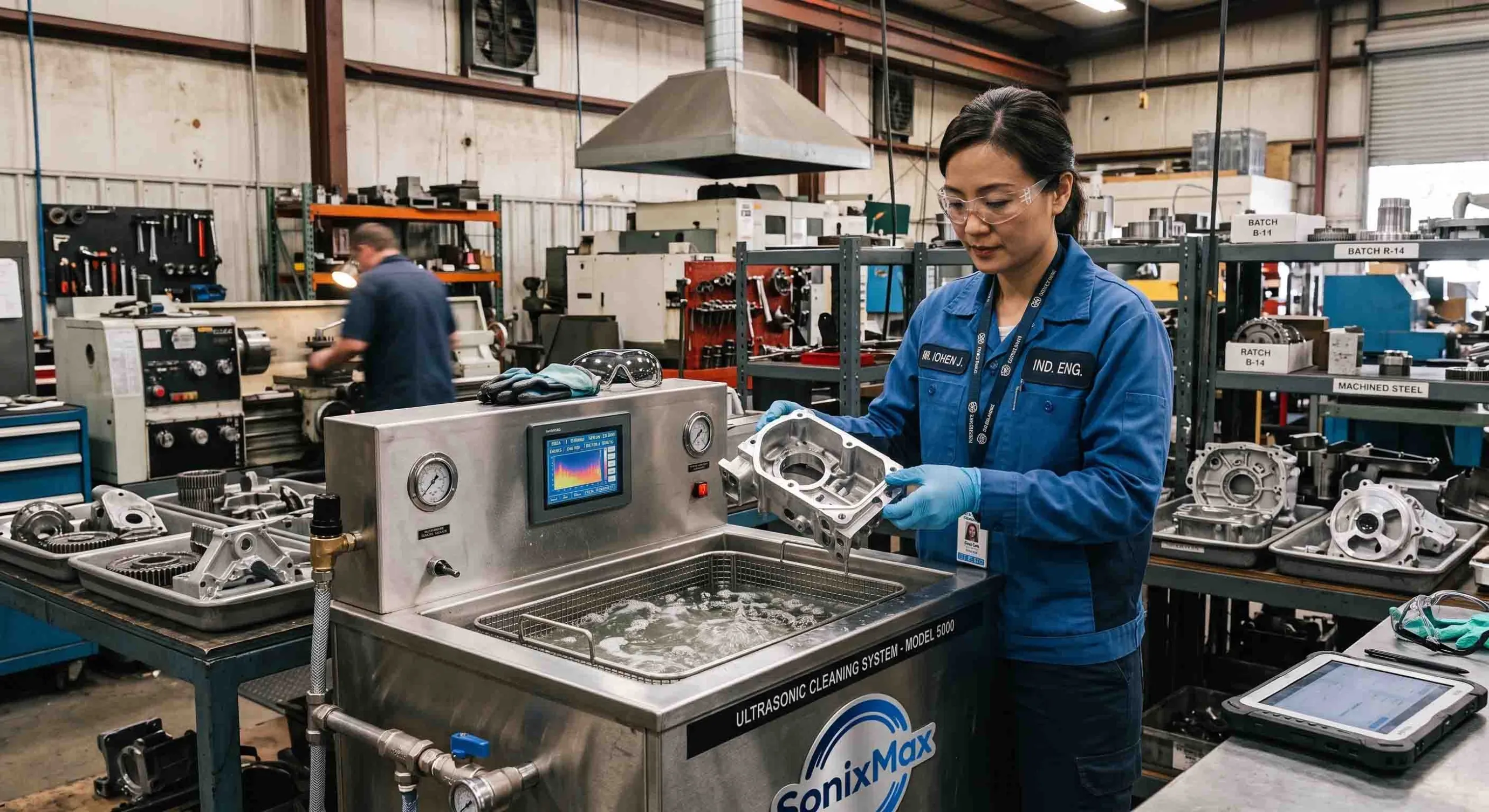
Selecting an industrial ultrasonic cleaner is not simply a matter of choosing a machine with the largest tank or the highest power rating.
For modern manufacturers, the right cleaning system must act as an integrated part of the production process. The components being cleaned, the nature of the contamination, the required throughput, and downstream processes all dictate the final equipment configuration.
Many companies experience bottlenecks or high rejection rates after purchasing cleaning equipment because the machine was selected based on generic specifications rather than the actual engineering requirements of their workflow. A system designed for heavy engine block maintenance will not perform well for high-precision CNC turned parts.
This guide explains how production managers and engineers can evaluate their specific requirements to configure and select a suitable industrial ultrasonic cleaning solution.
1. Evaluate Your Parts and Geometries First
Before looking at machine specifications, manufacturers must analyze the physical characteristics of their parts. The cleaning equipment should always be engineered around the component.
Traditional cleaning methods, such as high-pressure spray washing, suffer from "line-of-sight" limitations. If the spray cannot directly hit a surface, it cannot clean it. Furthermore, when cleaning components with blind holes or complex internal channels, traditional liquid flow often creates air pockets (air locks) that prevent the cleaning solution from reaching the contamination.
Ultrasonic cleaning solves this by utilizing cavitation—microscopic bubbles that form and collapse in the liquid, creating mechanical scrubbing action wherever the fluid can penetrate.
When evaluating your parts for ultrasonic cleaning, consider:
- Material hardness: Soft metals like aluminum may require different ultrasonic frequencies compared to cast iron or steel to prevent surface damage.
- Geometries: The presence of deep blind holes, internal threads, or fine mesh structures.
- Weight and density: Dense, heavy loads absorb more ultrasonic energy and require specific power considerations.
- Handling requirements: How parts will be loaded into baskets without masking each other (preventing the ultrasonic waves from reaching all surfaces).
2. Match the Contamination to the Cleaning Process
One of the most common mistakes in industrial cleaning projects is selecting the equipment before defining the chemistry and the process required to remove the specific soil.
Different contaminants react to ultrasonic cavitation in different ways:
- Machining Oils and Coolants: Typically require a combination of heat and alkaline cleaning solutions to emulsify the oils so they can be lifted away from the part surface.
- Polishing Compounds and Pastes: These are often particle-heavy and require aggressive cavitation to physically displace the abrasive particles from small crevices.
- Carbon Deposits: Require prolonged exposure to specific high-temperature chemistries alongside strong ultrasonic action.
The goal is not simply to ask, "How powerful should the machine be?" but rather, "What combination of temperature, chemistry, and ultrasonic energy will consistently break the bond between this specific contaminant and my part?"
3. Tank Sizing: Understanding Working Volume
Many buyers initially select equipment based on total tank volume (e.g., a 100-liter tank). However, in industrial applications, you cannot put 100 liters of parts into a 100-liter tank.
Engineers must calculate the Working Volume. To allow ultrasonic waves to propagate properly and for cavitation to occur uniformly, the parts basket must maintain a safe distance from the transducers (usually at the bottom) and the liquid surface.
When sizing your tank, ensure:
- There is a clearance of at least 3 to 5 centimeters between the basket and the tank walls/bottom.
- The liquid level covers the parts completely by at least 2 to 3 centimeters.
- The basket mesh is large enough to allow ultrasonic waves to pass through without reflecting the energy.
Choosing the right size is about ensuring sufficient cavitation space around your parts to maintain efficient, repeatable cycle times.
4. Selecting the Right Ultrasonic Frequency and Power
Ultrasonic frequency directly affects the physical size of the cavitation bubbles and the energy they release upon implosion.
Frequency Selection
- 28kHz: Produces longer wavelengths and larger cavitation bubbles. When these bubbles collapse, they release higher mechanical energy. This frequency is suitable for heavy industrial cleaning, such as removing thick greases from cast engine blocks or large steel molds. However, it can cause "cavitation pitting" (microscopic surface damage) on softer metals.
- 40kHz: Produces smaller bubbles that penetrate finer details, threads, and blind holes more effectively. It provides a more evenly distributed, gentler cleaning action. 40kHz is the industry standard for most CNC machined parts, automotive components, and general manufacturing applications.
Power Density (Watts per Liter)
For industrial cleaning, equipment is often evaluated on its power density. A general baseline for industrial applications is between 10 to 15 Watts per Liter. While heavy, densely packed parts may require higher power, simply maximizing the wattage does not guarantee better cleaning—it can sometimes lead to wasted energy or part damage if not paired with the correct frequency.
5. System Architecture: Single Tank vs. Multi-Stage Systems
The choice between a single-tank cleaner and a multi-tank system depends entirely on your production workflow and downstream requirements.
Single Tank Ultrasonic Cleaners
Suitable for maintenance workshops, low-volume batch processing, or applications where parts only require a basic wash without stringent rinsing requirements. Single tanks offer high flexibility and a smaller footprint.
- Recommended Solution: Industrial Single Tank Ultrasonic Cleaner
Multi-Tank Cleaning Systems
If your manufacturing process requires strict chemical residue control before moving to assembly, coating, or packaging, a multi-stage system is necessary. Dragging dirty chemistry onto a clean part defeats the purpose of the wash.
A typical industrial workflow includes:
- Ultrasonic Wash
- Ultrasonic or Agitation Rinse (to remove detergent residue)
- Rust Prevention (for carbon steel components)
- Hot Air Drying
- Recommended Solution: Multi-Stage Ultrasonic Cleaning Systems
6. Evaluating Auxiliary Features (Filtration and Drying)
Additional features should be selected based on total cost of ownership and production stability, rather than just buying a "fully loaded" machine.
Filtration and Oil Skimming
- The Problem: During continuous production runs, removed oils float to the top of the tank, and solid particles sink or suspend in the fluid. When parts are lifted out of the tank, they pass through this floating oil, leading to secondary contamination.
- The Solution: An overflow weir combined with a circulation filtration system.
- The Business Benefit: This continuously skims floating oils and removes suspended solids. It significantly extends the life of the cleaning chemistry (reducing wastewater disposal costs) and ensures that parts cleaned during the night shift meet the exact same quality standards as those cleaned during the morning shift.
Hot Air Drying
For components moving directly into rust-sensitive environments or final packaging, controlled drying is critical. Integrating a drying tank reduces manual handling, prevents flash-rusting on ferrous metals, and speeds up the overall production cycle.
7. Common Procurement Mistakes to Avoid
- Ignoring the Rinse Step: Focusing only on the wash tank, resulting in parts covered in dried chemical detergent.
- Specifying by Total Volume instead of Load Weight: Heavy loads absorb ultrasonic energy. A system must be powered for the weight of the parts, not just the volume of the water.
- Overlooking Material Handling: Failing to plan how operators will safely lift heavy baskets in and out of the fluid, leading to ergonomic issues or the need for automated hoists later.
8. Designing Your Custom Cleaning Solution
Industrial cleaning projects rarely fit into a one-size-fits-all box. The most cost-effective and reliable systems are those configured to match your specific factory environment.
At SonixMax, our engineering team helps manufacturers evaluate their complete workflow. By understanding your part dimensions, material substrates, contamination types, and throughput targets, we can help coordinate an equipment configuration that supports your production goals.
If you are evaluating equipment for your facility, contact our team with your part specifications or cleaning challenges to discuss the most suitable industrial cleaning architecture.