
Aug 15, 2026Buying Guides
Single-Tank vs Multi-Tank Ultrasonic Cleaners: How to Choose the Right System
Compare single-tank and multi-tank ultrasonic cleaners and learn how to choose the right system based on cleaning stages, rinsing, drying, production volume, and automation needs.
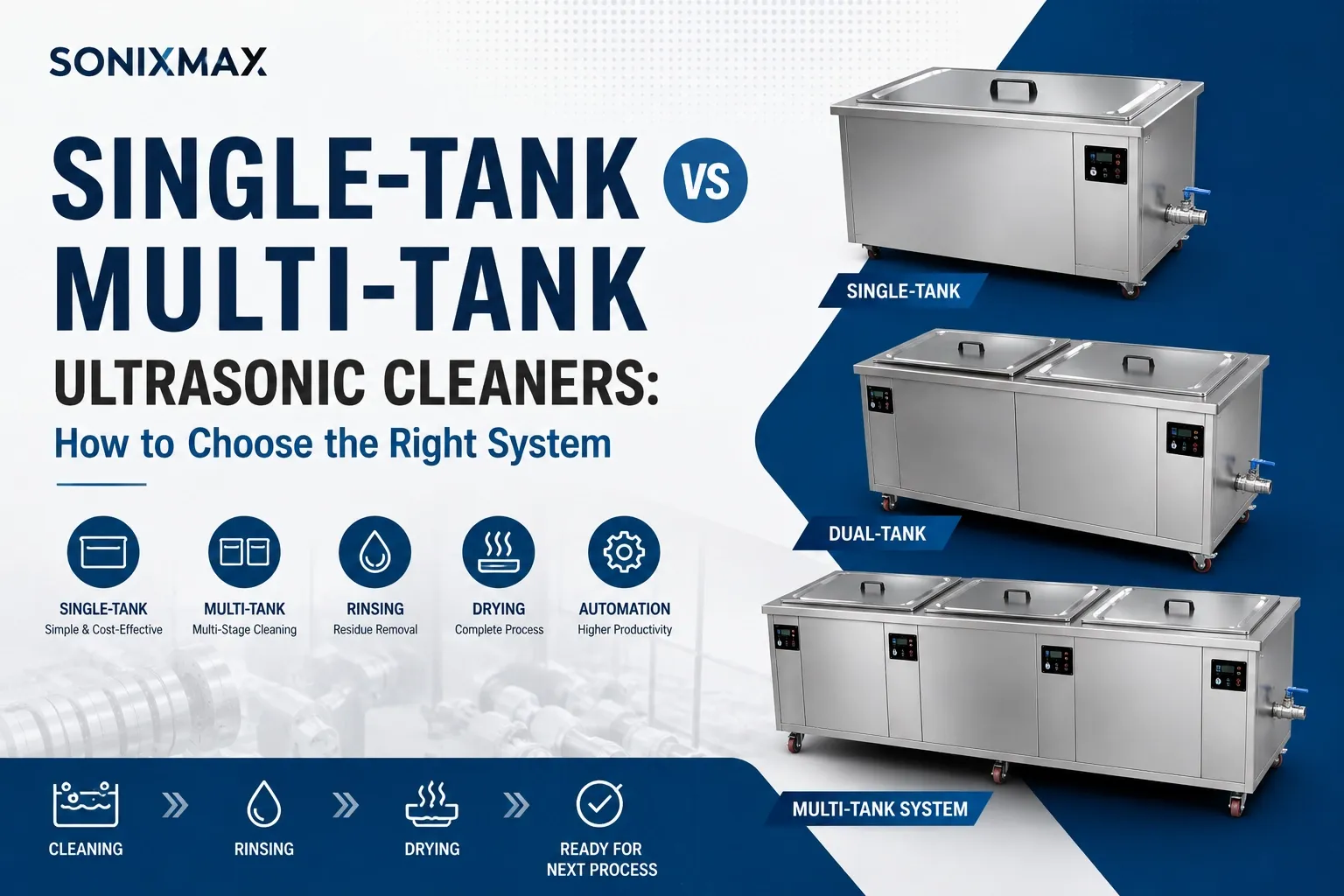
Choosing between a single-tank and multi-tank ultrasonic cleaner is not simply a question of machine size or the number of tanks.
The more important question is:
How many process stages does your cleaning application actually require?
For some industrial parts, one ultrasonic cleaning stage is enough. Other applications require separate rinsing, filtration, secondary cleaning, or drying before the parts can move to inspection, assembly, coating, packaging, or another production step.
This guide explains when a single-tank system is sufficient, when additional tanks become useful, and when a multi-stage or automated ultrasonic cleaning system should be considered.
Single-Tank vs Multi-Tank Ultrasonic Cleaners: What's the Difference?
A single-tank ultrasonic cleaner performs the main ultrasonic cleaning process in one tank. Depending on the application, heating, filtration, agitation, or automated lifting can also be integrated without adding another process tank.
A multi-tank ultrasonic cleaning system separates cleaning, rinsing, drying, or other treatment steps into dedicated tanks.
The main difference is therefore not simply the number of tanks—it is the number of controlled process stages.
| Single-Tank Ultrasonic Cleaner | Multi-Tank Ultrasonic Cleaner |
|---|---|---|
Main Process | Ultrasonic cleaning in one tank | Multiple dedicated treatment stages |
Rinsing | Separate or manual if required | Can be integrated |
Drying | Usually separate if required | Can be integrated |
Filtration | Can be integrated | Can be applied to selected stages |
Operation | Simple batch operation | Multi-stage batch processing |
Footprint | Smaller | Larger |
Best For | Simpler cleaning workflows | Cleaning processes requiring multiple controlled stages |
Neither configuration is automatically better. The right choice depends on what needs to happen to the parts before, during, and after ultrasonic cleaning.
When Is a Single-Tank Ultrasonic Cleaner Enough?
A single-tank ultrasonic cleaner is often suitable when the main objective is to remove oil, grease, machining coolant, carbon deposits, metal particles, polishing compounds, or other production contamination in one primary cleaning stage.
For example, a manufacturer cleaning machined components before general inspection may only require:
Loading → Ultrasonic Cleaning → Unloading
This keeps the process simple and reduces unnecessary equipment footprint.
A single-tank system can also incorporate heating, filtration and circulation, agitation, automated lifting, or customized ultrasonic configurations when additional process control is required.
This means a more demanding cleaning application does not automatically require multiple tanks.
When Should Filtration Be Added to a Single-Tank Cleaner?
Filtration is useful when oil, particles, metal debris, or other contaminants accumulate in the cleaning solution during repeated batch cleaning.
A single-tank ultrasonic cleaner with filtration circulates the cleaning solution through a filtration system before returning it to the tank. This can help manage suspended contamination and maintain the cleaning solution during production.
Filtration does not necessarily require another process tank. If the parts only require ultrasonic cleaning and do not need a separate rinsing or drying stage, a single tank with filtration may still be the more appropriate configuration.
When Should You Choose a Dual-Tank Ultrasonic Cleaner?
A second tank becomes useful when the parts require another clearly separated process after ultrasonic cleaning.
A common configuration is:
Ultrasonic Cleaning → Rinsing
The first tank removes contamination, while the second tank helps remove residual cleaning solution and loosened contaminants from the part surface.
A dual-tank system can also be configured for cleaning + drying, two different cleaning stages, or another secondary treatment. The appropriate arrangement depends on the cleaning chemistry, required surface condition, and downstream production process.
If cleaning and post-cleaning treatment need to be kept separate, a dual-tank ultrasonic cleaner can provide a more controlled workflow than performing several operations in one tank.
When Does a Triple-Tank Ultrasonic Cleaning System Make Sense?
A triple-tank ultrasonic cleaner is useful when three separate process stages are required.
One common configuration is:
Ultrasonic Cleaning → Rinsing → Drying
Other applications may use:
Ultrasonic Cleaning → First Rinsing → Second Rinsing
or:
Ultrasonic Cleaning → Ultrasonic Rinsing → Drying
The configuration should follow the actual process requirement rather than a fixed tank arrangement.
Triple-tank systems are particularly useful when cleaned parts need to proceed directly to inspection, assembly, coating, packaging, or another manufacturing step where residual cleaning solution or moisture needs to be controlled.
When Do You Need Four or More Process Tanks?
As cleaning requirements become more complex, additional tanks allow individual processes to be separated and controlled.
A multi-tank ultrasonic cleaning system may combine ultrasonic rough cleaning, fine cleaning, filtration, multiple rinsing stages, spray treatment, bubbling, air-knife dewatering, and hot-air drying.
For example:
Ultrasonic Cleaning → Rinsing → Secondary Rinsing → Drying
may be appropriate when the process requires an additional rinsing stage before drying.
Another system might use:
Ultrasonic Cleaning → Spray Treatment → Rinsing → Drying
The important point is that the number of tanks should follow the required cleaning process sequence. Adding more tanks does not automatically improve the cleaning result if the additional stages are not required.
Which Ultrasonic Cleaning System Should You Choose?
The following table provides a practical starting point:
Cleaning Requirement | Typical System Direction |
|---|---|
Basic ultrasonic cleaning | Single Tank |
Cleaning + solution filtration | Single Tank + Filtration |
Cleaning + agitation | Single Tank + Agitation |
Cleaning + rinsing | Dual Tank |
Cleaning + drying | Dual Tank |
Cleaning + rinsing + drying | Triple Tank |
Cleaning + multiple rinsing stages | Multi-Tank |
Cleaning + spray + rinsing + drying | Multi-Tank |
Multiple controlled process stages | Multi-Stage Cleaning System |
High-volume repetitive production | Automated Multi-Stage System |
These are typical configuration examples rather than fixed rules.
Two manufacturers cleaning similar components may require different systems if one part goes directly to general handling while the other must proceed to coating, precision assembly, or another controlled process.
For a broader overview of tank size, ultrasonic frequency, heating, filtration, and other selection factors, see our How to Choose the Right Industrial Ultrasonic Cleaner guide.
5 Factors to Consider Before Choosing
1. Part Size and Weight
Start with the maximum part dimensions, weight, quantity per batch, and required basket size. These factors determine the tank dimensions and also affect how parts should be loaded and transferred.
For larger or heavier components, lifting or automated handling may be more practical than repeated manual basket transfer.
2. Type of Contamination
Cutting oil, grease, carbon deposits, machining coolant, metal chips, polishing compounds, and fine particles can require different cleaning conditions.
The contamination should be evaluated together with the part material and geometry when selecting ultrasonic power, cleaning chemistry, filtration, agitation, and the number of process stages.
3. Required Cleanliness
A component cleaned for general maintenance may have very different requirements from a precision part that will immediately undergo coating, assembly, inspection, or another controlled process.
The relevant question is not simply whether the part looks clean, but whether its condition after cleaning is suitable for the next manufacturing step.
4. Production Capacity
For low or moderate batch volumes, manual loading and basket transfer may be practical. As production volume increases, repeatedly moving baskets between several tanks can become inefficient.
In these situations, automated lifting, manipulator transfer, conveyor transport, or PLC-controlled process sequences may be considered.
Tank configuration and automation level should be evaluated separately: a multi-tank system can still be manually operated.
5. What Happens After Cleaning?
The downstream process often determines whether additional tanks are necessary.
If the part only needs contamination removed before general handling, a single tank may be sufficient. If it needs rinsing before assembly, a second tank may be useful. If it must also be dried before coating, inspection, or packaging, a third or additional process stage may be required.
Thinking about the complete process is usually more useful than choosing equipment based on tank count alone.
When Should You Move to an Automated Cleaning Line?
Multi-tank does not automatically mean automated.
Automation becomes more relevant when production requires high daily throughput, repeated basket transfer, consistent process times, multiple cleaning and rinsing stages, or integration with an existing production line.
An automated ultrasonic cleaning system can combine PLC and HMI control with lifting, manipulator transfer, filtration, spray cleaning, rinsing, bubbling, dewatering, drying, or other processes according to the project.
For continuous manufacturing, a through-type ultrasonic cleaning line can move parts through cleaning, rinsing, dewatering, and drying stages using a conveyor system.
The decision to automate should therefore be based on production requirements and handling needs rather than simply on the number of tanks.
Typical Selection Examples
Application | Process Requirement | Possible System Direction |
|---|---|---|
Machined parts with cutting oil | Primary ultrasonic cleaning; filtration may be useful for repeated batches | Single Tank / Single Tank + Filtration |
Precision parts requiring rinsing | Cleaning followed by removal of residual cleaning solution | Dual Tank |
Parts requiring cleaning, rinsing and drying | Separate cleaning, rinsing and drying stages | Triple Tank |
Parts requiring several rinsing or treatment stages | Multiple controlled cleaning and post-cleaning processes | Multi-Tank |
High-volume repetitive production | Multiple stages with reduced manual transfer | Automated Multi-Stage System |
These examples are starting points. Actual equipment selection should also consider part dimensions, contamination, cleanliness requirements, production volume, and cleaning chemistry.
Frequently Asked Questions
Is a multi-tank ultrasonic cleaner always better than a single-tank system?
No. A multi-tank system provides additional process stages, but those stages are only useful when the application requires them. For a straightforward batch-cleaning process, a properly configured single-tank ultrasonic cleaner may be the more practical solution.
How many tanks do I need for ultrasonic cleaning?
The required number of tanks depends on the complete cleaning process. If only ultrasonic cleaning is required, one tank may be sufficient. If separate rinsing, drying, secondary rinsing, spray treatment, or other processes are required, additional tanks can be configured accordingly.
Do I need a rinsing tank after ultrasonic cleaning?
Not in every application. The need for rinsing depends on the cleaning chemistry, contamination, required surface condition, and what happens to the part after cleaning. A dedicated rinsing stage may be appropriate when residual cleaning solution needs to be removed before the next process.
Can a multi-tank ultrasonic cleaning system be automated?
Yes. Depending on production requirements, multi-tank systems can use manual basket transfer, automated lifting, manipulator transfer, conveyor systems, or PLC-controlled automation.
Not Sure How Many Tanks You Need?
The right industrial ultrasonic cleaning system should be selected around your parts and cleaning process, not simply around the number of tanks.
A straightforward application may only require a single ultrasonic cleaning tank, while another production process may require cleaning, filtration, rinsing, secondary rinsing, drying, and automated transfer.
To evaluate a suitable configuration, please provide:
- Part photos or drawings
- Part dimensions and weight
- Material
- Contamination type
- Quantity per batch or daily production capacity
- Required cleanliness
- Current cleaning process
- Required rinsing or drying process
- Voltage and destination country
SonixMax can evaluate your application and recommend whether a single-tank, dual-tank, multi-tank, or automated ultrasonic cleaning system is more suitable for your production process.