Oct 8, 2026Buying Guides
How Oral Care Brands Can Develop an Ultrasonic Retainer Cleaner
Learn how oral-care brands can develop an ultrasonic cleaner for retainers, aligners, dentures, and mouth guards, including appliance fit, water handling, UV-C options, packaging, and claims control.
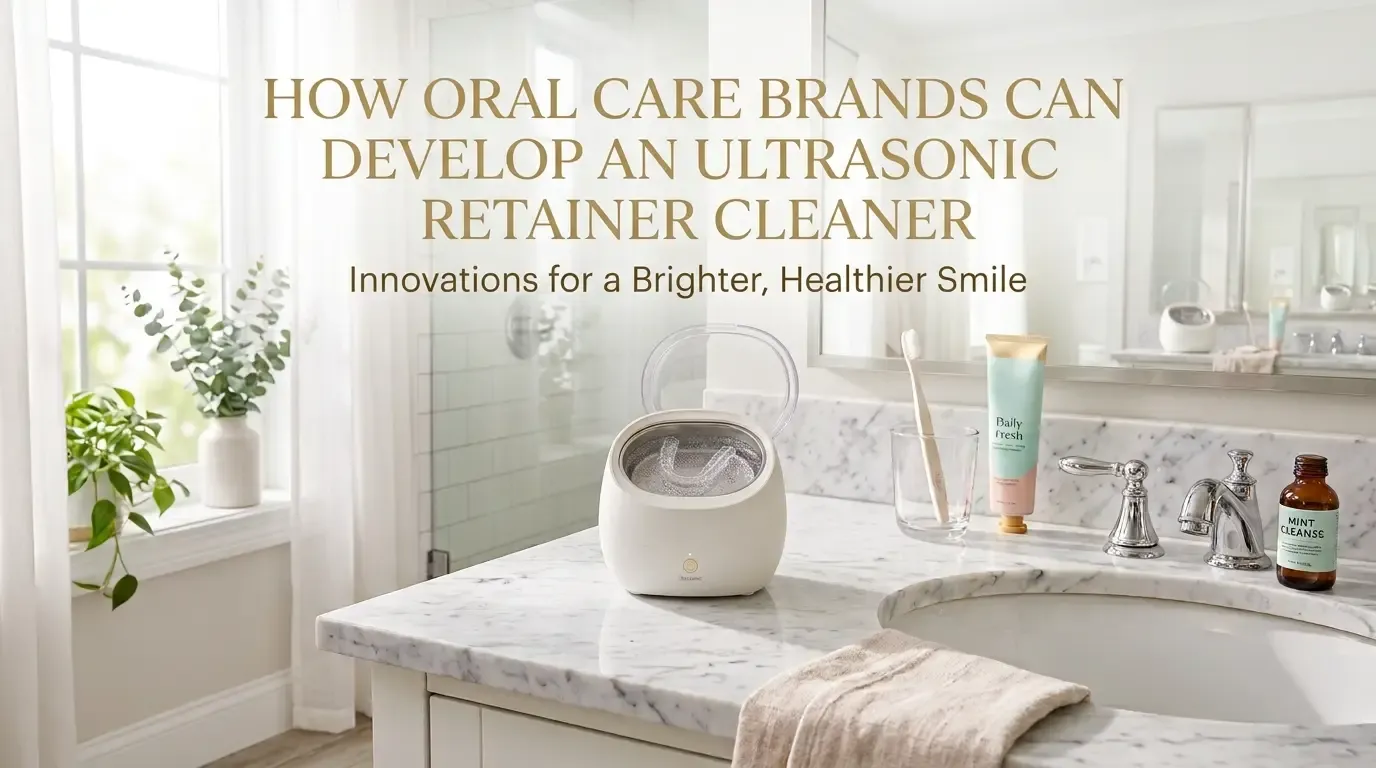
Oral-care products are used in daily routines. Retainers, aligners, dentures, mouth guards, and similar appliances are placed in the mouth, stored in cases, rinsed, cleaned, and reused again and again.
That makes cleaning convenience a major part of the customer experience.
For oral-care brands, an ultrasonic cleaner can become more than a small appliance. It can become a daily-use accessory that supports the brand’s hygiene positioning, product ecosystem, and aftercare experience.
The goal is not simply to add another device to the catalog. The goal is to choose or develop a cleaner that fits the customer’s appliance type, bathroom routine, packaging strategy, safety expectations, and sourcing route.
This guide explains how oral-care brands, retainer and aligner brands, dental accessory companies, ecommerce sellers, and private-label buyers can evaluate an ultrasonic cleaner product direction.
Quick Answer
Oral-care brands should develop an ultrasonic cleaner when the product fits the customer’s daily cleaning routine and appliance type.
For retainers, aligners, dentures, mouth guards, and similar oral appliances, the cleaner should be compact, easy to fill, easy to empty, simple to operate, and suitable for bathroom or sink-side use.
Important product decisions include tank size, appliance fit, lid design, water handling, splash-resistance expectations, cleaning mode simplicity, packaging, feature selection, and whether the project should use a standard platform, OEM customization, or deeper ODM development.
Brands should also be careful with hygiene-related claims. Product wording should be responsible and aligned with applicable documentation, testing, and destination-market requirements.
Beyond the Toothbrush: Why Oral-Care Brands Are Adding Ultrasonic Cleaning Devices
Many oral-care brands already sell products that require repeated cleaning.
A customer may use a retainer, aligner, denture, night guard, sports mouth guard, whitening tray, or other oral appliance every day. These items can collect saliva, residue, odor, and visible buildup over time.
Manual brushing is common, but it is not always ideal for every oral appliance. Aggressive brushing may create micro-scratches on clear retainers or aligners, making the surface appear cloudy over time and creating areas where residue can collect more easily.
This is where ultrasonic cleaning becomes commercially interesting.
An ultrasonic cleaner provides a non-abrasive cleaning method that can help loosen visible residue from suitable oral appliances without relying on hard manual scrubbing. For oral-care brands, this creates a natural aftercare opportunity.
Depending on the brand, an ultrasonic cleaner may be positioned as:
- a retainer care accessory
- an aligner cleaning device
- a denture care product
- a mouth guard cleaning accessory
- an ecommerce bundle item
- a dental-clinic retail product
- a private-label oral-care SKU
The product should be evaluated as part of the customer routine, not only as a small electronic appliance.
Define the Target Appliance: Retainers, Aligners, Dentures, or Mouth Guards
Before choosing a cleaner, define what the customer is expected to clean.
A retainer cleaner, aligner cleaner, denture cleaner, and mouth guard cleaner may look similar, but their user scenarios can differ.
Retainers and aligners are often used by orthodontic customers who want a quick daily routine. Denture users may care more about easy handling, tank access, and appliance size. Mouth guards may require more internal space depending on shape and thickness.
A product for one appliance type may not automatically fit another.
Before selecting a model, brands should check:
- appliance dimensions
- appliance shape
- whether one or two appliances need to fit
- whether the product is used at home, while traveling, or in a clinic setting
- whether the customer expects a compact device or a larger countertop unit
- whether accessories or cases are part of the user routine
The clearer the target appliance, the easier it is to choose the right product platform.
Daily-Use Routine Matters More Than Feature Count
For oral-care products, ease of use is more important than a long feature list.
Customers may use the cleaner every morning, every night, or after meals. If the product is difficult to fill, drain, wipe, charge, or store, the customer may stop using it even if the ultrasonic function works.
A good oral-care ultrasonic cleaner should support a simple routine:
- Add water or cleaning liquid according to the brand’s guidance.
- Place the appliance inside the tank.
- Start a short cleaning cycle.
- Remove, rinse, and dry the appliance as needed.
- Empty and wipe the tank when appropriate.
The cleaner should feel easy, hygienic, and low-friction.
This is why product design should focus on daily handling, not only technical functions. A complicated interface may look more advanced in a catalog, but household users often prefer simple operation.
Sink-Side Design: Tank Shape, Footprint, and Water Handling
Tank design is one of the most important product decisions for oral-care ultrasonic cleaners.
The tank must fit the intended appliance comfortably. A small retainer may fit easily, but a denture, mouth guard, or larger appliance may require more usable internal space.
Nominal capacity is not enough. Brands should check real internal dimensions, tank shape, lid clearance, and whether the appliance can be placed and removed easily.
Water handling also matters because the product is usually used near a bathroom sink.
Brands should evaluate:
- whether the tank is easy to fill
- whether the tank is easy to empty
- whether water can spill during normal use
- whether the lid helps control splashing
- whether the product footprint fits bathroom counters
- whether the tank can be wiped or cleaned easily
- whether splash-resistance expectations need to be discussed
If the product is intended for sink-side use, splash resistance should be reviewed carefully. Some projects may discuss IPX-rated designs, such as splash-resistant structures, but this should be evaluated according to the actual product design, testing, and target market requirements.
These details influence customer satisfaction, reviews, and return risk.
Portability, Type-C Charging, and Travel Use
Some oral-care customers want a cleaner they can keep in the bathroom. Others may want a product that supports travel, dormitory use, business trips, or daily use outside the home.
This is especially relevant for clear aligner and retainer users, who may clean their appliances frequently and carry cases with them.
For portable product concepts, brands may consider:
- compact footprint
- lightweight body
- Type-C charging
- cordless or rechargeable design
- battery capacity
- charging safety
- travel-friendly lid design
- storage and carrying convenience
However, portability should be chosen based on the target customer. A countertop denture cleaner and a travel-oriented aligner cleaner may need different product directions.
Hygiene Positioning Without Overclaiming
Oral-care products are closely connected to hygiene, but brands should be careful with product claims.
An ultrasonic cleaner may help remove visible residue or support routine cleaning of suitable oral appliances. However, brands should avoid broad claims such as “sterilizes,” “kills all bacteria,” or “medical-grade disinfection” unless such claims are supported by appropriate testing, documentation, and regulatory review.
Responsible wording is important.
Safer positioning may focus on:
- daily cleaning routine
- oral-appliance care
- visible residue removal
- convenience
- non-abrasive cleaning support
- easy maintenance
- support for hygiene-related habits
If a brand wants to use words such as “sterilization,” “disinfection,” “kills bacteria,” or “medical-grade,” this may trigger additional regulatory, testing, labeling, or marketplace review in some destination markets. For UV-related or antimicrobial claims, documentation and claim wording should be discussed early.
Claims should match the product’s actual function, cleaning method, documentation, and destination-market requirements.
UV-C, Cleaning Modes, and Feature Selection
Some oral-care ultrasonic cleaners include additional features such as UV-C, multiple cleaning modes, drying, or countdown displays.
These features can support premium positioning, but they should not be added automatically.
UV-C, in particular, should be evaluated carefully. If a brand wants to use UV-C as a product feature, it should consider user safety, product structure, documentation, labeling, and destination-market requirements. The wording around UV-C should also be controlled so the product does not make unsupported sterilization, disinfection, or medical claims.
Cleaning modes should be simple and understandable. Many customers do not need a complicated menu. A small number of clear cycles may be better than many options that create confusion.
Before adding features, ask:
- Does this feature solve a real customer problem?
- Can the user understand it easily?
- Does it affect safety, documentation, or labeling?
- Does it increase cost or complexity?
- Does it support the product positioning?
The best product is not always the one with the most functions. It is the one that fits the daily routine.
The Consumables Opportunity: Cleaning Tablets and Powders
For oral-care brands, the device itself may not be the only commercial opportunity.
An ultrasonic cleaner can become the center of a broader cleaning routine that includes cleaning tablets, cleaning powders, or branded cleaning solutions where appropriate.
This creates a product ecosystem:
- the cleaner supports daily use
- the consumable supports repeat purchase
- the brand stays connected to the customer after the initial device sale
For D2C and ecommerce brands, this can support higher customer lifetime value. For dental accessory brands, it can create a more complete oral-appliance care system.
However, consumables also require careful review. Ingredients, claims, packaging, storage, usage instructions, and destination-market requirements should be evaluated separately from the device.
The cleaner and consumable should work together as a practical routine, not as an overcomplicated system.
Packaging for Ecommerce, Dental Clinics, and Retail
Packaging for oral-care ultrasonic cleaners should match the sales channel.
A D2C or ecommerce product needs packaging that protects the cleaner during delivery while keeping dimensional weight and fulfillment cost under control.
A dental-clinic retail product may need clean, professional packaging that communicates appliance-care use clearly. A retail product may need stronger shelf visibility, application images, barcode placement, and multilingual information if required.
Packaging should make the use case obvious.
The customer should quickly understand whether the product is intended for retainers, aligners, dentures, mouth guards, or general oral-appliance care.
Useful packaging considerations include:
- clear product image
- appliance-care positioning
- compact package size
- protective inner structure
- barcode and label area
- plug or charging information
- destination-market language needs
- simple visual explanation of use case
Packaging should be discussed early, not treated as the final step.
Standard Platform, OEM Customization, or ODM Development
Not every oral-care brand needs a fully custom product at the beginning.
A standard platform can be suitable when the brand wants to test demand quickly or launch a product with lower development complexity.
OEM customization is useful when the product body mainly follows an existing platform, but the brand needs stronger identity through logo, packaging, user manual, label, product color, or accessory configuration. Product color and deeper visual changes may require higher order quantities than simple logo or packaging customization.
ODM development is more suitable when the brand needs deeper product-level differentiation. This may involve appearance, structure, capacity, function, tooling, or new product development.
For oral-care products, brands should be especially careful when requesting feature changes related to UV-C, charging, splash resistance, internal structure, or appliance fit. These changes can affect testing, documentation, safety review, and project timeline.
In simple terms, OEM is usually branding and light customization based on an existing product platform. ODM means the product itself may change more deeply.
For more detail on sourcing routes, see How to Source a Private Label Ultrasonic Cleaner for Your Brand.
Common Mistakes Oral-Care Brands Should Avoid
One common mistake is selecting a model only because it looks compact. The cleaner still needs to fit the intended appliance comfortably.
Another mistake is adding UV-C or multiple functions without thinking through documentation, user instructions, safety expectations, and claims control.
Brands should also avoid making broad hygiene or sterilization claims without the right support. Oral-care products require careful wording because customers may connect them with health and hygiene.
A fourth mistake is ignoring water handling. If the product is difficult to fill, empty, wipe, or place near a sink, the user experience may be weak.
A fifth mistake is forgetting the consumables strategy. If the brand plans to sell cleaning tablets, powders, or liquids, the device, consumable, packaging, and claims should be planned together.
Finally, brands should avoid over-customizing before market demand is clear. A standard or OEM product may be enough for initial launch, while deeper ODM development can be considered after the product direction is validated.
What Information to Send Before Requesting a Quote
Before requesting a quote for an ultrasonic retainer or aligner cleaner, prepare the basic product direction.
Information | Why It Matters |
|---|---|
Target appliance | Helps determine tank size, shape, and product positioning |
Target customer | Affects appearance, packaging, features, and price point |
Sales channel | Influences packaging, labeling, fulfillment, and retail presentation |
Branding needs | Determines logo, color, packaging, and accessory requirements |
Feature requirements | Helps evaluate UV-C, modes, charging, splash resistance, or other options |
Consumable plan | Helps evaluate whether tablets, powders, or liquids are part of the product ecosystem |
Expected order quantity | Helps determine whether standard, OEM, or ODM is suitable |
Destination market | Affects plug type, labeling, documentation, and packaging requirements |
Reference product or design direction | Helps clarify expected appearance and user experience |
A clear use case is more helpful than asking for every possible function.
What Sonixmax Can Help Evaluate
Sonixmax can help oral-care brands, ecommerce sellers, dental accessory companies, importers, and private-label buyers evaluate household ultrasonic cleaner product directions for retainers, aligners, dentures, mouth guards, and related oral appliances.
Depending on the project, Sonixmax can help review:
- suitable household ultrasonic cleaner platform
- tank size and usable internal dimensions
- appliance fit
- water handling direction
- logo and packaging direction
- product color options
- UV-C or feature options where applicable
- standard platform vs OEM customization
- whether deeper ODM development should be considered
- sample evaluation and product presentation
The goal is to develop an oral-care cleaning product that fits the customer routine, brand positioning, and sales channel.
Need Help Developing an Ultrasonic Retainer Cleaner?
If you are planning to develop an ultrasonic cleaner for retainers, aligners, dentures, mouth guards, or other oral-care accessories, send Sonixmax your project requirements.
Include your target appliance, customer group, sales channel, preferred product size, branding needs, expected order quantity, destination market, and any reference product if available.
Sonixmax can help evaluate a suitable household ultrasonic cleaner direction and recommend whether a standard platform, private-label project, OEM customization, or ODM development route is more appropriate.
For one existing product direction, see the 180mL Ultrasonic Cleaner for Retainers, Aligners & Dentures.