Oct 10, 2026Buying Guides
How Eyewear Brands Should Choose an Ultrasonic Cleaner for Glasses Care
Learn how eyewear brands, optical retailers, and private-label buyers should choose an ultrasonic cleaner for glasses care, including tank length, frame fit, coating caution, packaging, and OEM option
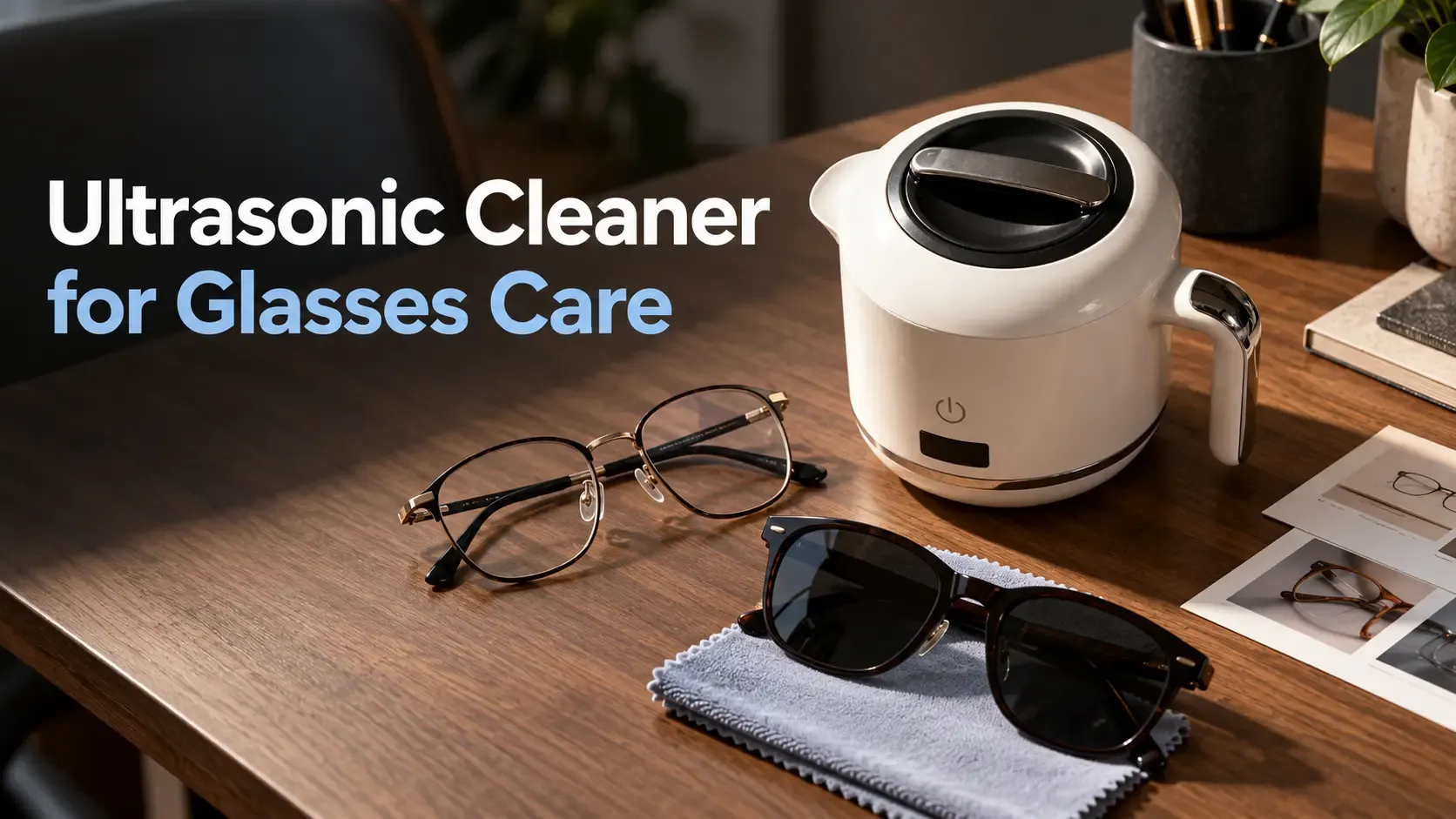
Eyewear brands are increasingly adding cleaning accessories to their product range, but choosing an ultrasonic cleaner for glasses is not as simple as selecting a small household machine.
A glasses-care product has to match real eyewear use: frame size, lens shape, coating sensitivity, customer habits, packaging, and brand positioning.
For eyewear brands, optical retailers, ecommerce sellers, and private-label buyers, the key question is not only:
Can this ultrasonic cleaner clean glasses?
The better question is:
Does this cleaner fit our eyewear products, customer experience, and brand risk level?
A cleaner that looks attractive in a catalog may still create problems if common frames do not fit, customers misunderstand the usage limits, or the product feels inconsistent with the eyewear brand.
This guide explains how eyewear brands should evaluate an ultrasonic cleaner before adding it to a glasses care product line.
Quick Answer
Eyewear brands should choose an ultrasonic cleaner based on usable tank length, frame fit, lens and coating caution, simple operation, easy water handling, and clear customer positioning.
The most important factor is not only tank capacity. A cleaner may look large enough by volume but still fail to fit common eyeglasses or sunglasses. Usable internal length and tank shape are often more important than the listed milliliter capacity.
Brands should also avoid presenting ultrasonic cleaning as suitable for every pair of glasses. Some lens coatings, decorative parts, glued components, damaged frames, or delicate materials may require caution.
For eyewear brands, the best ultrasonic cleaner is not the model with the longest feature list. It is the one that fits the target eyewear range, is easy for customers to use correctly, and supports the brand’s aftercare experience.
Why Eyewear Brands Add Ultrasonic Cleaners to Their Product Line
Eyewear is not only a functional product. It is also a personal accessory that customers wear every day.
Glasses collect fingerprints, skin oils, dust, cosmetics, sweat, and small particles around hinges, nose pads, lens edges, and frame grooves. These areas are difficult to clean thoroughly with a cloth alone.
For eyewear brands, an ultrasonic cleaner can become a useful aftercare product because it supports:
- daily glasses care
- optical store accessory sales
- ecommerce bundle offers
- premium eyewear maintenance kits
- customer retention after the first purchase
- private-label product expansion
Instead of selling only glasses, a brand can offer a more complete eyewear care routine.
However, the cleaner must be matched carefully to the actual glasses being cleaned. Poor fit, confusing operation, or unclear usage boundaries can create customer complaints instead of brand value.
Tank Length Matters More Than Stated Capacity
Many buyers first look at tank capacity, such as 300ml, 450ml, or 600ml.
For eyewear cleaning, this can be misleading.
A tank may have enough liquid volume but still be too short or too narrow for common frames. Sunglasses, oversized fashion frames, sports glasses, and curved frames may need more usable internal space than standard optical frames.
Before choosing a glasses ultrasonic cleaner, eyewear brands should check:
- usable internal tank length
- usable internal tank width
- tank depth
- whether common frames can lie naturally inside
- whether sunglasses or larger frames fit
- whether glasses touch the tank wall or lid
- whether the basket reduces usable space
This is especially important for brands selling fashion eyewear, sunglasses, or larger frame styles.
A small household ultrasonic cleaner may work for compact eyeglasses, but it may not support all eyewear categories. The machine should be tested with real target products, not judged only by capacity.
Lens, Coating, and Frame Compatibility Need Careful Positioning
Ultrasonic cleaning can help remove dirt from hard-to-reach areas, but eyewear brands should avoid presenting it as suitable for every pair of glasses.
Some glasses may include coatings, decorative finishes, glued parts, damaged frame joints, loose screws, delicate trims, or older materials. These details can affect whether ultrasonic cleaning is appropriate.
Brands should be especially cautious with:
- damaged or cracked lenses
- loose frame joints
- glued decorations or rhinestones
- fragile coatings
- painted or decorative surfaces
- specialty sunglasses
- antique or highly delicate frames
- frames with existing wear or peeling finish
This does not mean ultrasonic cleaning should be avoided completely. It means the brand should provide clear, responsible positioning.
A safer message is:
Ultrasonic cleaning can be useful for suitable eyewear, but customers should check lens coatings, frame condition, and care instructions before use.
This protects the brand from overclaiming and helps customers understand that glasses care depends on product condition and material.
Avoid Feature Creep in Glasses Care Products
For eyewear care, more features do not always create a better product.
A long feature list may look impressive, but every added function can increase cost, user confusion, packaging complexity, and after-sales questions.
For many eyewear brands, the most important user experience is simple:
- Open the lid.
- Add water.
- Place glasses inside.
- Start the cleaning cycle.
- Remove, rinse if needed, and wipe dry.
If the product includes too many modes, buttons, or technical claims, customers may not understand how to use it correctly.
Advanced functions should only be added when they support the product concept. For example, a compact eyewear care product may not need many cleaning modes if the target customer mainly wants a simple glasses cleaning routine.
A clear and easy-to-use product often creates a better customer experience than a complex product with features the customer does not understand.
Keep the User Experience Simple
Most eyewear customers do not want a technical cleaning device. They want a simple care accessory.
For glasses care, simplicity often matters more than advanced controls.
A good eyewear ultrasonic cleaner should be easy to:
- open and close
- fill with water
- place glasses inside
- start with minimal steps
- pour out water
- wipe and store after use
A complicated interface can reduce repeat usage. If the product has too many buttons or unclear modes, customers may stop using it after the first few tries.
The machine should feel like part of the customer’s eyewear care routine, not like a professional tool that needs explanation.
Appearance Should Match the Eyewear Brand
Eyewear brands often care deeply about visual identity.
An ultrasonic cleaner sold alongside glasses should not look like a generic industrial device. It should match the brand’s target market and retail positioning.
For a fashion eyewear brand, the cleaner may need a cleaner, more lifestyle-oriented appearance.
For an optical retail chain, the product may need a practical and professional look.
For an ecommerce brand, product photography, packaging, and perceived value may matter as much as the device itself.
Important appearance factors include:
- overall shape
- color direction
- lid design
- button design
- surface finish
- packaging style
- product photography compatibility
- whether the product looks giftable or retail-ready
A good eyewear cleaner should support the brand experience, not interrupt it.
Household Model or Commercial Model?
Not every eyewear buyer needs the same type of ultrasonic cleaner.
For consumer eyewear brands, a compact household ultrasonic cleaner may be suitable as a branded care accessory for customers.
For optical shops, service counters, or small professional settings, a commercial benchtop ultrasonic cleaner may be more appropriate, especially when staff clean glasses repeatedly during the day.
The difference is not only size. It is also about usage frequency, positioning, and buyer expectations.
Use Scenario | More Suitable Direction | Why |
|---|---|---|
Eyewear brand accessory | Household ultrasonic cleaner | Better for consumer packaging, gifting, and private-label retail |
Ecommerce bundle | Household ultrasonic cleaner | Easy to present as a glasses care product |
Optical store counter use | Commercial benchtop cleaner | More suitable for repeated professional use |
Distributor eyewear channel | Household or commercial range | Depends on buyer segments and sales channel |
Premium eyewear care kit | Household model with better appearance | Supports brand value and customer experience |
OEM and Private Label Considerations
Eyewear brands often do not need a fully new machine at the beginning.
A standard household ultrasonic cleaner platform with suitable branding may already be enough for early market testing.
Common private-label directions may include logo, packaging, label, color direction, and product presentation.
Deeper customization may involve structure, capacity, lid design, control layout, or a new product appearance. These changes require more careful evaluation because they may affect development time, MOQ, tooling, and validation.
For brands new to ultrasonic cleaners, it is usually better to start with a proven platform and adjust the branding, packaging, and product positioning first.
Common Mistakes Eyewear Brands Should Avoid
The first mistake is choosing by tank capacity alone. For glasses, internal length and frame fit matter more than the headline volume.
The second mistake is assuming one cleaner fits every eyewear product. Sunglasses, oversized frames, sports glasses, and delicate fashion frames may have different fit and care requirements.
The third mistake is making broad safety claims. Brands should avoid suggesting that ultrasonic cleaning is suitable for all lenses, all coatings, or all frames.
The fourth mistake is overcomplicating the product. Too many buttons, modes, or claims may make the cleaner harder for customers to understand.
The fifth mistake is treating packaging as an afterthought. For eyewear brands, packaging strongly affects perceived value, giftability, and ecommerce presentation.
What Information to Prepare Before Requesting a Quote
Before requesting an eyewear ultrasonic cleaner quotation, brands should prepare the basic product direction.
Information | Why It Matters |
|---|---|
Target eyewear type | Helps evaluate tank length, width, and product positioning |
Typical frame dimensions | Confirms whether glasses fit naturally inside the tank |
Sunglasses or optical frames | Larger sunglasses may need more usable space |
Sales channel | Affects packaging, product presentation, and configuration |
Brand positioning | Helps determine appearance, color, and packaging direction |
Expected customization | Clarifies logo, packaging, color, or deeper ODM needs |
Target market | Affects plug type, labeling, documentation, and packaging requirements |
Estimated order quantity | Helps determine whether standard, OEM, or ODM is realistic |
Reference products | Helps communicate appearance and user experience expectations |
Clear product information helps the supplier recommend a more suitable direction instead of guessing from a general inquiry.
What Sonixmax Can Help Evaluate
Sonixmax can help eyewear brands, optical retailers, ecommerce sellers, importers, and private-label buyers evaluate whether a household or commercial ultrasonic cleaner is suitable for glasses care.
Depending on the project, Sonixmax can help evaluate:
- usable tank size for target eyewear
- whether compact household models are suitable
- whether a commercial benchtop model is more appropriate
- product range direction for eyewear or optical channels
The goal is not simply to add another accessory. The goal is to choose a glasses care product that fits the eyewear, the customer routine, and the brand.
Need Help Choosing an Ultrasonic Cleaner for Your Eyewear Brand?
If you are developing an ultrasonic cleaner for glasses care, send Sonixmax your target eyewear type, typical frame dimensions, sales channel, branding needs, expected order quantity, and target market.
Sonixmax can help evaluate whether a household ultrasonic cleaner, commercial benchtop cleaner, or customized product direction is more suitable for your eyewear care project.