Automatic series
Through-Type 8-Stage Industrial Ultrasonic Cleaning Line with Continuous Conveyor
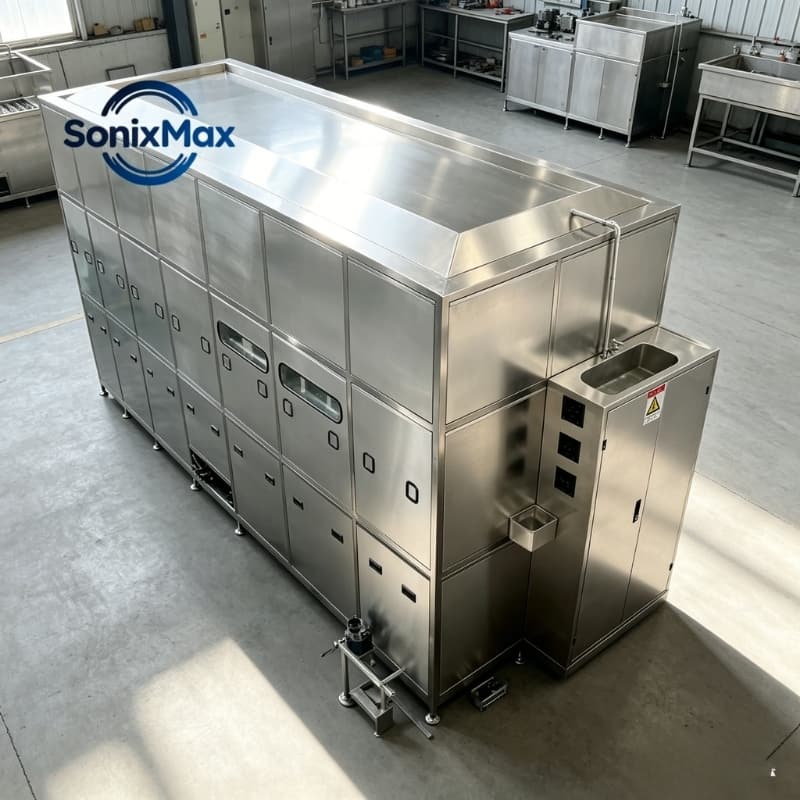
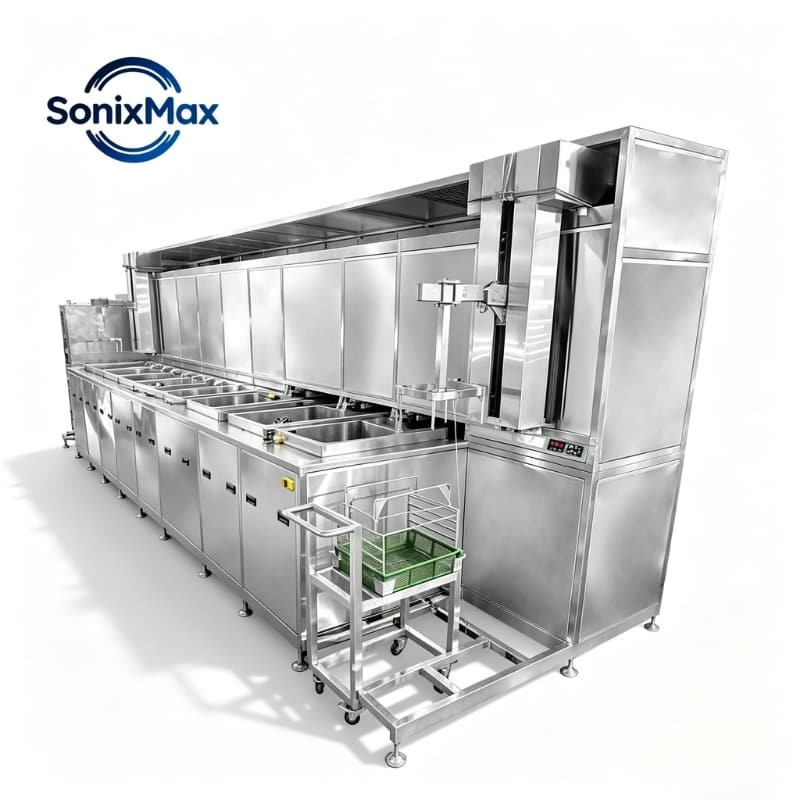
Through-type 8-stage industrial ultrasonic cleaning line for continuous in-line production. It combines 28/40kHz ultrasonic cleaning, heated soaking, spray cleaning and rinsing, air-knife dewatering, and hot-air drying with automatic conveyor transfer. The reference system provides 6000W total ultrasonic power and SUS316L process tanks, with the process configuration customizable for different parts and production requirements.
Continuous Cleaning for In-Line Production
For repeated or high-volume production, manually transferring parts between separate cleaning, rinsing, and drying equipment can interrupt the manufacturing workflow.
A through-type system arranges the required processes along one continuous conveyor path.
Parts enter from the loading side and pass through eight treatment stages:
Ultrasonic Cleaning → Heating / Soaking → Ultrasonic Cleaning → Spray Cleaning → Ultrasonic Fine Cleaning → Spray Rinsing → Air Knife Dewatering → Hot Air Drying
After the final drying stage, the workpieces exit from the unloading side and can proceed to inspection, assembly, coating, packaging, or other downstream operations.
This configuration is particularly suited to parts that can be continuously transported through a defined cleaning process.
8-Stage Working Process
Stage | Process | Main Purpose |
|---|---|---|
Tank 1 | Ultrasonic Cleaning | Primary ultrasonic treatment with heating |
Tank 2 | Heating / Soaking | Heated immersion treatment |
Tank 3 | Ultrasonic Cleaning | Secondary ultrasonic treatment |
Tank 4 | Spray Cleaning | Directed spray treatment |
Tank 5 | Ultrasonic Fine Cleaning | 40kHz ultrasonic fine-cleaning stage |
Tank 6 | Spray Rinsing | Spray rinsing after ultrasonic treatment |
Tank 7 | Air Knife Dewatering | Surface-water removal before drying |
Tank 8 | Hot Air Circulation Drying | Final heated-air drying |
Working Process:
Loading → #1 Ultrasonic Cleaning → #2 Heating / Soaking → #3 Ultrasonic Cleaning → #4 Spray Cleaning → #5 Ultrasonic Fine Cleaning → #6 Spray Rinsing → #7 Air Knife Dewatering → #8 Hot Air Circulation Drying → Unloading
The process above represents this reference 8-stage configuration. Process stages, treatment time, conveyor arrangement, and other parameters can be engineered according to the workpiece and production requirements.
How the Through-Type Cleaning Line Works
Unlike multi-tank systems that require baskets to be transferred manually or by an overhead manipulator, this system transports workpieces continuously through the complete cleaning process using an integrated conveyor.
The conveyor carries the parts sequentially through ultrasonic treatment, heated soaking, spray treatment, rinsing, dewatering, and drying.
Conveyor speed can be adjusted according to the required treatment time and production throughput.
This creates a continuous process from loading to unloading while keeping the individual cleaning functions separated into dedicated treatment stages.
Core System Features
Continuous Herringbone Conveyor
The system uses a stainless-steel herringbone conveyor to transport workpieces through the eight treatment stages.
The conveyor is driven by a 400W, 200:1 horizontal geared motor, with a torque limiter installed at the drive shaft to provide transmission protection.
The conveyor speed is adjustable according to the required treatment time and production capacity.
28kHz + 40kHz Ultrasonic Treatment
Different ultrasonic frequencies are used at different stages of the reference cleaning process.
- Tank 1: 28kHz
- Tank 3: 28kHz
- Tank 5: 40kHz
The initial stages use 28kHz ultrasonic treatment, while Tank 5 uses 40kHz for the later fine-cleaning stage.
This allows different ultrasonic stages to perform different functions within the complete cleaning sequence.
6000W Multi-Stage Ultrasonic System
The reference system contains five ultrasonic vibration plates:
- Tank 1: 3 × 1200W
- Tank 3: 1 × 1200W
- Tank 5: 1 × 1200W
Total ultrasonic power is 6000W.
Independent Ultrasonic Generators
The ultrasonic system uses independent generators, with ultrasonic power adjustable according to the production process and cleaning requirements.
This allows the ultrasonic operating parameters to be configured around different treatment stages rather than relying on one common power setting.
Heated Cleaning & Soaking
Tank 1 provides 9kW heating power during the initial ultrasonic cleaning stage.
Tank 2 provides an additional 6kW heated soaking stage.
The remaining treatment tanks do not use process heating in the reference configuration, except for the dedicated hot-air drying system in Tank 8.
Spray Cleaning & Spray Rinsing
The system includes two dedicated spray stages:
- Tank 4 — Spray Cleaning
- Tank 6 — Spray Rinsing
This allows spray treatment to be positioned between the ultrasonic stages and again before dewatering and drying.
Air Knife Dewatering
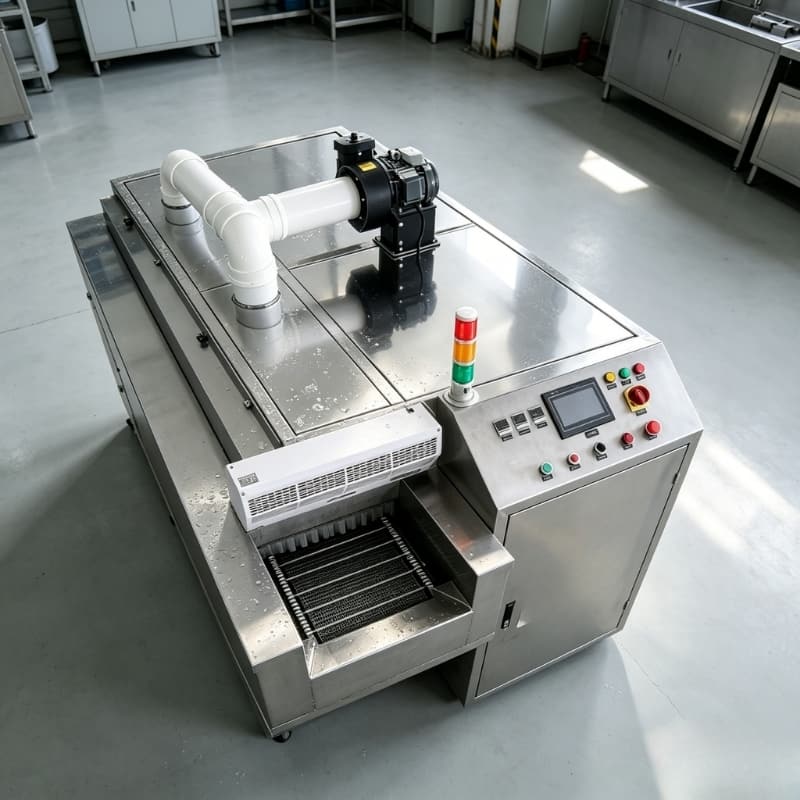
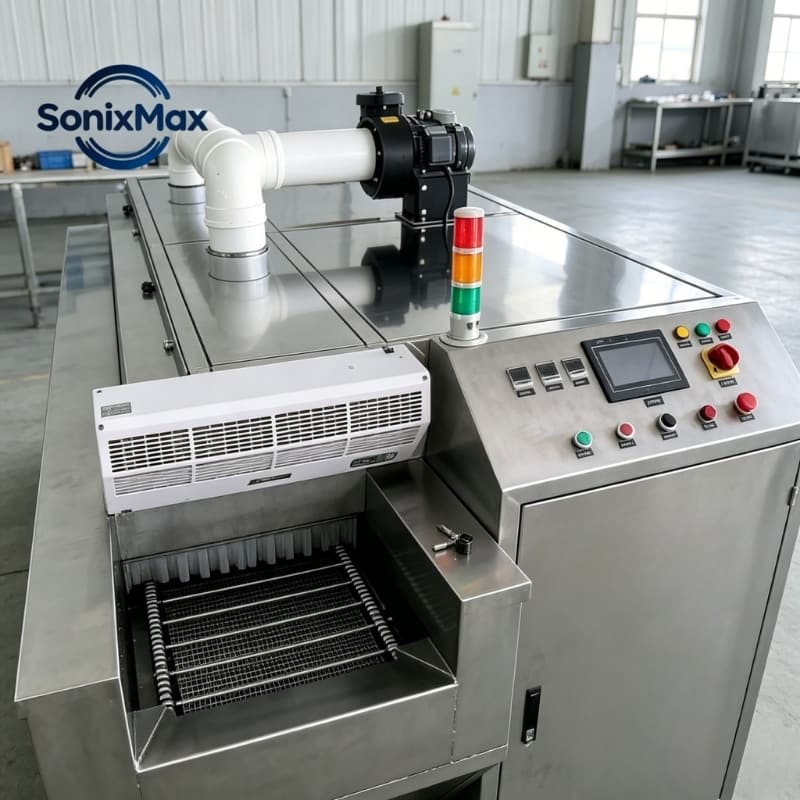
Tank 7 uses an air-knife system to remove surface water after rinsing.
This provides a separate dewatering step before the parts enter the final heated drying section.
Hot Air Circulation Drying
Tank 8 uses circulating hot air for final drying.
The system is equipped with two 9kW air heaters, providing 18kW total drying power.
Internal air circulation recirculates the heated airflow through the drying section before the workpieces leave the production line.
SUS316L Process Tanks
The tanks in this reference system are manufactured from SUS316L stainless steel.
For customized projects, tank material can be selected according to cleaning chemistry, operating conditions, and process requirements.
Torque-Limited Conveyor Drive
A torque limiter is installed at the conveyor drive shaft.
This provides mechanical protection for the transmission system if abnormal resistance or obstruction occurs during conveyor operation.
Technical Data & Specifications
Stage | Function | Configuration | Frequency | Power / Heat |
|---|---|---|---|---|
Tank 1 | Ultrasonic Cleaning | 3 Vibration Plates + Independent Generators | 28kHz | 3600W Ultrasonic / 9kW Heating |
Tank 2 | Heating / Soaking | Heated Immersion Tank | — | 6kW Heating |
Tank 3 | Ultrasonic Cleaning | 1 Vibration Plate + Independent Generator | 28kHz | 1200W Ultrasonic |
Tank 4 | Spray Cleaning | Spray Cleaning System | — | Pump Driven |
Tank 5 | Ultrasonic Fine Cleaning | 1 Vibration Plate + Independent Generator | 40kHz | 1200W Ultrasonic |
Tank 6 | Spray Rinsing | Spray Rinsing System | — | Pump Driven |
Tank 7 | Air Knife Dewatering | Air Knife System | — | Air Supply |
Tank 8 | Hot Air Circulation Drying | Internal Circulating Air Supply | — | 18kW (2 × 9kW) |
General Specifications
Item | Specification |
|---|---|
Overall Size | 10050 × 1300 × 1800 mm |
Process Stages | 8 |
Conveyor Type | Stainless-Steel Herringbone Conveyor |
Conveyor Speed | Adjustable |
Conveyor Center Distance | 350 mm |
Drive Motor | 400W / 200:1 Horizontal Geared Motor |
Drive Protection | Torque Limiter |
Tank Material | SUS316L Stainless Steel |
Ultrasonic Frequencies | 28kHz / 40kHz |
Ultrasonic Vibration Plates | 5 |
Power per Vibration Plate | 1200W |
Total Ultrasonic Power | 6000W |
Process Heating Power | 15kW |
Hot Air Drying Power | 18kW |
Combined Process Heating & Drying Load | 33kW |
Ultrasonic Generator | Independent Generators / Adjustable Power |
Drying Process | Air Knife + Hot Air Circulation |
The specifications above represent this through-type cleaning-line configuration. Tank dimensions, conveyor arrangement, ultrasonic power, frequency, spray system, drying configuration, and electrical requirements can be adapted according to the project.
Typical Applications
The through-type configuration is intended for industrial parts that can be continuously transported through a fixed multi-stage cleaning process.
Application | Typical Cleaning Requirement |
|---|---|
Automotive Components | Oil, machining residue and particles |
Fasteners & Hardware | Continuous cleaning of repeated production quantities |
CNC Machined Parts | Cutting oil, coolant and machining particles |
Precision Metal Components | Multi-stage cleaning and rinsing |
Electronic Housings | Process residue on manufactured housings and metal parts |
Die-Cast Components | Oil and manufacturing contamination |
Stamped Components | Lubricants and production residue |
Industrial Metal Parts | In-line cleaning before downstream processes |
Actual suitability should be evaluated according to part dimensions, geometry, material, contamination, conveyor loading method, required cleanliness, and production capacity.
When a Through-Type Cleaning Line Is Suitable
A through-type cleaning line is particularly useful when the cleaning process needs to operate as part of a continuous manufacturing workflow.
It can be considered when:
- Similar parts are processed repeatedly
- Workpieces can be transported continuously through the equipment
- Multiple cleaning and rinsing stages are required
- Manual transfer between individual machines should be reduced
- Cleaning needs to connect with upstream or downstream production
- Production throughput is an important equipment-selection factor
For large basket loads, highly variable workpieces, or processes requiring independently controlled dwell times in different tanks, other multi-tank automation arrangements may be more suitable.
Custom Project Engineering
The reference machine uses an 8-stage configuration, but the final through-type cleaning line can be engineered around the workpiece, cleaning process, and required production capacity.
Engineering Area | Available Configuration |
|---|---|
Conveyor System | Width, speed, loading arrangement and drive configuration |
Process Stages | Ultrasonic cleaning, soaking, spray cleaning, rinsing, dewatering and drying |
Tank Dimensions | Customized according to workpiece size and cleaning capacity |
Ultrasonic Power | Configured according to tank capacity and cleaning requirements |
Ultrasonic Frequency | 20 / 25 / 28 / 35 / 40 / 60 / 68 / 80 / 168 / 200kHz options |
Ultrasonic Direction | Bottom or bottom + side ultrasonic installation |
Ultrasonic Generator | Separate or integrated configuration |
Tank Material | SUS304 / SUS316 or project-specific stainless steel |
Outer Panel | Brushed or mirror-finish stainless steel |
Liquid Management | Filtration and circulation where required |
Spray System | Spray cleaning and rinsing configuration |
Dewatering | Air-knife configuration |
Drying | Hot-air circulation |
Process Control | PLC and production-line control |
Loading / Unloading | Application-specific handling arrangement |
Factory Layout | Equipment arrangement and line direction |
Electrical System | Destination-specific voltage and electrical configuration |
Branding | Authorized private-label branding available |
The final configuration should be selected according to the actual process rather than by adding unnecessary functions.
Ultrasonic Configuration Options
For customized through-type cleaning systems, the ultrasonic system can be adapted according to tank capacity, workpiece size, geometry, and cleaning requirements.
Ultrasonic Power
Ultrasonic power can be configured according to tank capacity and the required cleaning process.
Larger treatment volumes generally require a corresponding ultrasonic system configuration rather than simply applying the reference-machine power.
Frequency Selection
Available ultrasonic frequency options include:
20 / 25 / 28 / 35 / 40 / 60 / 68 / 80 / 168 / 200kHz
The appropriate frequency should be selected according to the workpiece, contamination, material, geometry, and cleaning requirements.
Ultrasonic Installation Direction
Ultrasonic treatment can be configured from:
- Bottom
- Bottom + sides
Bottom-mounted ultrasonic treatment is commonly used, while additional side-mounted ultrasonic transducers can be considered for larger or more complex workpieces.
Generator Configuration
Separate and integrated ultrasonic-generator configurations are available depending on the system design and project requirements.
How We Configure a Through-Type Cleaning Line
Workpiece
Part dimensions, material, geometry, orientation, and weight determine conveyor dimensions, loading arrangement, and suitable transport method.
Contamination
Machining oil, coolant, grease, particles, polishing residue, and other process contamination influence the ultrasonic, heating, filtration, and spray configuration.
Cleaning Requirement
Required cleanliness and downstream processes determine the required ultrasonic stages, rinsing sequence, cleaning chemistry, and treatment time.
Production Throughput
Required production capacity, part spacing, loading density, and treatment time are used to determine conveyor configuration and overall line design.
Drying Requirement
Part geometry and retained water influence the required air-knife and hot-air drying configuration.
Production-Line Integration
Loading height, unloading position, line direction, available floor space, utilities, electrical requirements, and connection with upstream or downstream equipment should be considered during system design.
Project Technical Support
SonixMax supports through-type cleaning projects from initial process evaluation through system configuration and technical coordination.
Project support can include:
- Cleaning process evaluation
- Process-flow configuration
- Ultrasonic system selection
- After-sales technical coordination
Frequently Asked Questions
Why does this system use both 28kHz and 40kHz?
The reference configuration uses 28kHz in Tanks 1 and 3 for the initial ultrasonic treatment stages and 40kHz in Tank 5 for subsequent fine cleaning.
Using separate frequencies allows different ultrasonic stages to perform different functions within the complete cleaning sequence.
How much ultrasonic power does the system provide?
The reference configuration provides 6000W total ultrasonic power across five vibration plates:
- Tank 1: 3600W
- Tank 3: 1200W
- Tank 5: 1200W
Each vibration plate is rated at 1200W.
Is the conveyor speed adjustable?
Yes. Conveyor speed can be adjusted according to the required treatment time and production throughput.
The exact operating range should be determined according to the final conveyor and production-line configuration.
Can other ultrasonic frequencies be used?
Yes. Frequency selection can be adapted according to the application.
Available options include 20, 25, 28, 35, 40, 60, 68, 80, 168, and 200kHz, while the reference machine uses 28kHz and 40kHz.
Why use air-knife dewatering before hot-air drying?
Air-knife dewatering removes surface water before the parts enter the heated drying section.
The following hot-air circulation stage then provides the final drying treatment.
Can the conveyor and tank dimensions be customized?
Yes. Conveyor dimensions, tank dimensions, loading arrangement, ultrasonic configuration, and overall line layout can be engineered according to the workpiece and required production capacity.
Request a Cleaning Solution
To configure a through-type ultrasonic cleaning line for your production process, please provide your part drawings or photos, dimensions, material, contamination, required cleanliness, production capacity, current cleaning process, loading method, available factory space, voltage, and destination country.
SonixMax can then evaluate the appropriate ultrasonic stages, conveyor configuration, cleaning and rinsing process, drying system, and overall line layout.