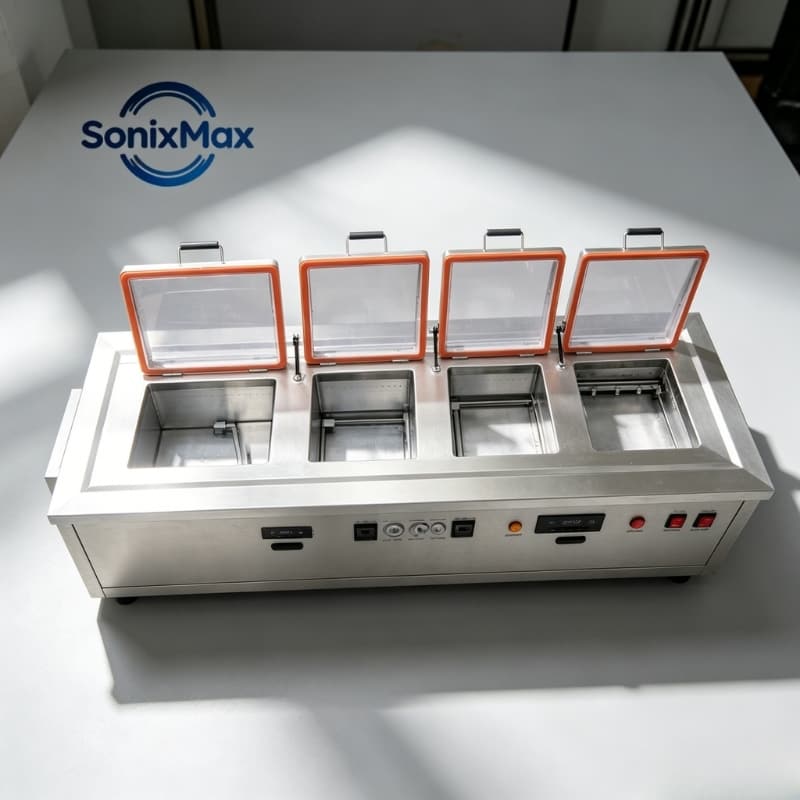
Multi-tank series
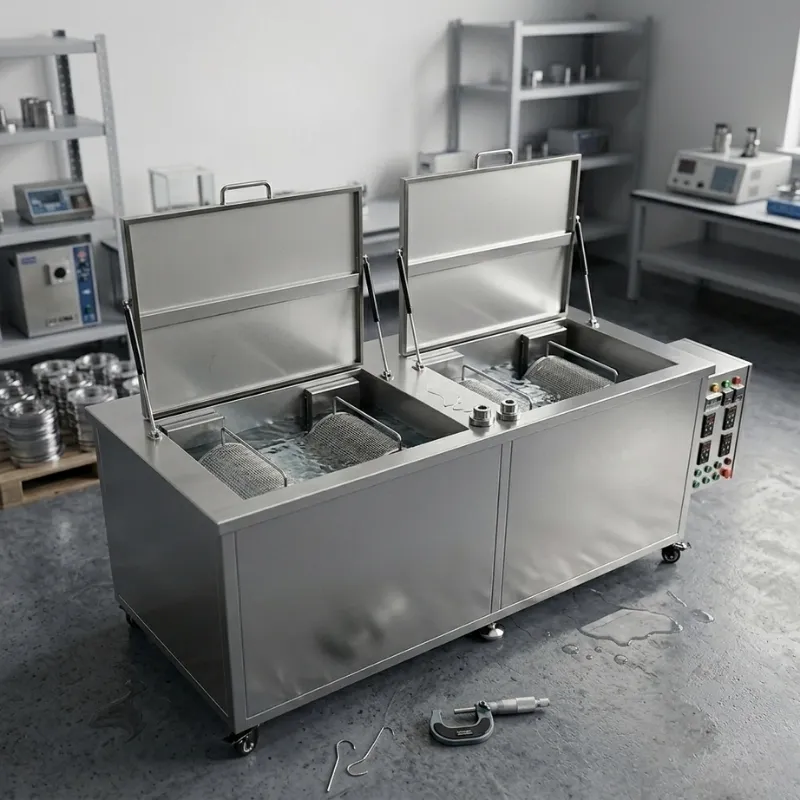
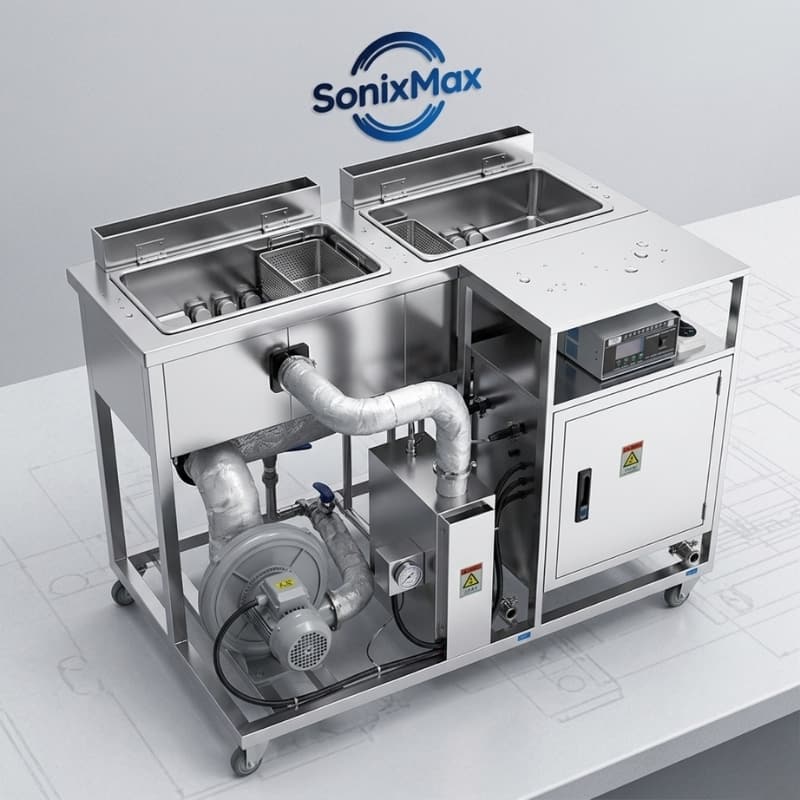
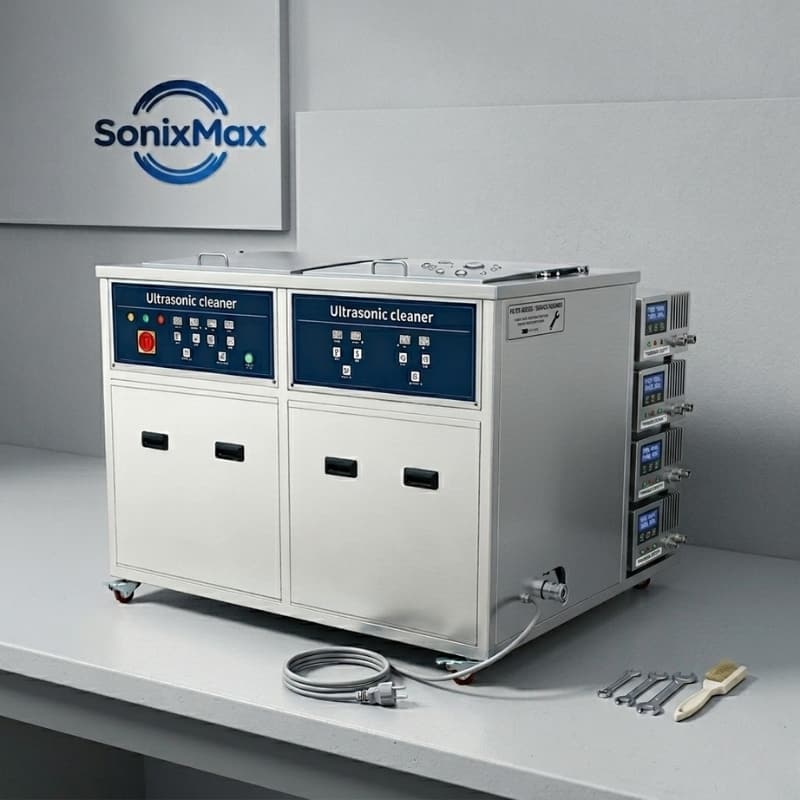
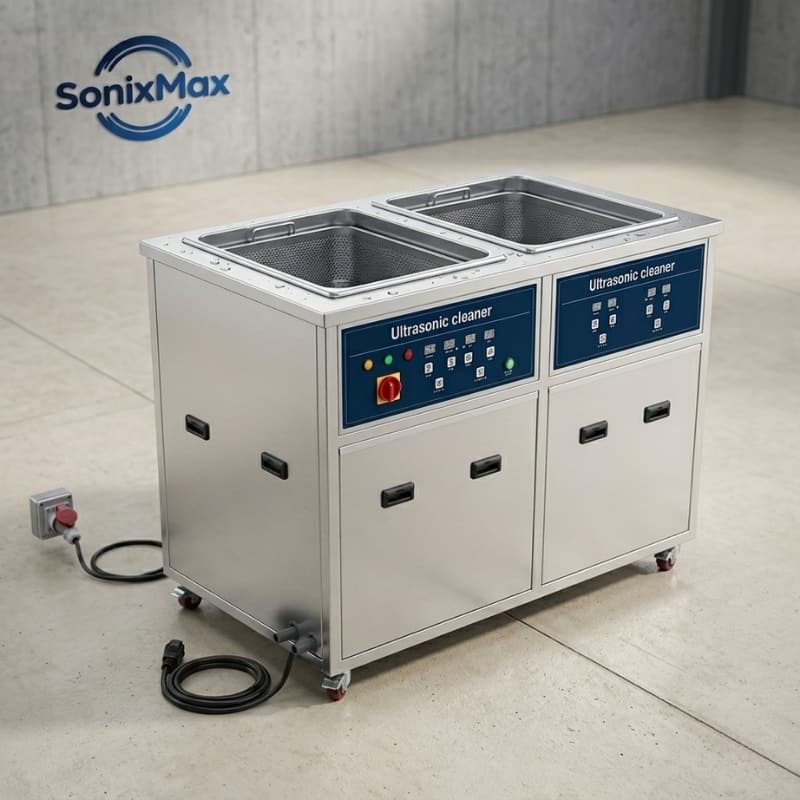
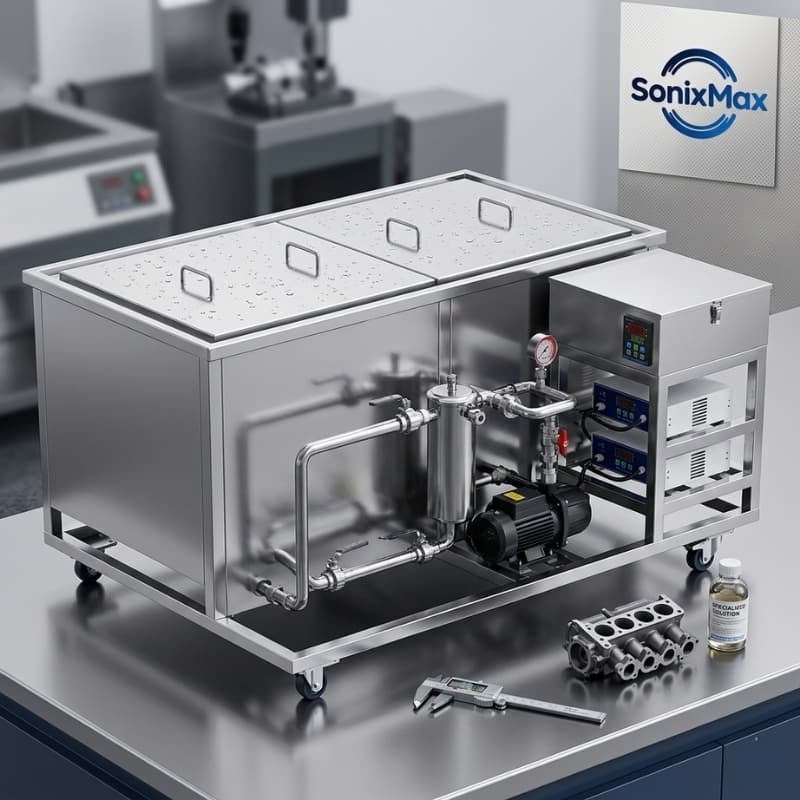
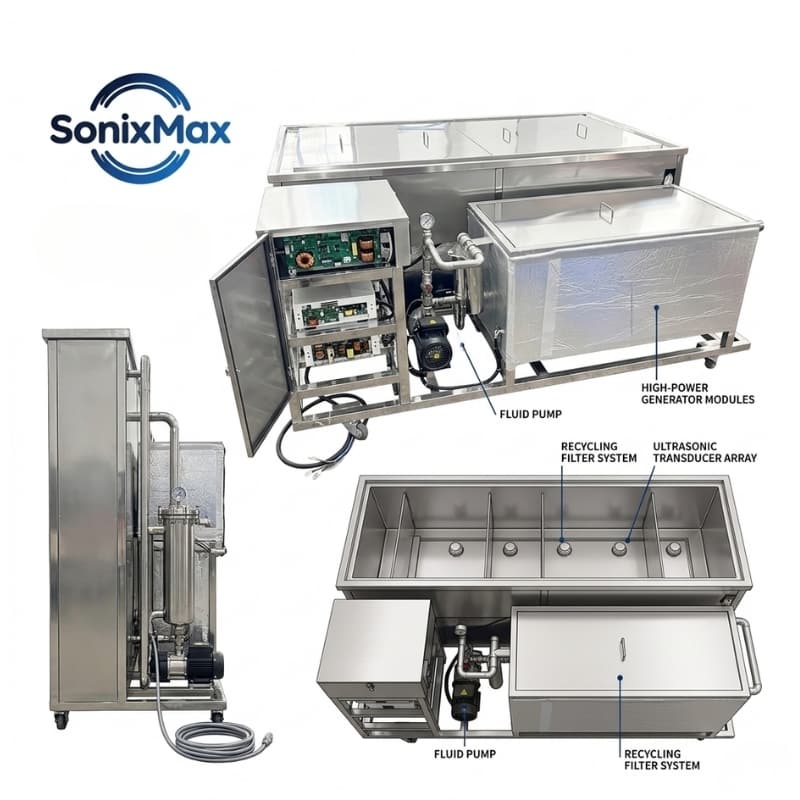
Industrial Dual-Tank Ultrasonic Cleaner (Cleaning + Filtration + Rinsing)
Dual-tank ultrasonic cleaning system combining cleaning and rinsing functions with filtration options for industrial parts and manufacturing applications. By integrating a dedicated rinsing stage and a continuous filtration system, this series ensures that parts are not only cleaned of heavy debris but also free from residual detergents and secondary contaminants.
Product Overview
For many industrial components, ultrasonic cleaning is only the first stage of the process.
After oils, particles, polishing compounds, machining residue, or other contamination are loosened and removed during primary cleaning, the workpiece may still carry cleaning solution and residual contamination on its surfaces.
This dual-tank system separates the process into primary ultrasonic cleaning and secondary rinsing, allowing each stage to be controlled independently.
Both tanks can be equipped with ultrasonic treatment and temperature control from ambient conditions up to 95°C, while the filtration system supports cleaning-liquid management during repeated batch operation.
With standard capacities from 45L to 1500L, the system can be selected according to part dimensions, batch quantity, contamination, required cleanliness, and production process.
Best suited for: industrial parts requiring ultrasonic cleaning followed by a separate rinsing or secondary treatment stage.
Consider another system if: your process only requires basic ultrasonic cleaning, or requires multiple rinsing stages, dedicated drying, automatic transfer, or a more complex multi-stage cleaning line.
Cleaning & Rinsing Process
The main advantage of this series is not simply having two tanks. It is the ability to separate the primary cleaning process from the following rinsing stage.
Tank 1 — Ultrasonic Cleaning
The first tank performs the main contamination-removal process.
Ultrasonic cavitation works together with suitable cleaning chemistry, temperature, and process time to remove contaminants such as:
- Cutting oil and coolant
- Grease and lubricant
- Fine particles and machining debris
- Polishing compound
- General manufacturing residue
Temperature can be controlled from ambient conditions up to 95°C, depending on the workpiece, contamination, and cleaning chemistry.
Tank 2 — Ultrasonic Rinsing / Secondary Treatment
After primary cleaning, parts are transferred to the second tank for rinsing or secondary ultrasonic treatment.
The separate tank helps reduce cleaning-solution carryover and remaining loosened contamination before the workpiece proceeds to the next production stage.
The second tank also supports ultrasonic treatment and temperature control from ambient conditions up to 95°C, allowing the rinsing process to be configured according to the application.
Filtration
The 10μm filtration system supports cleaning-liquid management during repeated batch operation.
Rather than replacing the rinsing stage, filtration and rinsing perform different functions:
Filtration manages suitable suspended contamination in the process liquid, while rinsing provides a separate treatment stage for the workpiece.
A typical process can therefore be configured as:
Load Parts → Ultrasonic Cleaning → Ultrasonic Rinsing / Secondary Treatment → Unload / Next Process
The actual process should be confirmed according to the required cleaning result.
Typical Parts & Applications
Parts / Applications | Typical Contamination | Process Benefit |
|---|---|---|
Machined metal components | Cutting oil, coolant, chips and particles | Primary cleaning removes machining contamination before a separate rinse |
Precision components | Fine particles, polishing residue and process contamination | Secondary treatment helps prepare parts for inspection or assembly |
Automotive components | Oil, grease and manufacturing residue | Suitable for repeated batch cleaning with separated cleaning and rinsing |
Gears & transmission parts | Lubricant, machining oil and particles | Ultrasonic action reaches complex surfaces before secondary rinsing |
Valves & fittings | Oil, particles and machining residue | Useful for threads, recesses and complex geometries |
Parts before coating or assembly | Cleaning solution and remaining process residue | Separate rinsing prepares components for downstream production |
The required process depends on the part material, geometry, contamination, cleaning chemistry, cleanliness target, and downstream process.
Core Features
Dual Ultrasonic Tank Configuration
Both process tanks can provide ultrasonic treatment, separating primary cleaning from secondary rinsing or treatment.
Depending on the selected model, the standard specification ranges from 12 × 2 to 216 × 2 ultrasonic transducers.
Adjustable Ultrasonic Power
Ultrasonic output can be adjusted according to the selected model and process requirements.
This allows the cleaning conditions to be matched more closely to the workpiece and contamination rather than relying on one fixed operating level.
28kHz / 40kHz Frequency Options
The series supports 28kHz and 40kHz configurations.
28kHz can be considered for robust industrial parts and heavier contamination, while 40kHz can be considered for finer geometries or applications requiring a different cavitation characteristic.
Final frequency selection should be based on the actual cleaning application.
Independent Cleaning & Rinsing Stages
Separating the two stages allows the primary contaminated cleaning bath and the following rinsing process to perform different functions.
This provides greater process flexibility than completing the entire cleaning cycle in a single tank.
Temperature Control up to 95°C
Both cleaning and rinsing stages can be configured with temperature control from ambient conditions up to 95°C.
Actual operating temperature should be selected according to the cleaning chemistry, part material, contamination, and process requirements.
10μm Filtration
The standard filtration configuration provides 10μm filtration accuracy to support process-liquid management during repeated cleaning cycles.
The final filtration arrangement can be evaluated according to the type and amount of contamination.
1–99 Minute Time Control
Process time can be adjusted according to contamination level, cleaning chemistry, temperature, workpiece geometry, and required cleaning result.
SUS304 Industrial Tank Construction
The standard inner tanks use SUS304 stainless steel with T2.0 construction, providing a practical configuration for repeated industrial batch-cleaning processes.
Technical Specifications
Model | Inner Tank Size (mm) | Capacity | Material | Transducers | Adjustable Ultrasonic Power | Frequency | Timer | Heating Power | Cleaning Temperature | Rinsing Temperature | Filter Accuracy |
|---|---|---|---|---|---|---|---|---|---|---|---|
SNXM-2024FR | 500 × 300 × 300 | 45L | SUS304 | 12 pcs × 2 | 0–600W × 2 | 28/40kHz | 1–99 min | 1.5kW | Ambient–95°C | Ambient–95°C | 10μm |
SNXM-2036FR | 500 × 350 × 350 | 61L | SUS304 | 18 pcs × 2 | 0–900W × 2 | 28/40kHz | 1–99 min | 1.5kW | Ambient–95°C | Ambient–95°C | 10μm |
SNXM-2048FR | 550 × 400 × 400 | 88L | SUS304 | 24 pcs × 2 | 0–1200W × 2 | 28/40kHz | 1–99 min | 3kW | Ambient–95°C | Ambient–95°C | 10μm |
SNXM-2060FR | 600 × 450 × 400 | 108L | SUS304 | 30 pcs × 2 | 0–1500W × 2 | 28/40kHz | 1–99 min | 3kW | Ambient–95°C | Ambient–95°C | 10μm |
SNXM-2072FR | 600 × 500 × 450 | 135L | SUS304 | 36 pcs × 2 | 0–1800W × 2 | 28/40kHz | 1–99 min | 4.5kW | Ambient–95°C | Ambient–95°C | 10μm |
SNXM-2096FR | 700 × 500 × 500 | 193L | SUS304 | 48 pcs × 2 | 0–2400W × 2 | 28/40kHz | 1–99 min | 6kW | Ambient–95°C | Ambient–95°C | 10μm |
SNXM-20120FR | 800 × 600 × 550 | 288L | SUS304 | 60 pcs × 2 | 0–3000W × 2 | 28/40kHz | 1–99 min | 6kW | Ambient–95°C | Ambient–95°C | 10μm |
SNXM-20144FR | 1000 × 600 × 600 | 360L | SUS304 | 72 pcs × 2 | 0–3600W × 2 | 28/40kHz | 1–99 min | 9kW | Ambient–95°C | Ambient–95°C | 10μm |
SNXM-20168FR | 1200 × 700 × 500 | 420L | SUS304 | 84 pcs × 2 | 0–4200W × 2 | 28/40kHz | 1–99 min | 9kW | Ambient–95°C | Ambient–95°C | 10μm |
SNXM-20180FR | 1200 × 800 × 500 | 480L | SUS304 | 90 pcs × 2 | 0–4500W × 2 | 28/40kHz | 1–99 min | 9kW | Ambient–95°C | Ambient–95°C | 10μm |
SNXM-20192FR | 1200 × 800 × 600 | 560L | SUS304 | 96 pcs × 2 | 0–4800W × 2 | 28/40kHz | 1–99 min | 18kW | Ambient–95°C | Ambient–95°C | 10μm |
SNXM-20216FR | 1000 × 900 × 600 | 540L | SUS304 | 108 pcs × 2 | 0–5400W × 2 | 28/40kHz | 1–99 min | 18kW | Ambient–95°C | Ambient–95°C | 10μm |
SNXM-20240FR | 1000 × 800 × 800 | 640L | SUS304 | 120 pcs × 2 | 0–6000W × 2 | 28/40kHz | 1–99 min | 18kW | Ambient–95°C | Ambient–95°C | 10μm |
SNXM-20264FR | 1000 × 1000 × 800 | 800L | SUS304 | 132 pcs × 2 | 0–6600W × 2 | 28/40kHz | 1–99 min | 18kW | Ambient–95°C | Ambient–95°C | 10μm |
SNXM-20288FR | 1200 × 1000 × 800 | 960L | SUS304 | 144 pcs × 2 | 0–7200W × 2 | 28/40kHz | 1–99 min | 24kW | Ambient–95°C | Ambient–95°C | 10μm |
SNXM-20432FR | 1500 × 1000 × 1000 | 1500L | SUS304 | 216 pcs × 2 | 0–10800W × 2 | 28/40kHz | 1–99 min | 36kW | Ambient–95°C | Ambient–95°C | 10μm |
Specifications shown above are standard reference configurations. Final tank functions, ultrasonic frequency, filtration arrangement, rinsing conditions, electrical configuration, baskets, fixtures, and additional process functions should be confirmed according to the project.
How to Select the Right Configuration
For this series, tank capacity is only one part of system selection.
The more important question is whether the cleaning and rinsing stages match the actual production process.
Workpiece Size & Batch Loading
Provide the maximum part dimensions, quantity per batch, approximate batch weight, and loading method.
These determine the required tank dimensions, usable working space, basket design, and handling requirements.
Type of Contamination
Identify what needs to be removed, such as cutting oil, coolant, grease, polishing compound, particles, or other process residue.
Contamination type influences ultrasonic frequency, cleaning chemistry, temperature, filtration, and process time.
Cleaning Chemistry
The cleaning solution used in the first tank should be compatible with the workpiece material and contamination.
The required rinsing stage should then be configured according to the chemistry and acceptable carryover.
Rinsing Requirement
The second stage should be selected according to what needs to be removed after primary cleaning.
Depending on the application, the objective may be to reduce cleaning-solution carryover, remove remaining loosened contamination, or prepare the part for the next manufacturing stage.
Required Cleanliness
General maintenance parts, components before assembly, and precision parts before coating or inspection may require different process configurations.
The required result determines whether a two-stage system is sufficient or whether additional rinsing or treatment stages should be considered.
Downstream Process
The process after rinsing should also be considered.
If parts need drying, cooling, coating, inspection, assembly, or another controlled operation immediately after rinsing, the overall cleaning system should be designed around that workflow.
Custom Engineering Options
The standard dual-tank system provides the basic cleaning + filtration + rinsing platform.
Additional functions can be integrated according to the workpiece, contamination, cleanliness requirement, production volume, and handling method.
Customization Area | Available Configuration |
|---|---|
Tank & Basket | Custom tank dimensions, baskets and workpiece fixtures |
Ultrasonic System | 28kHz / 40kHz and application-specific ultrasonic configuration |
Cleaning & Rinsing | Process-specific cleaning and rinsing arrangement |
Liquid Management | Filtration, circulation and additional rinsing stages |
Cleaning Assistance | Spraying and bubbling for suitable applications |
Part Movement | Agitation / reciprocating movement according to process requirements |
Material Handling | Lifting, throwing and application-specific transfer mechanisms |
Rotating Parts | Drum / rolling cleaning configurations for suitable small parts |
Drying | Heated-air drying and air-knife configurations when required |
Cooling | Cooling configurations for suitable processes |
Process Control | PLC and HMI control for suitable systems |
Automation | Multi-stage integration and gantry-type transfer systems |
Electrical Configuration | Adapted to equipment size and destination requirements |
Not every function is necessary for every project.
The final system should be built around the required cleaning result and process sequence, rather than adding functions that do not contribute to the application.
Which System Configuration Fits Your Process?
Process Requirement | Recommended Direction |
|---|---|
Ultrasonic cleaning only | |
Cleaning + filtration | |
Cleaning + agitation | |
Cleaning + drying | |
Cleaning + filtration + drying | |
Cleaning + filtration + rinsing | This Series |
Cleaning + multiple rinsing / drying stages | Multi-Tank Ultrasonic Cleaning System |
Multi-stage process + automatic transfer |
The objective is to select the process required by the parts—not simply the machine with the most functions.
Why Work with SonixMax?
Industrial ultrasonic cleaning systems should be selected around the actual cleaning process rather than tank capacity alone.
SonixMax evaluates the workpiece, contamination, batch loading, required cleanliness, cleaning chemistry, rinsing requirement, liquid management, material handling, and downstream process before recommending a system configuration.
For applications where primary ultrasonic cleaning and a separate rinsing stage are sufficient, this dual-tank series provides a practical starting platform.
For more complex projects, additional functions such as filtration, circulation, spraying, bubbling, agitation, lifting, drum cleaning, drying, air knife, PLC control, and automated transfer can be evaluated according to the production process.
Project support can include equipment selection, process configuration, customization coordination, technical communication, export packaging and delivery coordination, and after-sales communication.
FAQ
Why use a dual-tank system instead of a single ultrasonic tank?
A dual-tank system separates primary ultrasonic cleaning from the following rinsing or secondary treatment stage.
This is useful when parts should not move directly from the primary cleaning bath to inspection, assembly, coating, or another downstream process.
Does the second tank also have ultrasonic cleaning?
According to the standard configuration, both tanks are equipped with ultrasonic transducers and ultrasonic power.
The second tank can therefore provide ultrasonic action during rinsing or secondary treatment when required by the application.
Can both tanks be heated?
Yes. The cleaning and rinsing stages can be configured with temperature control from ambient conditions up to 95°C.
The actual operating temperature should be selected according to the workpiece material, cleaning chemistry, and process requirements.
Request an Industrial Ultrasonic Cleaning Solution
If your parts require ultrasonic cleaning followed by filtration-supported liquid management and a separate rinsing or secondary ultrasonic treatment stage, send us your application requirements.
Please provide your part photos or drawings, dimensions, material, contamination, quantity per batch, approximate batch weight, required cleanliness, current cleaning process, and downstream process.
SonixMax can evaluate whether this dual-tank configuration is suitable or whether additional rinsing, drying, handling, or automation stages are required.