Oct 6, 2026Ultrasonic Cleaning Solutions
How to Evaluate Whether an Ultrasonic Cleaning System Fits Your Facility
Evaluate whether an ultrasonic cleaning system fits your facility by reviewing workflow, parts, throughput, handling, utilities, process steps, maintenance, and testing needs.
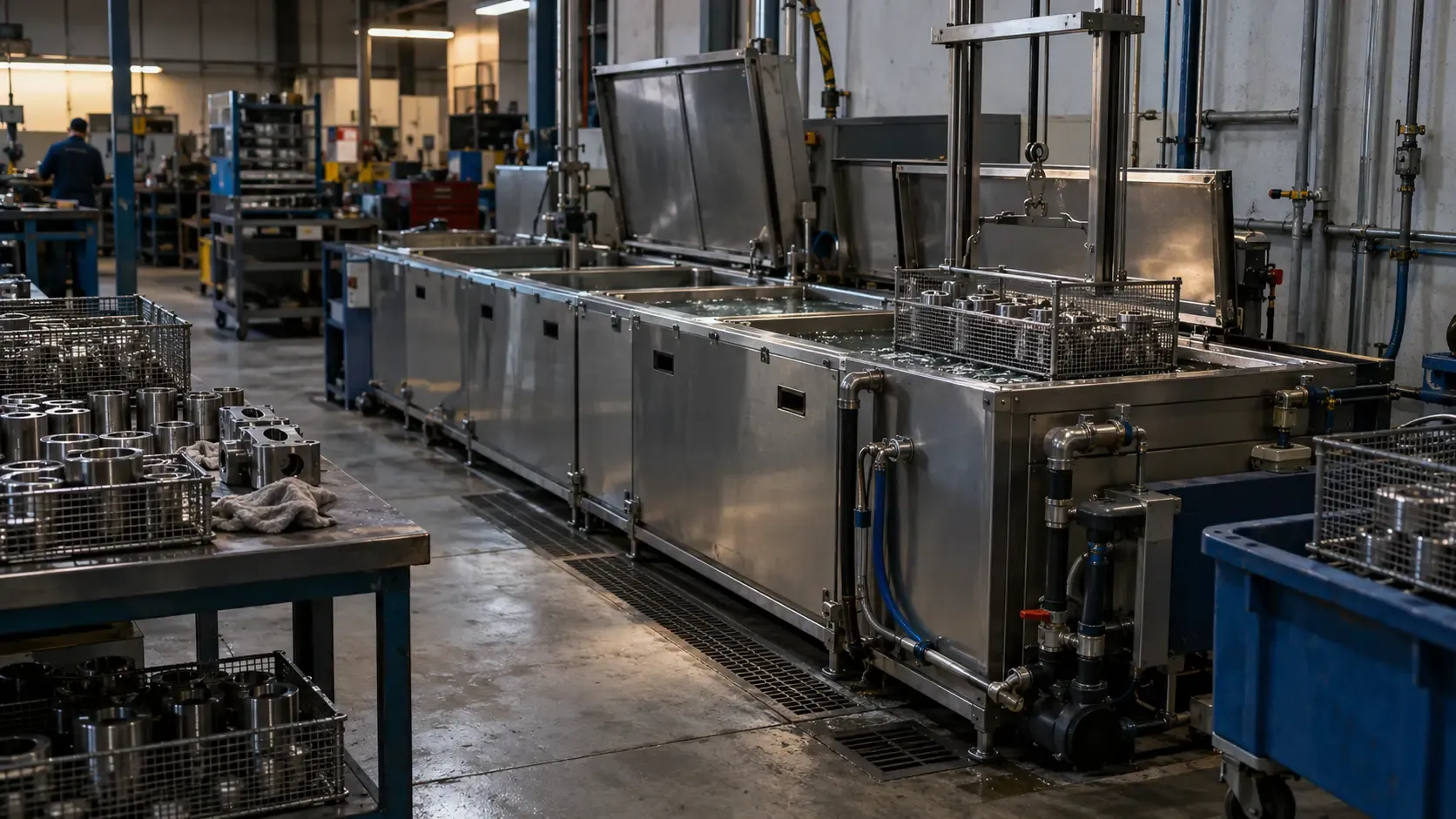
An industrial ultrasonic cleaning system should not be evaluated as an isolated machine. In many facilities, it becomes part of the production, maintenance, repair, or quality-control workflow.
For production managers, maintenance teams, and engineering buyers, the real question is not simply:
“Which ultrasonic cleaner should we buy?”
The better question is:
“Will this cleaning system fit our parts, workflow, operators, facility utilities, and production rhythm?”
A multi-stage automated system that works well in one factory may be oversized for another workshop. A simple single-tank cleaner may be practical for maintenance cleaning, but insufficient for repeated production cleaning.
The difference lies in part geometry, daily throughput, handling method, facility layout, cleaning target, and what happens before and after cleaning.
This guide explains how to evaluate whether an ultrasonic cleaning system fits your facility before approving the purchase.
Quick Answer
An ultrasonic cleaning system is a good facility fit when it solves a real cleaning bottleneck, matches your part geometry and contamination, fits the available space and utilities, and can be operated and maintained without disrupting production.
Before approving a system, evaluate:
- the current cleaning bottleneck
- how parts move before and after cleaning
- part size, weight, material, and geometry
- required cleaning result
- cycle time and throughput
- operator loading and handling
- available space, power, water, drainage, and air
- filtration, rinsing, drying, lifting, or automation needs
- maintenance and daily serviceability
- whether trial cleaning is needed
The goal is not to buy the most complicated system. The goal is to choose a cleaning process that fits your facility.
Start with the Facility Bottleneck
A facility evaluation should begin with the problem you are trying to solve.
Some facilities want to reduce manual brushing. Others need more consistent results between shifts. Some need to clean blind holes, grooves, or internal passages that are difficult to reach with spray cleaning. Others need to stop residue from affecting coating, plating, assembly, or inspection.
These are different problems, and they may require different solutions.
If the issue is heavy grease on open surfaces, ultrasonic cleaning may not be the only answer. A parts washer or pre-cleaning step may still be useful. If the issue is hidden residue inside complex geometry, ultrasonic cleaning may be more relevant.
The first step is to define the bottleneck clearly:
- labor and cleaning time
- inconsistent cleaning result
- difficult-to-reach geometry
- residue before the next process
- bath contamination
- oversized or heavy parts
- operator handling problems
- low production throughput
Once the bottleneck is clear, it becomes easier to evaluate whether an ultrasonic cleaning system is the right direction.
Map the Cleaning Workflow
A cleaning system has to fit into the real movement of parts inside your facility.
Before choosing equipment, map what happens before and after cleaning. In many facilities, the workflow includes:
- Previous process
- Dirty part staging and loading
- Cleaning process
- Rinsing, drying, or inspection
- Next process
This step matters because the next process often determines the required cleaning result.
If parts return to general maintenance use, visual cleaning may be enough. If parts go to coating, plating, welding, assembly, inspection, or packaging, the cleaning process may need better residue control, rinsing, drying, or handling.
A system that cleans well but disrupts material flow can still create production problems. For example, if operators have no space for dirty baskets, clean baskets, carts, or inspection trays, the cleaning area can quickly become a bottleneck.
When reviewing workflow, consider:
- where dirty parts come from
- how parts arrive at the cleaning area
- who loads the basket or fixture
- where cleaned parts go next
- whether parts need rinsing or drying
- whether there is space for baskets, carts, trays, or fixtures
Evaluate the Parts and Cleaning Result
Your parts define whether ultrasonic cleaning is suitable and what type of process may be needed.
Ultrasonic cleaning is often useful when cleaning liquid needs to reach blind holes, threads, grooves, internal passages, small cavities, or detailed machined surfaces. It may be less suitable, or may need additional testing, when parts are very large, very heavy, highly sensitive, coated, assembled with mixed materials, or difficult to immerse.
The required cleaning result is just as important as the part itself.
“Clean” may mean visually clean for one facility. For another, it may mean oil-free before assembly, dry before packaging, ready for coating, residue-controlled, or particle-controlled.
If the cleaning result is not defined, the system cannot be evaluated properly.
Before comparing equipment, define:
- which parts will be cleaned
- largest part dimensions and weight
- material and surface sensitivity
- difficult-to-clean areas
- contamination type
- accepted and rejected cleaning result
- what happens after cleaning
This keeps the evaluation focused on the process result, not only the equipment size.
Evaluate Cycle Time and Throughput
A system may have enough tank volume but still fail in daily production if the cycle time does not match the facility rhythm.
For low-volume maintenance work, operators may be able to wait for a batch to finish. In a production environment, cleaning can become a bottleneck if loading, heating recovery, washing, rinsing, drying, or unloading takes longer than expected.
Tank size answers only one question:
Can the part fit?
Throughput answers a different question:
Can the cleaning process keep up with daily work?
When evaluating throughput, look at the complete process, not only ultrasonic cleaning time. Loading, draining, rinsing, drying, inspection, and part transfer may all affect the actual cycle.
Consider:
- parts per basket
- batches per shift
- acceptable cleaning time
- loading and unloading time
- heating recovery
- rinsing and drying time
- operator waiting time
- whether cleaning may become the new bottleneck
A single-tank batch cleaner may be enough for flexible, low-volume cleaning. A multi-stage or automated system may be considered when cleaning is part of a repeated production flow.
Review Operator Handling and Ergonomics
A system that is difficult to load, unload, or maintain may cause problems even if the cleaning performance is acceptable.
Operator handling should be reviewed early, especially when parts are heavy, baskets are large, or the tank is deep.
If operators must manually lift wet baskets, move parts between tanks, or handle hot liquid repeatedly, the system may need lifting, agitation, transfer assistance, lids, splash control, or ventilation.
This is not only a convenience issue. Handling affects safety, repeatability, and whether the system is used correctly in daily operation.
Review:
- loaded basket weight
- loading height
- whether parts move between tanks
- whether lifting assistance is needed
- whether operators handle wet or hot parts
- whether ventilation or covers are needed
- whether maintenance access is practical
For heavy baskets, deep tanks, or repeated batches, the loading and transfer method may be just as important as tank capacity.
Confirm Facility Constraints
Before approving a system, confirm that the facility can support it.
This is especially important for large industrial tanks, multi-stage systems, and automated ultrasonic cleaning lines. A system may look suitable in a quotation but still create problems if the workshop does not have enough space, power, water, drainage, air, or access for loading and maintenance.
Facility review should include both installation and daily use.
Check whether there is space not only for the tank itself, but also for generator cabinets, clean and dirty staging areas, carts, baskets, operators, and maintenance access.
Review:
- available floor space
- generator cabinet location
- dirty and clean staging area
- loading path
- power supply
- water supply
- drainage
- compressed air
- ventilation or exhaust needs
- maintenance access
- distance to the next process
A cleaning system should fit the site as well as the parts.
Decide Which Process Steps Are Needed
A single ultrasonic wash tank may be enough for some applications. Many industrial facilities, however, need additional process steps.
The key is not to add every feature by default. The key is to connect each process step to a real facility problem.
Filtration may be useful when parts release oil, chips, sludge, or particles into the bath. It can help reduce frequent solution replacement and support more stable cleaning conditions.
Rinsing may be useful when detergent residue affects coating, plating, assembly, inspection, or final surface quality.
Drying may be useful when parts cannot remain wet, water spots are a concern, flash rust is a risk, or parts go directly to packaging, assembly, or storage.
If multiple process steps are required, a multi-stage cleaning system may be more suitable than a single tank.
Review Maintenance and Daily Serviceability
A system should not only clean well. It should also be practical to maintain.
Maintenance access is easy to overlook during purchasing, but it affects daily use after installation. If the tank is difficult to drain, filters are difficult to access, or pumps and valves are hard to service, operators may struggle with long-term use.
Before approval, consider:
- how the tank will be drained
- how the bath will be cleaned
- how often filters may need service
- whether pumps, valves, filters, and generators are accessible
- whether there is enough space for maintenance
- whether baskets, lids, and fixtures can be cleaned or replaced
- how sludge, oil, or used solution will be handled
A facility-fit evaluation should include serviceability, not only cleaning performance.
Consider Trial Cleaning When the Result Is Uncertain
Trial cleaning may be useful when the cleaning result is uncertain or the parts are difficult.
This is especially important when:
- you are using ultrasonic cleaning for the first time
- parts are high value
- materials are sensitive
- geometry is complex
- contamination is difficult
- cleanliness requirements are strict
- the process affects coating, plating, welding, or assembly
A useful trial should use actual parts and actual contamination whenever possible. It should also define what counts as success before the test begins.
A trial does not need to answer every final equipment detail. Its purpose is to reduce uncertainty and check whether the process direction can meet the cleaning requirement without creating new problems.
Facility Fit Evaluation Checklist
Evaluation Area | What to Check | Why It Matters |
|---|---|---|
Bottleneck | What is failing in the current process? | Defines the real purpose of the system |
Workflow | How parts move before and after cleaning | Prevents layout and handling problems |
Parts | Size, weight, material, geometry | Determines whether ultrasonic cleaning fits the application |
Cleaning result | Visual, oil-free, coating-ready, residue-controlled | Defines required process steps |
Throughput | Batches per shift, cycle time, operator rhythm | Prevents cleaning from becoming a bottleneck |
Handling | Basket weight, loading height, transfer method | Affects safety and daily usability |
Facility | Space, power, water, drainage, air, ventilation | Confirms installation feasibility |
Process steps | Filtration, rinsing, drying, lifting, automation | Connects features to actual problems |
Maintenance | Drainage, filter access, cleaning, service space | Affects daily operation after installation |
Testing | Real parts, real contamination, clear success criteria | Reduces uncertainty before purchase |
Supplier support | Application review, configuration advice, testing support | Helps match the system to the facility |
Final Approval Questions
Before approving an ultrasonic cleaning system, your team should be able to answer:
- What facility bottleneck will this system solve?
- Which parts will be cleaned in this system?
- What result must the process achieve?
- How will parts be loaded, transferred, rinsed, dried, and inspected?
- Will the system fit the available space and utilities?
- Can operators use and maintain it safely?
- Are filtration, rinsing, drying, lifting, or automation truly needed?
- Is sample testing needed before final confirmation?
If these questions are unclear, the purchase may need more application review before final approval.
What Sonixmax Can Help Evaluate
If you are evaluating whether an ultrasonic cleaning system fits your facility, Sonixmax can help review:
- current cleaning bottleneck
- part size, material, and geometry
- contamination type
- required cleaning result
- batch quantity and workflow
- loading and handling method
- filtration, rinsing, and drying needs
- facility constraints
- whether sample testing may be useful
Relevant product and guide directions include:
Need Help Evaluating a Cleaning System for Your Facility?
If you are not sure whether your facility needs a single-tank ultrasonic cleaner, filtration system, multi-stage cleaning system, or automated cleaning line, send Sonixmax your application details.
Include:
- current cleaning bottleneck
- part dimensions and material
- contamination type
- current cleaning method
- batch quantity
- required cleaning result
- workshop conditions
- photos or drawings if available
Sonixmax can help evaluate a suitable ultrasonic cleaning process and equipment direction based on your facility requirements.