Aug 17, 2026Buying Guides
How to Choose an Automated Ultrasonic Cleaning Line: Process, Transfer System & Configuration
A practical guide to choosing an automated ultrasonic cleaning line based on cleaning process, throughput, transfer system, drying, and production requirements.
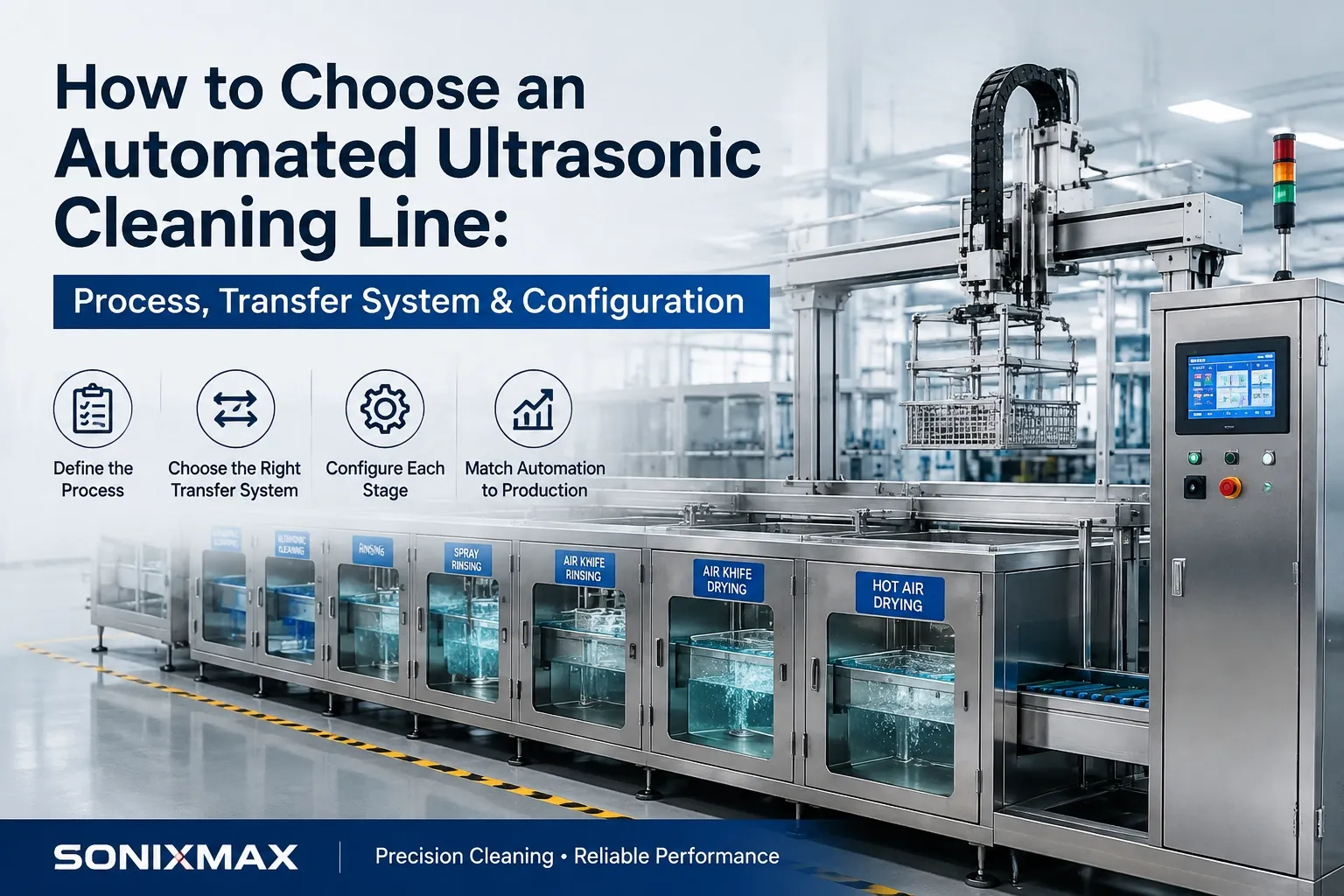
Choosing an automated ultrasonic cleaning line starts with the cleaning process—not simply the number of tanks or the level of automation.
For industrial projects, the right system depends on the parts being cleaned, contamination, required cleanliness, production capacity, transfer method, and the cleaning, rinsing and drying stages required after ultrasonic cleaning.
A practical selection process usually follows this sequence:
Parts → Contamination → Cleaning Process → Throughput → Transfer Method → System Configuration
Defining these requirements first makes it easier to determine whether your production needs a multi-stage batch system, a manipulator-based cleaning line, or a continuous conveyor system.
Start with the Cleaning Process, Not the Number of Tanks
A common mistake when specifying an automatic ultrasonic cleaning system is deciding how many tanks the machine should have before defining the required cleaning process.
The number of tanks should follow the process.
A relatively simple application may require:
Ultrasonic Cleaning → Rinsing → Drying
More demanding applications may require:
Ultrasonic Cleaning → Filtration → Rinsing → Fine Rinsing → Dewatering → Drying
Depending on the parts and contamination, additional processes such as spray cleaning, bubbling, agitation or vacuum-assisted cleaning may also be incorporated.
For example, filtration can help control suspended contamination when cleaning oily machined components, while additional rinsing stages may be required when detergent residue must be reduced before coating, assembly or inspection.
If you are still determining how many cleaning and rinsing stages your process requires, see our multi-stage ultrasonic cleaning systems guide.
Define the Parts and Production Requirements
Once the cleaning process is understood, the next step is defining what the line actually needs to handle.
Part Size, Weight and Geometry
Part dimensions and weight influence tank size, basket dimensions, conveyor width and transfer capacity.
Geometry matters as well. Open metal components and parts with blind holes, narrow passages or internal cavities may require different cleaning and fluid-access strategies.
For heavy or complex components, the transfer mechanism must also be designed around the actual loaded basket weight rather than the nominal size of the cleaning tank.
Production Capacity
Production requirements should be expressed as measurable throughput wherever possible—for example:
parts per hour, baskets per hour, or daily production volume.
This helps determine tank capacity, basket quantity, cycle time and whether multiple stations need to operate simultaneously.
A system designed for several batches per shift may require a very different automation concept from a line integrated into continuous production.
Required Cleanliness
The required result affects the number and type of process stages.
General degreasing may only require cleaning and rinsing, while precision manufacturing processes may need filtration, multiple rinses, controlled drying or additional cleaning stages.
The objective is not to add as many processes as possible. Each stage should solve a defined cleaning or production requirement.
Choose the Right Transfer System
The transfer system is one of the most important differences between automated ultrasonic cleaning lines.
Two common approaches are manipulator or basket transfer systems and continuous conveyor systems.
Manipulator or Basket Transfer
A manipulator transfers baskets between independent process tanks according to a programmed sequence.
This approach is particularly useful when the process requires:
- Multiple cleaning and rinsing stages
- Different dwell times between stations
- Controlled lifting and lowering of baskets
- Flexible process sequences
- Batch-based production
PLC-controlled manipulators can coordinate basket movement with ultrasonic cleaning, heating, rinsing and drying stages.
For complex parts where additional processes such as vacuum-assisted cleaning are required, a manipulator-based system can also provide greater flexibility in how individual stages are arranged.
Conveyor or Through-Type Transfer
A conveyor ultrasonic cleaning line is better suited to applications where parts move continuously through a fixed process.
Workpieces travel through the cleaning stages using a mesh belt, chain conveyor or other engineered transport system.
This configuration is particularly suitable for:
- Continuous manufacturing
- High production volumes
- Repetitive parts
- Stable process sequences
- Integration with upstream or downstream equipment
Conveyor speed and process length are selected according to the required production rate and treatment time.
Manipulator vs Conveyor Cleaning Lines
Factor | Manipulator / Basket Transfer | Conveyor / Through-Type |
|---|---|---|
Production Mode | Batch | Continuous |
Part Variety | More flexible | Better for stable product flow |
Process Flexibility | High | Usually fixed sequence |
Transfer | Basket between stations | Continuous conveyor |
Dwell Time | Can vary by station | Related to line and conveyor design |
Complex Multi-Stage Processes | Well suited | Possible with fixed process design |
Production-Line Integration | Possible | Particularly suitable |
Typical Application | Precision multi-stage cleaning | High-volume continuous cleaning |
Neither system is automatically better.
The correct transfer method should follow the production mode, parts and cleaning process rather than simply the desired level of automation.
Configure the Cleaning, Rinsing and Drying Stages
After defining the process and transfer method, each station can be configured according to its specific purpose.
Process Requirement | Typical Configuration |
|---|---|
Oil and machining residue removal | Ultrasonic cleaning + heating + filtration |
Detergent removal | Rinsing or ultrasonic rinsing |
Additional fluid movement | Agitation or bubbling |
Complex internal geometry | Vacuum-assisted cleaning where required |
Additional surface cleaning | Spray cleaning or rinsing |
Surface water removal | Air knife dewatering |
Final drying | Hot air or other suitable drying method |
Filtration and Liquid Management
Filtration is useful when contamination removed from the parts would otherwise remain suspended in the cleaning liquid and return to the workpiece.
Oil separation, circulation and other liquid-management functions can also be incorporated depending on the contamination and cleaning chemistry.
Rinsing
Rinsing requirements depend on the cleaning agent and downstream process.
A single rinse may be sufficient for some applications, while other processes require ultrasonic rinsing, spray rinsing or multiple rinse stages to better control residual detergent and contamination.
Drying
Drying should also be selected according to the part geometry and required output condition.
Air knives can remove a large amount of surface water before final drying. Circulating hot air can then remove remaining moisture.
For suitable batch components, centrifugal drying can provide another option. Some automated lines combine air knife dewatering, centrifugal drying and hot air circulation when the process requires multiple drying steps.
When Is Vacuum-Assisted Cleaning Useful?
Vacuum should be treated as a process option rather than a standard feature required on every automated ultrasonic cleaner.
For components with blind holes, internal passages or complex cavities, trapped air can prevent cleaning liquid from reaching some internal surfaces effectively.
A vacuum-assisted process may help improve liquid access in these situations by reducing trapped air before or during the cleaning process.
However, many open-surface metal components do not require vacuum cleaning.
The decision should therefore be based on part geometry, contamination location and validated cleaning requirements, rather than adding vacuum simply because it is a more advanced configuration.
How Much Automation Does Your Process Need?
Full automation is not necessary for every industrial cleaning project.
A manually transferred or semi-automatic multi-tank system may be sufficient when production volume is moderate, the cleaning sequence is simple, and operator handling does not create a production bottleneck.
Automation becomes more valuable when the process involves repeated multi-stage cleaning, high throughput, controlled cycle times or integration with other manufacturing equipment.
Typical automation functions can include:
- Automatic loading and transfer
- PLC-controlled process sequences
- Ultrasonic operation
- Temperature control
- Cleaning and rinsing time
- Conveyor speed or manipulator movement
- Drying stages
- Process status and alarms
The objective is not maximum automation. It is the appropriate level of automation for the required production process.
Common Automated Ultrasonic Cleaning Line Configurations
There is no single standard layout for every industrial application. The following examples show how different production requirements can lead to different system configurations.
Manipulator-Based Multi-Stage Cleaning System
For batch production requiring multiple independent process stages, a PLC-controlled manipulator can transfer baskets between cleaning, rinsing and drying stations.
SonixMax projects can combine ultrasonic cleaning, spray rinsing, fine cleaning, drying and vacuum-assisted processes when required by the application.
This configuration is useful when process flexibility and controlled basket movement are more important than continuous conveyor flow.
Six-Stage Automated Cleaning and Drying Line
Another configuration combines multiple cleaning and drying technologies in one automated process.
Ultrasonic Cleaning → Secondary Ultrasonic Cleaning → Bubbling Rinsing → Air Knife Dewatering → Centrifugal Drying → Hot Air Drying
This type of system is suitable when cleaning, rinsing and thorough drying need to be integrated into a repeatable production sequence.
Through-Type Conveyor Cleaning Line
For continuous production, a through-type conveyor can move parts automatically through a fixed sequence.
A representative eight-stage process may include:
Ultrasonic Cleaning → Heating / Soaking → Ultrasonic Cleaning → Spray Cleaning → Ultrasonic Fine Cleaning → Spray Rinsing → Air Knife Dewatering → Hot Air Drying
This configuration is particularly useful when stable throughput and production-line integration are priorities.
What Information Should You Provide Before Requesting a Cleaning Line?
An automated cleaning line is normally configured around the actual manufacturing process rather than selected only by tank capacity.
Before requesting a solution, prepare the following information:
- Part photos or drawings
- Part dimensions and weight
- Material
- Contamination type
- Required cleanliness
- Batch quantity or hourly/daily production capacity
- Current cleaning process
- Required cleaning, rinsing and drying stages
- Available factory space or layout
- Voltage and destination country
If you are still deciding whether your process needs one tank or multiple stages, our single-tank vs multi-tank ultrasonic cleaner selection guide explains the differences.
Providing these details allows the cleaning process, transfer method, tank configuration and automation requirements to be evaluated together.
FAQ
How many tanks does an automated ultrasonic cleaning line need?
There is no fixed number. Tank quantity should follow the required process. A system may need separate stages for ultrasonic cleaning, rinsing, fine rinsing, dewatering and drying, while a simpler application may require fewer stations.
Should I choose a manipulator or conveyor cleaning system?
Manipulator systems are generally more flexible for basket-based batch processes and variable dwell times. Conveyor systems are particularly suitable for continuous production with a stable process sequence. The decision should be based on production mode, parts, throughput and required treatment time.
Can an automated cleaning line be integrated into an existing production line?
Yes. The system layout, transfer height, conveyor direction, production rate, electrical requirements and loading/unloading arrangement can be evaluated according to the existing manufacturing process and available factory space.
Request an Automated Cleaning Solution
Planning an automated ultrasonic cleaning project?
Send us your part drawings or photos, contamination details, required cleaning process, production capacity and factory layout.
SonixMax can evaluate the cleaning stages, transfer method, tank configuration and automation requirements for your project.