
Aug 17, 2026Buying Guides
When Do You Need Filtration in an Ultrasonic Cleaning System?
Learn when an ultrasonic cleaner needs filtration, which contaminants filtration can manage, and when to choose filtration, rinsing, or a multi-tank system.
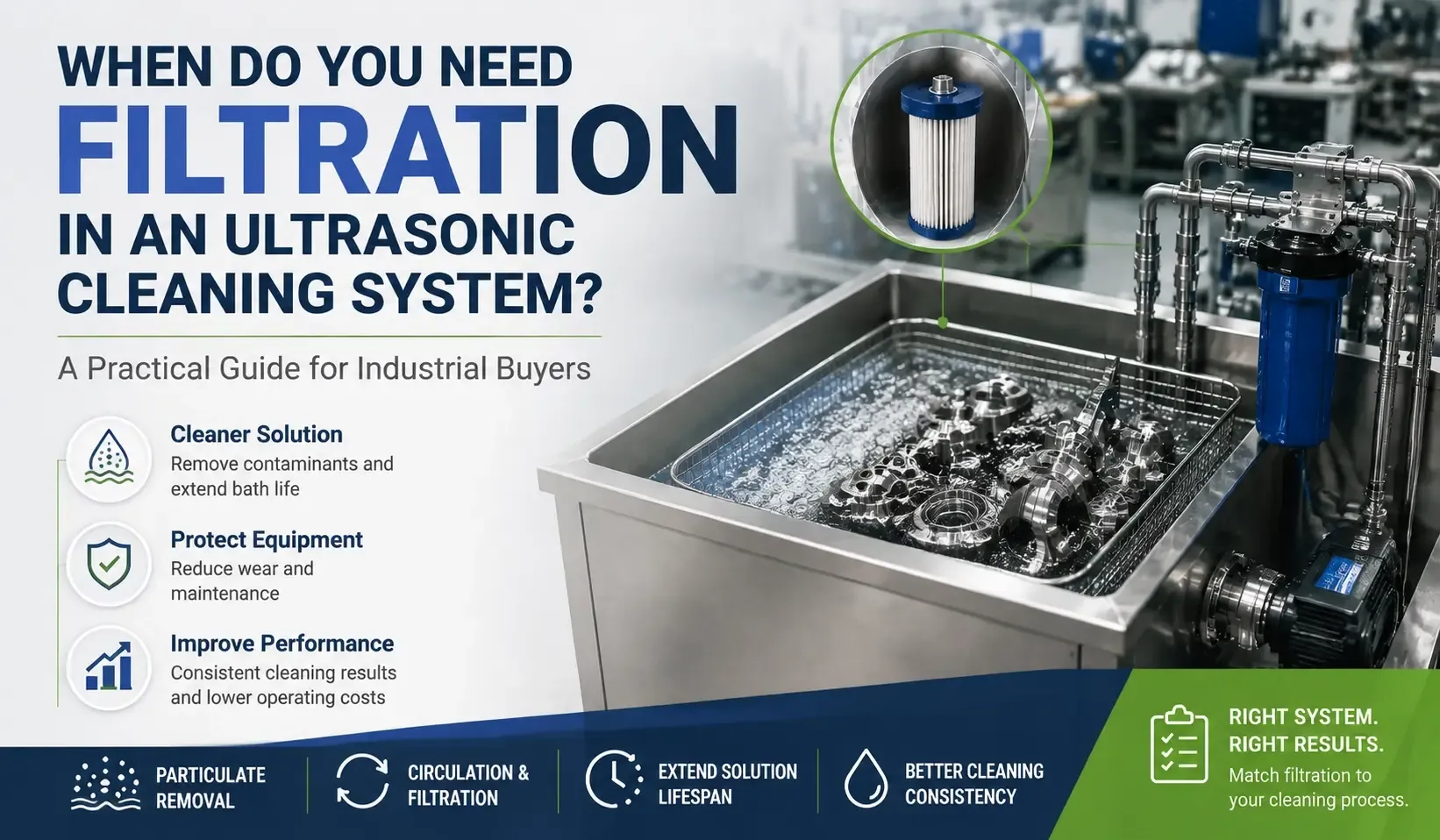
Not every ultrasonic cleaning system needs filtration.
For light contamination, small batches, or occasional cleaning, replacing the cleaning solution at suitable intervals may be enough. But when parts continuously introduce oil, metal fines, carbon particles, polishing residue, or other suspended contaminants into the tank, the bath can become difficult to manage.
In these applications, a filtration system can help remove suspended contamination from the cleaning solution and support more stable bath conditions during repeated production.
The important question is therefore not simply “Is filtration better?” but:
Does your cleaning process generate enough removable contamination to justify filtration?
This guide explains when filtration is useful, when it may be unnecessary, and when a rinse tank, oil separation, or a multi-stage ultrasonic cleaning system may be more appropriate.
What Does a Filtration System Do in Ultrasonic Cleaning?
A typical ultrasonic filtration system circulates cleaning liquid from the tank through a pump and filter before returning it to the cleaning system.
The purpose is to remove contaminants that can be captured by the selected filtration setup, such as suspended particles, metal fines, and loosened debris.
A simplified process looks like this:
Cleaning Tank → Circulation → Pump → Filter → Return to Tank
This can be particularly useful when the same bath is used for repeated batches and contamination gradually accumulates in the solution.
However, filtration should be understood as part of cleaning-liquid management. It does not replace ultrasonic cavitation itself, and it does not automatically replace rinsing.
When Is Filtration Worth Adding?
The need for filtration depends more on the cleaning process than on tank capacity alone.
A large ultrasonic cleaner does not automatically need filtration, while a smaller production tank handling heavily contaminated parts may benefit from it.
Four factors are especially useful when making the decision.
High Contamination Load
Filtration becomes more relevant when parts release significant amounts of removable particulate contamination into the bath.
Typical examples include:
- machined metal parts carrying chips, fines, and machining residue;
- engine or mechanical components with loosened carbon and debris;
- molds and tooling with particulate contamination;
- components carrying polishing residue or other suspended solids.
Without suitable liquid management, loosened contamination remains in the cleaning bath and may accumulate as more parts are processed.
The type of contamination matters, however. A standard particulate filter is not equally effective for every contaminant.
Repeated Batch Cleaning
A workshop cleaning a few parts occasionally has very different requirements from a production line processing batch after batch.
With repeated cleaning, every batch introduces additional contamination into the solution.
Filtration can help manage part of this contamination between or during production cycles, depending on the system design and operating sequence.
This is one reason filtration is more commonly considered for production-oriented ultrasonic cleaning systems than for occasional low-volume cleaning.
Large Tanks or Costly Solution Replacement
Changing the entire bath is relatively simple with a small cleaner.
The situation changes with larger industrial tanks.
More cleaning liquid means more time for draining, refilling, reheating, and preparing the bath. If the cleaning chemistry also has a meaningful operating cost, frequent complete solution replacement can become inefficient.
In these situations, filtration may help extend the practical service period of the bath by removing suitable suspended contaminants.
It does not mean the cleaning solution can be used indefinitely. Bath condition, chemistry concentration, accumulated contamination, and cleaning performance still need to be monitored.
More Consistent Production Conditions
For repeated industrial cleaning, the objective is often not just to clean one successful batch.
The process needs to remain reasonably consistent across ongoing production.
Contamination loading changes the condition of the cleaning bath over time. A properly selected filtration and circulation system can form part of a broader liquid-management strategy designed to keep operating conditions more controlled.
When You May Not Need Filtration
Adding filtration also adds pumps, filters, piping, maintenance requirements, and system cost.
For that reason, it should not be treated as a standard upgrade for every ultrasonic cleaner.
A simple system may be more appropriate when:
- contamination is light;
- cleaning volume is low;
- the machine is used only occasionally;
- the bath is small and easy to replace;
- very little removable particulate matter enters the solution.
For example, a low-volume workshop cleaning relatively clean components may gain little from adding a complete filtration circuit.
In that situation, a standard single-tank ultrasonic cleaner with appropriate bath maintenance may be sufficient.
The better approach is to match the configuration to the contamination load and production requirements rather than automatically selecting the system with the most functions.
Filtration vs. Rinsing: They Solve Different Problems
This distinction is important when selecting an industrial ultrasonic cleaning system.
Filtration manages contamination in the cleaning liquid.
Rinsing removes cleaning chemistry and loosened contamination remaining on the parts after the cleaning stage.
These are not the same process.
Consider a machined component covered with oil and fine particles.
During ultrasonic cleaning, cavitation helps loosen contamination from the component. Filtration may help remove some of the suspended particles circulating in the cleaning solution.
But after the part leaves the cleaning tank, traces of detergent or loosened contamination may still remain on its surface.
If the required process includes removing those residues before drying or further manufacturing, a separate rinse stage may still be necessary.
This is why adding filtration to a single tank does not automatically turn it into a complete cleaning-and-rinsing process.
If your main concern is maintaining the cleaning bath during repeated production, an ultrasonic cleaner with filtration may be appropriate.
If the process requires separate cleaning and rinsing stages, a dual-tank or multi-tank configuration may be a better solution.
What Type of Contamination Are You Removing?
Before specifying a filtration system, identify what actually enters the cleaning liquid.
Different contaminants require different liquid-management strategies.
Contamination | Filtration Consideration |
|---|---|
Metal fines and small particles | Often suitable for particulate filtration |
Loose solid debris | Filtration may help remove suspended material |
Polishing residue | Depends on particle characteristics and filter selection |
Floating oil | Oil separation or skimming may also be required |
Heavy sludge | May settle in the tank and require tank cleaning or other management |
Dissolved contamination | Standard particulate filtration may not remove it |
This is why specifying only “add a filter” is usually not enough for an industrial system.
The supplier should understand the contaminant, expected loading, cleaning chemistry, production rate, and required result before determining the filtration arrangement.
The same applies to filter rating. A finer filter is not automatically better for every application. Filter selection needs to balance contamination capture, flow requirements, maintenance frequency, and the overall cleaning process.
Filtration Is Only One Part of Bath Management
One common mistake is to assume that installing filtration eliminates the need for tank maintenance.
It does not.
Some heavy contamination can settle at the bottom of the cleaning tank instead of remaining suspended long enough to enter the filtration circuit. Oil may require a different separation method, while dissolved contaminants may remain in the solution even after particulate filtration.
Depending on the application, bath management may therefore involve a combination of:
filtration, circulation, oil separation, periodic tank cleaning, chemistry control, and scheduled solution replacement.
The circulation arrangement also needs to match the ultrasonic cleaning process.
Flow rate, return position, filtration timing, and tank design can affect how the system operates. For this reason, filtration should be designed as part of the complete cleaning process rather than added as an isolated accessory.
How to Specify Filtration When Requesting an Ultrasonic Cleaning System
You do not need to determine every pump, filter, and piping specification before requesting a quotation.
It is more useful to give the equipment supplier accurate information about the cleaning process.
For an industrial application, provide:
- part material;
- maximum part dimensions and weight;
- type of oil, particles, carbon, polishing residue, or other contamination;
- number of parts per batch;
- expected batches per hour or per day;
- current cleaning method;
- required cleanliness after cleaning;
- preferred tank capacity, if already known;
- whether rinsing and drying are required;
- available power supply and installation conditions;
- part photos, drawings, or cleaning samples when available.
These details make it possible to determine whether the application is better suited to a standard tank, filtration and circulation, oil separation, additional rinse stages, or a more complete multi-stage cleaning system.
Choosing the Right Ultrasonic Cleaning Configuration
Filtration should follow the cleaning process—not the other way around.
For relatively light contamination and occasional cleaning, a standard single-tank ultrasonic cleaner may be enough.
For repeated batch cleaning where removable particles continuously enter the bath, adding filtration and circulation may make the cleaning solution easier to manage.
When parts require a separate rinse after ultrasonic cleaning, the process may need a dual-tank or multi-tank system rather than simply adding a filter.
For more complex production requirements involving cleaning, rinsing, drying, material transfer, and process control, a multi-stage ultrasonic cleaning system or automated cleaning line may be more appropriate.
The correct configuration depends on the parts, contamination, production volume, cleanliness requirement, and the stages required after cleaning.
Discuss Your Cleaning Process with SonixMax
If you are unsure whether your application needs filtration, start with the parts and contamination rather than a machine configuration.
Send SonixMax your part photos or drawings, dimensions and weight, contamination type, batch quantity, current cleaning method, and required cleaning result.
We can use this information to discuss whether your application is better suited to a standard single tank, filtration system, cleaning-and-rinsing configuration, or a customized multi-stage ultrasonic cleaning system.