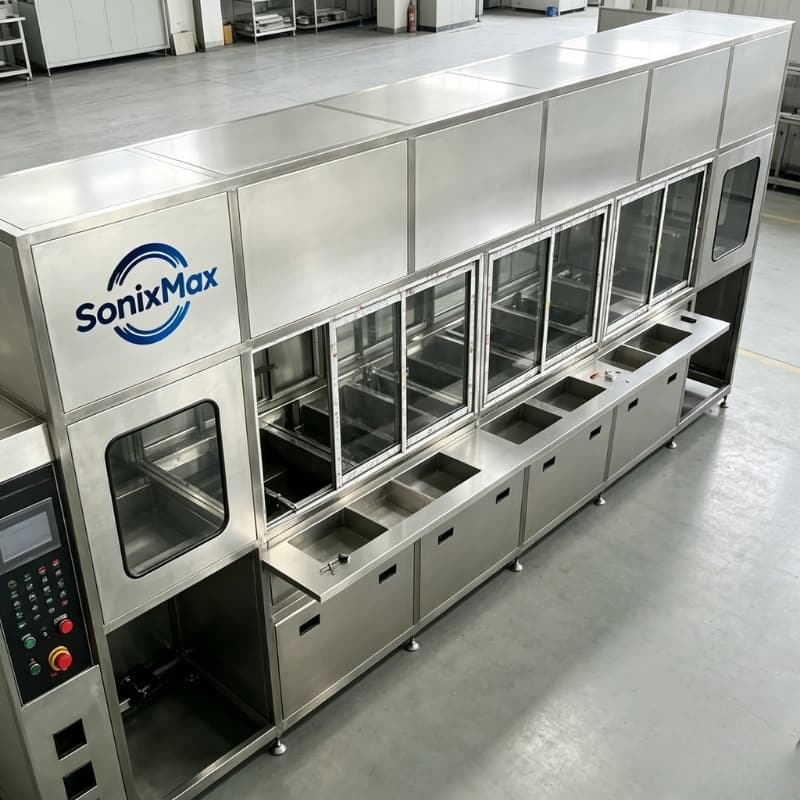
Automatic series
Automatic Multi-Stage Ultrasonic Cleaning Line with Conveyor & Dual Drying
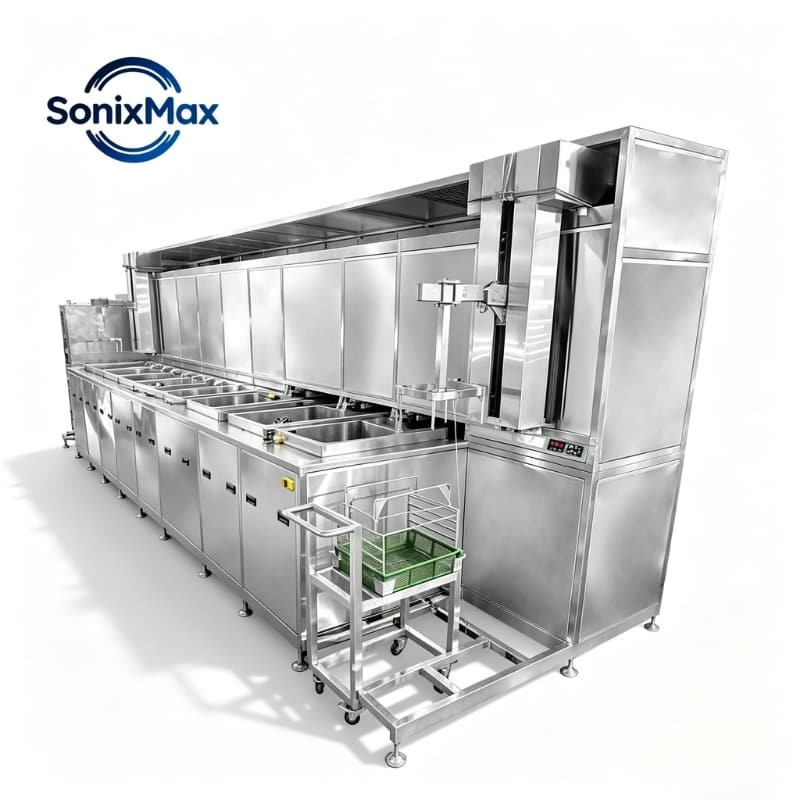
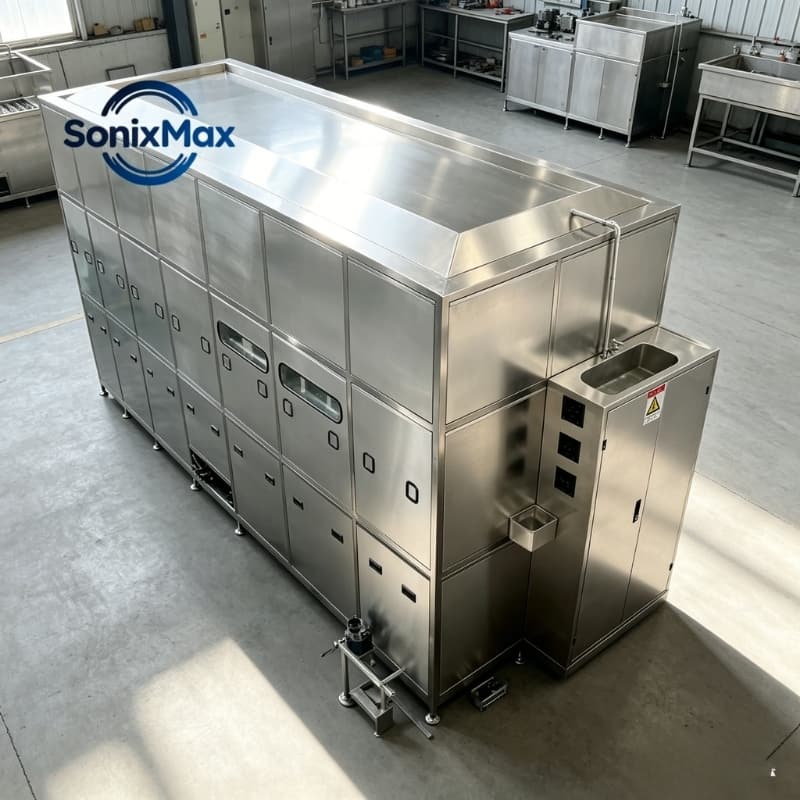
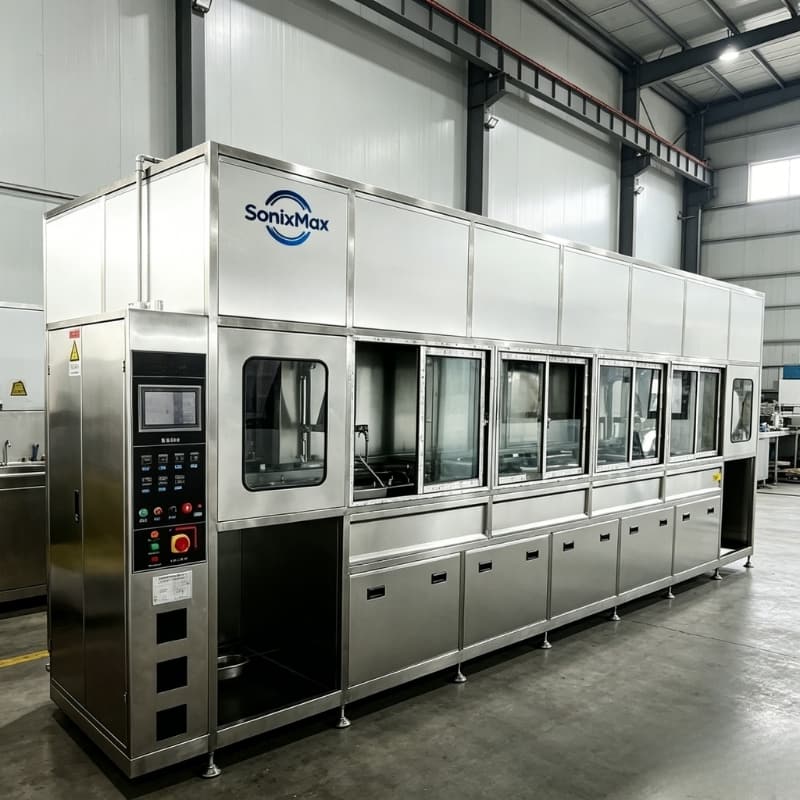
The 300L fully automatic six-tank ultrasonic cleaning line combines two-stage ultrasonic cleaning, filtration, bubbling rinsing, air-knife dewatering, centrifugal drying, and hot-air circulation drying. With 7200W ultrasonic power and 18kW heating per ultrasonic tank, SUS316 wet-process tanks, conveyor transfer, and PLC control, it is designed for continuous industrial batch cleaning.
Continuous Cleaning for Production-Line Applications
For manufacturers processing repeated batches of industrial components, cleaning may involve several separate operations before parts are ready for inspection, assembly, coating, or other downstream processes.
Repeated manual transfer between cleaning, rinsing, and drying equipment can interrupt production flow and make it more difficult to coordinate processing time between stages.
This automated line combines the complete process into one system:
Primary Ultrasonic Cleaning → Secondary Ultrasonic Cleaning → Bubbling Rinsing → Air Knife Dewatering → Centrifugal Drying → Hot Air Circulation Drying
Workpieces are carried in stainless steel cleaning baskets and transferred through the process by the conveyor system, reducing repeated manual handling between individual treatment stages.
How the Automated Cleaning Line Works
The reference system uses six dedicated process stations, with each stage performing a specific cleaning, rinsing, dewatering, or drying function.
Tank 1 — Primary Ultrasonic Cleaning
The first tank performs the primary ultrasonic cleaning process and integrates ultrasonic cleaning, heating, filtration, circulation, and workpiece agitation.
The 850 × 850 × 500 mm tank is constructed from 2.0 mm SUS316 stainless steel.
Four ultrasonic plate assemblies are installed around the tank:
- 2 on the bottom
- 1 on the front
- 1 on the rear
Together they contain 144 ultrasonic transducers, operating at 40kHz with 7200W ultrasonic power.
An 18kW heating system and a dedicated filtration and circulation system support the primary cleaning process.
Tank 2 — Secondary Ultrasonic Cleaning
The second tank provides another ultrasonic cleaning stage before rinsing.
It uses the same 850 × 850 × 500 mm, 2.0 mm SUS316 tank construction and another four ultrasonic plate assemblies with 144 transducers.
The ultrasonic system operates at 40kHz / 7200W, with 18kW heating power.
This provides a second ultrasonic treatment stage within the complete cleaning process.
Tank 3 — Bubbling Rinsing
After ultrasonic cleaning, the parts enter the bubbling rinsing stage.
The 850 × 850 × 500 mm tank is manufactured from 2.0 mm SUS316 stainless steel and incorporates bubbling pipes connected to a high-pressure blower.
An air filter is included in the bubbling system.
This stage provides liquid movement around the workpieces before they proceed to dewatering and drying.
Shared Agitation System — Tanks 1–3
The first three wet-process tanks share one workpiece agitation system.
This provides mechanical workpiece movement during the ultrasonic cleaning and bubbling rinsing stages.
The exact movement arrangement can be configured according to the workpiece, basket, and cleaning process.
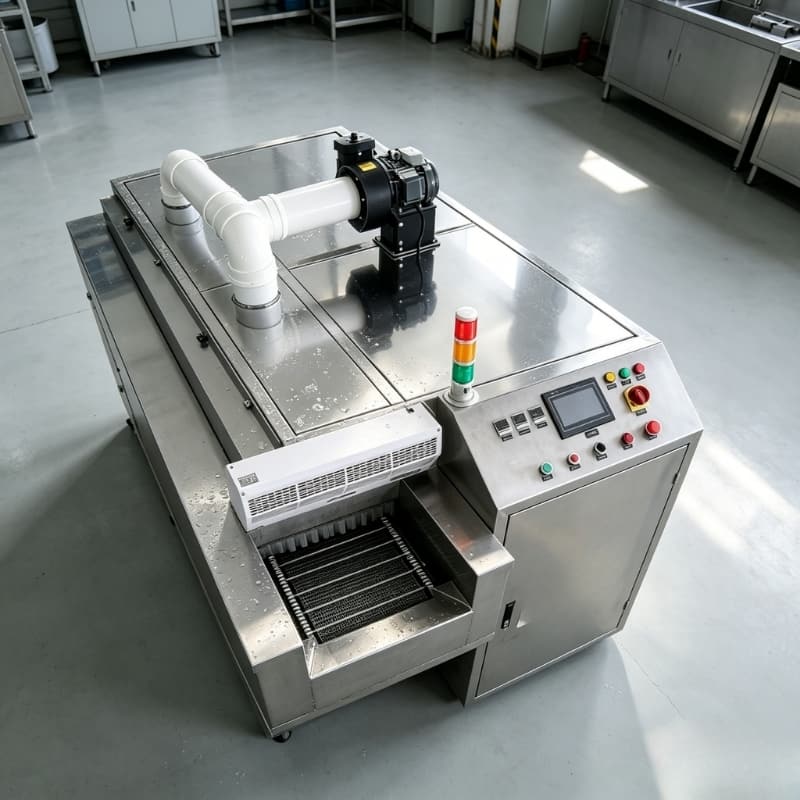
Tank 4 — Air Knife Dewatering
The fourth station removes surface water after rinsing.
The 850 × 850 × 500 mm chamber is constructed from 2.0 mm SUS304 stainless steel and uses air knives arranged around all four sides.
The air knives can move back and forth while connected to a high-pressure blower, providing sweeping airflow around the workpieces before they enter the drying stages.
Tank 5 — Centrifugal Drying
The fifth station uses centrifugal action to remove retained water from the workpieces.
The chamber measures 850 × 850 × 500 mm and uses 2.0 mm SUS304 stainless steel construction.
The centrifugal drying system provides 12kW drying power and is equipped with a high-efficiency air purifier.
Tank 6 — Hot Air Circulation Drying
The final station uses circulating hot air to complete the drying process.
The 850 × 850 × 500 mm chamber is manufactured from 2.0 mm SUS304 stainless steel and provides 12kW drying power.
A high-efficiency air purifier is also integrated into the drying system.
After this stage, the workpieces proceed to unloading or the next manufacturing process.
Working Process
Station | Process |
|---|---|
Loading | Workpiece / Basket Loading |
Tank 1 | Primary Ultrasonic Cleaning |
Tank 2 | Secondary Ultrasonic Cleaning |
Tank 3 | Bubbling Rinsing |
Tank 4 | Air Knife Dewatering |
Tank 5 | Centrifugal Drying |
Tank 6 | Hot Air Circulation Drying |
Unloading | Workpiece / Basket Unloading |
Working Process:
Loading → Primary Ultrasonic Cleaning → Secondary Ultrasonic Cleaning → Bubbling Rinsing → Air Knife Dewatering → Centrifugal Drying → Hot Air Circulation Drying → Unloading
Why This Multi-Stage Process?
Two Ultrasonic Cleaning Stages
The system uses two dedicated ultrasonic tanks before rinsing.
Each tank provides 144 transducers, 7200W ultrasonic power, 40kHz frequency, and 18kW heating in the reference configuration.
Separating ultrasonic treatment into two stages provides a more controlled cleaning sequence for parts requiring more than one ultrasonic treatment before rinsing.
Bubbling Rinsing
After the ultrasonic stages, bubbling rinsing provides liquid movement around the workpieces before the drying process begins.
The tank uses bubbling pipes, a high-pressure blower, and an air filter.
Three-Step Water Removal
Instead of relying on a single drying method, the system uses:
Air Knife Dewatering → Centrifugal Drying → Hot Air Circulation Drying
Air knives first remove surface water, centrifugal action provides additional mechanical water removal, and circulating hot air completes the drying process.
Core System Features
Conveyor-Based Transfer
Workpieces are transported through the production line using a conveyor system and stainless steel cleaning baskets.
This connects the six treatment stages into one coordinated process and reduces repeated manual transfer between separate machines.
40kHz Ultrasonic Cleaning
Both ultrasonic cleaning tanks operate at 40kHz in the reference configuration.
Each tank uses 144 transducers with 7200W ultrasonic power distributed through ultrasonic plate assemblies mounted on the bottom, front, and rear surfaces.
Filtration & Circulation
Tank 1 incorporates a dedicated filtration and circulation system to support cleaning-liquid management during the primary ultrasonic process.
Shared Workpiece Agitation
Tanks 1–3 share one agitation system to provide workpiece movement during the wet-process stages.
SUS316 Wet-Process Tanks
The first three liquid-processing tanks use 2.0 mm SUS316 stainless steel.
The subsequent dewatering and drying chambers use 2.0 mm SUS304 stainless steel.
Four-Side Sweeping Air Knives
The dewatering chamber uses air knives positioned on four sides with reciprocating movement and high-pressure airflow.
Centrifugal + Hot Air Drying
The system combines centrifugal drying with hot-air circulation rather than relying on heated drying alone.
Both drying stages provide 12kW drying power in the reference configuration.
PLC-Controlled Production Line
PLC control coordinates the automated cleaning line and conveyor-based production process.
Technical Data & Specifications
Tank / System | Function | Main Configuration | Tank Construction | Power / Key Data |
|---|---|---|---|---|
Tank 1 | Primary Ultrasonic Cleaning | 4 Ultrasonic Plate Assemblies + 144 Transducers + Filtration & Circulation + Shared Agitation | 850 × 850 × 500 mm / 2.0 mm SUS316 | 7200W Ultrasonic / 18kW Heating / 40kHz |
Tank 2 | Secondary Ultrasonic Cleaning | 4 Ultrasonic Plate Assemblies + 144 Transducers + Shared Agitation | 850 × 850 × 500 mm / 2.0 mm SUS316 | 7200W Ultrasonic / 18kW Heating / 40kHz |
Tank 3 | Bubbling Rinsing | Bubbling Pipes + High-Pressure Blower + Air Filter + Shared Agitation | 850 × 850 × 500 mm / 2.0 mm SUS316 | Bubbling System |
Tank 4 | Air Knife Dewatering | Four-Side Reciprocating Air Knives + High-Pressure Blower | 850 × 850 × 500 mm / 2.0 mm SUS304 | High-Pressure Air |
Tank 5 | Centrifugal Drying | Centrifugal Drying + High-Efficiency Air Purifier | 850 × 850 × 500 mm / 2.0 mm SUS304 | 12kW Drying Power |
Tank 6 | Hot Air Circulation Drying | Hot Air Circulation + High-Efficiency Air Purifier | 850 × 850 × 500 mm / 2.0 mm SUS304 | 12kW Drying Power |
Transfer System | Workpiece Transfer | Conveyor + Stainless Steel Cleaning Baskets | — | PLC-Controlled Line |
Liquid Handling | Water Inlet & Drainage | Manual Water Inlet / Drain Valves | — | Manual Operation |
Additional System Data
Item | Configuration |
|---|---|
Ultrasonic Frequency | 40kHz |
Tank 1 Transducers | 144 pcs |
Tank 2 Transducers | 144 pcs |
Ultrasonic Power | 7200W per ultrasonic tank |
Heating Power | 18kW per ultrasonic tank |
Tank 1 Ultrasonic Plate Position | Bottom ×2 + Front ×1 + Rear ×1 |
Tank 2 Ultrasonic Plate Position | Bottom ×2 + Front ×1 + Rear ×1 |
Shared Agitation System | Tanks 1–3 |
Cleaning Basket | Stainless Steel |
Control | PLC |
The specifications above represent this system configuration. Tank dimensions, process stages, ultrasonic configuration, basket design, conveyor arrangement, electrical system, and production-line layout can be adapted for different projects.
Typical Applications
This system is suitable for industrial production where components require multiple cleaning stages followed by controlled rinsing and drying.
Application | Typical Cleaning Requirement |
|---|---|
Automotive Components | Machining oil, grease, particles and production residue |
Precision CNC Parts | Cutting oil, coolant, chips and fine particles |
Aerospace Components | Multi-stage cleaning and controlled drying |
Hardware Components | Repeated batch cleaning during production |
Mold & Die Components | Oil, polishing compounds and machining residue |
Stainless Steel Components | Cleaning and drying before downstream processing |
Precision Metal Parts | Process contamination and retained moisture |
Industrial Components | Automated multi-stage cleaning during manufacturing |
Actual process suitability should be evaluated according to the workpiece material, geometry, contamination, batch load, cleanliness requirements, and downstream process.
Custom Project Engineering
Although the specifications above describe this six-stage system, automated cleaning lines can be adapted according to the production process.
Engineering Area | Available Configuration |
|---|---|
Process Stages | Cleaning, rinsing, dewatering and drying sequence |
Tank System | Number of stations, tank dimensions and capacity |
Tank Material | SUS304 / SUS316 according to process requirements |
Ultrasonic System | Frequency, power and transducer configuration |
Liquid Management | Filtration and circulation |
Workpiece Movement | Agitation according to basket and part requirements |
Rinsing | Bubbling and application-specific rinsing processes |
Dewatering | Air-knife configuration and movement |
Drying | Centrifugal and hot-air drying |
Basket System | Custom dimensions and fixtures |
Transfer System | Conveyor layout and production flow |
Process Control | PLC programming |
Factory Layout | Equipment arrangement according to installation space |
Electrical System | Destination-specific voltage and electrical configuration |
The final system should be configured around the required cleaning process, workpiece, production capacity, and factory conditions.
How We Configure the Cleaning Line
The configuration of an automated cleaning line depends on both the required cleaning process and production requirements.
Workpiece & Basket Load
Part dimensions, material, geometry, quantity per basket, and total basket weight influence tank size, basket design, agitation, and transfer requirements.
Contamination
Cutting oil, machining coolant, grease, carbon residue, polishing compound, chips, particles, and other production contamination influence the ultrasonic and filtration configuration.
Cleaning & Rinsing Process
The required cleanliness, cleaning chemistry, number of cleaning stages, and rinsing requirements determine the wet-process configuration.
Drying Requirement
Part geometry and retained water determine the appropriate combination of air-knife dewatering, centrifugal drying, and hot-air circulation drying.
Production Capacity
Batch size, required cycle time, production volume, and loading/unloading requirements influence the conveyor and overall line configuration.
Factory Conditions
Available installation space, utilities, voltage, electrical requirements, and connection with upstream or downstream equipment are considered during system planning.
Project Technical Support
SonixMax supports automated cleaning projects from process evaluation through system configuration and technical coordination.
Support can include:
- Cleaning process evaluation
- System and process configuration
- Tank and basket planning
- Conveyor layout
- Agitation configuration
- Drying-process evaluation
- Electrical configuration
- Factory layout coordination
- Export documentation
- Installation and operating documentation
- After-sales technical coordination
Frequently Asked Questions
Why does this system use two ultrasonic cleaning tanks?
The reference configuration uses two separate ultrasonic treatment stages before bubbling rinsing. Each ultrasonic tank provides 144 transducers, 7200W ultrasonic power, 40kHz frequency, and 18kW heating.
The final number of ultrasonic stages should be determined according to the workpiece, contamination, and required cleaning process.
Why are the first three tanks made from SUS316?
The three wet-process tanks use 2.0 mm SUS316 stainless steel, while the dewatering and drying sections use SUS304.
This provides a more corrosion-resistant material configuration for the liquid-processing section. Final material selection should also consider the cleaning chemistry and operating conditions.
What is the shared agitation system?
Tanks 1–3 share a mechanical agitation system that provides workpiece movement during the wet-process stages.
The movement configuration can be adapted according to the basket, workpiece, and cleaning requirements.
How does the air-knife dewatering system work?
Air knives are arranged around four sides of the chamber and can move back and forth while connected to a high-pressure blower.
This provides sweeping airflow around the workpieces to remove surface water before centrifugal and hot-air drying.
Why use both centrifugal and hot-air drying?
The two stages use different water-removal methods.
Centrifugal drying uses mechanical rotational action to remove retained water, while hot-air circulation provides the final heated drying stage.
Can the tank dimensions or process stages be changed?
Yes. Tank dimensions, station quantity, ultrasonic configuration, basket design, agitation, drying process, conveyor layout, and electrical configuration can be adapted according to the project requirements.
Request an Automated Cleaning Solution
To evaluate the appropriate cleaning-line configuration, please provide your part drawings or photos, part dimensions and material, contamination, batch quantity and weight, required cleanliness, current cleaning process, drying requirements, production capacity or cycle time, factory layout, voltage, and destination country.
SonixMax can then evaluate the required ultrasonic process, rinsing method, agitation, drying configuration, basket design, conveyor arrangement, and overall production-line layout.