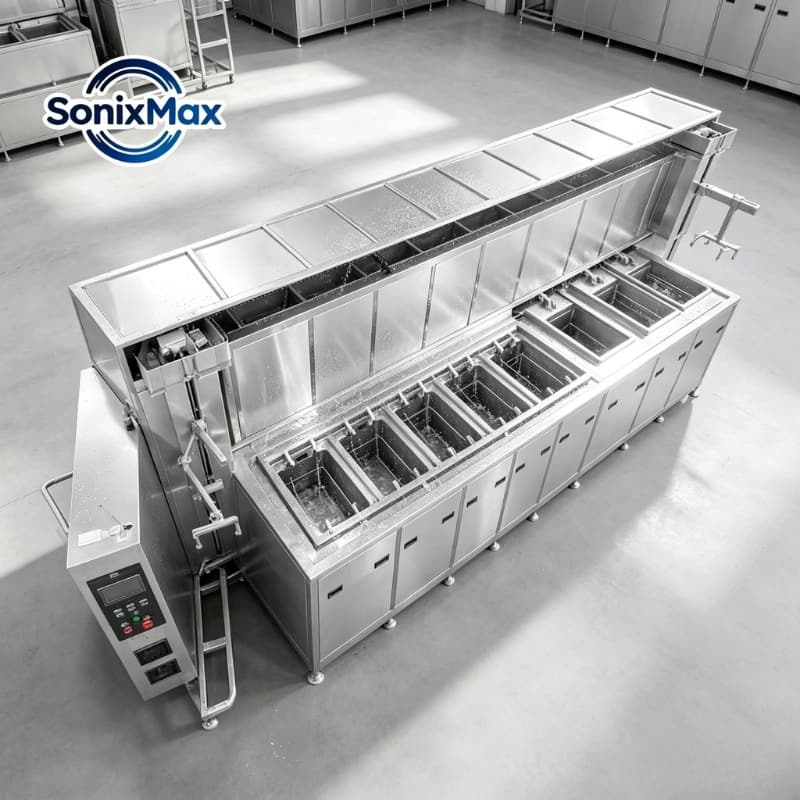
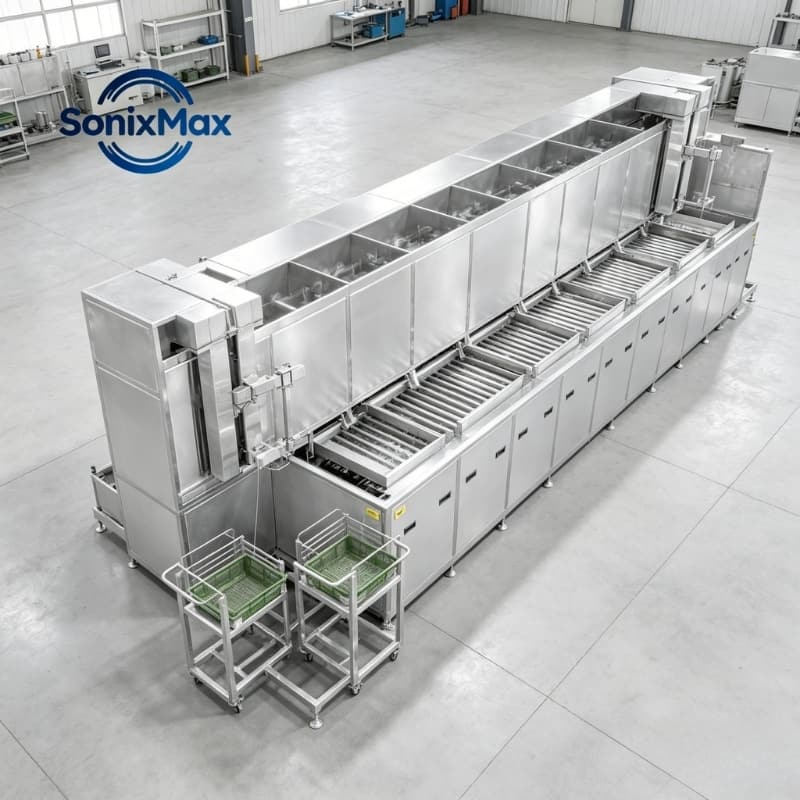
Automatic series
Automatic Vacuum Ultrasonic Cleaning System with PLC & Manipulator Robot Arm
This automatic ultrasonic cleaning system features PLC control, HMI interface, and a manipulator robot arm for automated operation. With adjustable ultrasonic power (0-100%), heating up to 95°C, automatic frequency tracking, and multi-stage processes including cleaning, rinsing, and hot air drying, the system supports efficient and repeatable cleaning workflows with reduced manual handling. Optional filtration, lifting system, and custom tank configurations are available.
Automated Cleaning for Multi-Stage Production
Industrial components with complex geometries, blind holes, internal passages, or demanding cleanliness requirements may require several treatment stages rather than a single ultrasonic cleaning process.
When baskets are manually transferred between separate cleaning, rinsing, and drying stations, manufacturers may face inconsistent process timing, repeated handling, contamination carry-over, and difficulty coordinating the complete cleaning cycle.
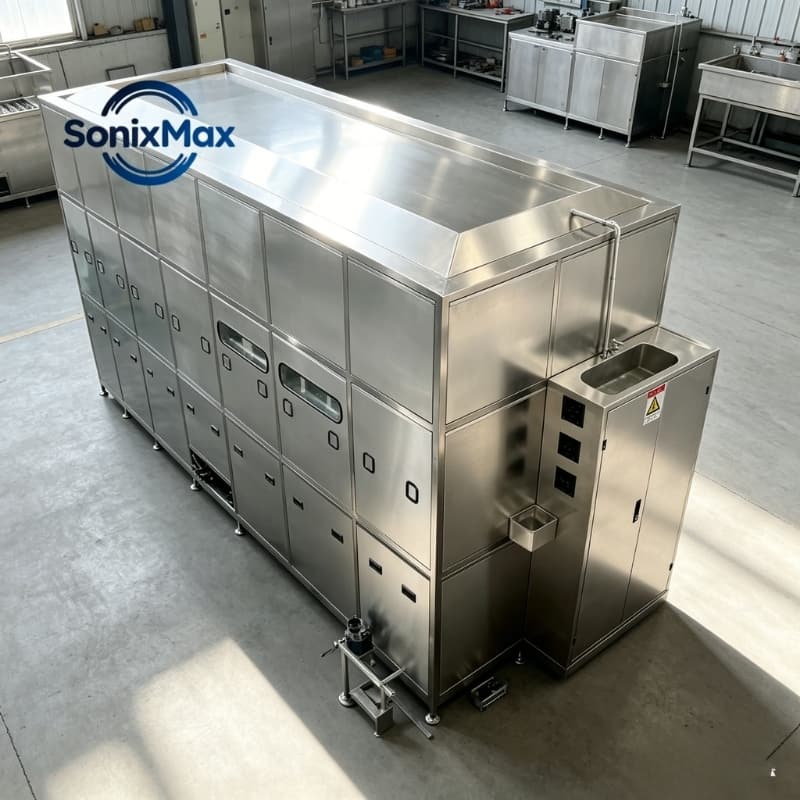
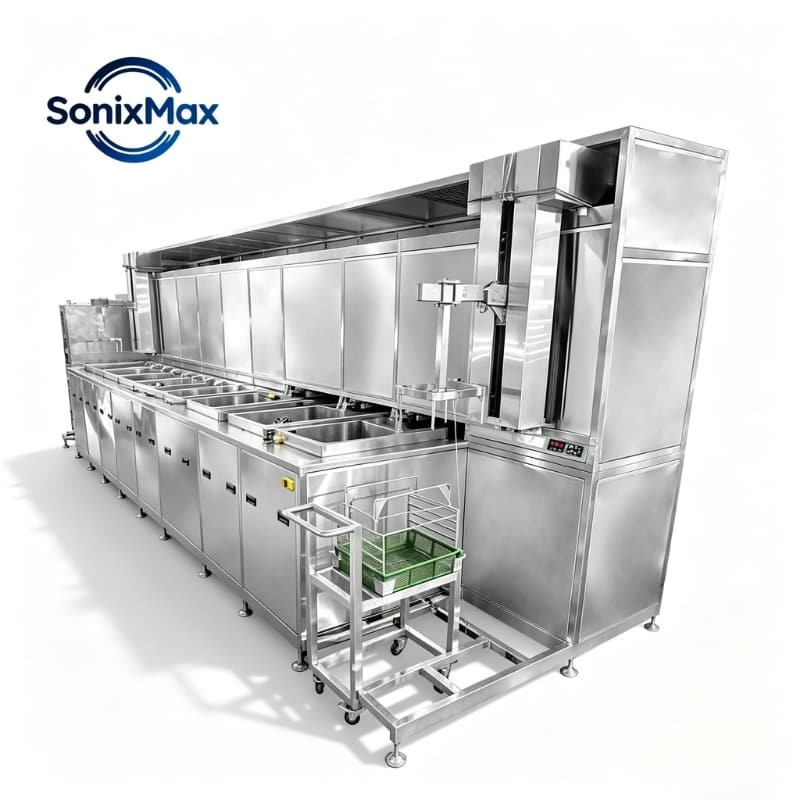
The SonixMax AUTO Series combines these operations into one automated line. A PLC-controlled manipulator transfers baskets through the programmed process sequence, allowing cleaning, rinsing, dewatering, and drying stages to operate as one coordinated system.
This configuration is particularly suitable for manufacturers looking to reduce manual basket handling and integrate multi-stage cleaning into a more controlled production workflow.
How the Automated Cleaning System Works
The cleaning line is managed through a PLC control system with HMI touchscreen, while an overhead manipulator automatically transfers workpiece baskets between the configured process stations.
A representative process for this system is:
Loading → Ultrasonic Rough Cleaning → Spray Rinsing → Ultrasonic Fine Cleaning → Bubbling Rinsing → Ultrasonic Rinsing → Wind Blow Dewatering → Hot Air Drying → Unloading
Each treatment stage performs a different function within the complete cleaning process, while the control and transfer systems coordinate process timing and basket movement.
The number of stations, treatment time, tank dimensions, ultrasonic configuration, and transfer sequence can be adapted according to the workpiece and production requirements.
Typical Cleaning Process
Station | Process |
|---|---|
Loading | Workpiece / Basket Loading |
#1–2 | Ultrasonic Rough Cleaning |
#3 | Spray Rinsing |
#4 | Ultrasonic Fine Cleaning |
#5 | Bubbling Rinsing |
#6 | Ultrasonic Rinsing |
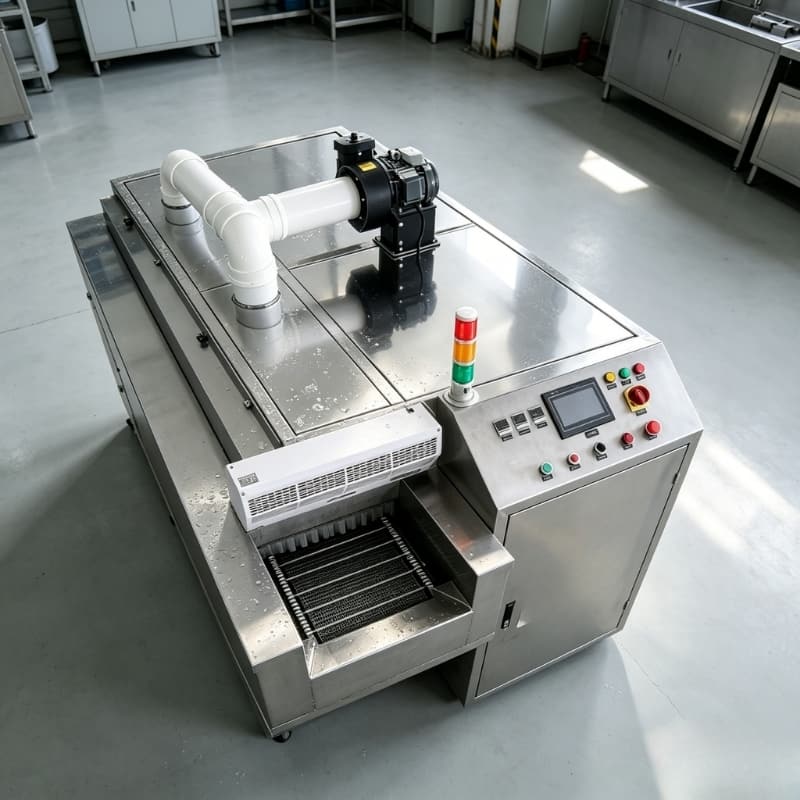
#7 | Wind Blow Dewatering |
#8 | Hot Air Drying |
Unloading | Workpiece / Basket Unloading |
Working Process:
Loading → #1–2 Ultrasonic Rough Cleaning → #3 Spray Rinsing → #4 Ultrasonic Fine Cleaning → #5 Bubbling Rinsing → #6 Ultrasonic Rinsing → #7 Wind Blow Dewatering → #8 Hot Air Drying → Unloading
This process represents a typical configuration for this system. The number of stages and treatment sequence can be adjusted according to the workpiece, contamination, cleanliness requirements, and production process.
Core System Functions
PLC + HMI Process Control
The PLC system coordinates ultrasonic operation, heating, process timing, manipulator movement, rinsing, dewatering, drying, and the overall treatment sequence.
The HMI touchscreen provides a centralized interface for operators to monitor and adjust the cleaning process.
Automatic Manipulator Transfer
An overhead manipulator automatically transfers workpiece baskets between treatment stations according to the programmed sequence.
This reduces repeated manual basket handling while providing controlled movement and more consistent processing between stages.
Manipulator travel, lifting stroke, basket dimensions, load capacity, and transfer sequence can be configured according to the project.
Multi-Stage Ultrasonic Cleaning
The representative process uses different ultrasonic stages for different cleaning requirements.
#1–2 Ultrasonic Rough Cleaning performs the primary contamination-removal process, while #4 Ultrasonic Fine Cleaning provides a subsequent treatment stage before the rinsing process continues.
Ultrasonic frequency, power, tank dimensions, temperature, and treatment time can be configured according to the workpiece material, geometry, contamination, and required cleaning result.
Multi-Method Rinsing
The system combines several rinsing methods rather than relying on one rinse stage.
Spray Rinsing provides directed liquid treatment after rough cleaning.
Bubbling Rinsing introduces liquid movement during the rinsing process.
Ultrasonic Rinsing provides an additional ultrasonic-assisted rinse before dewatering and drying.
The rinsing sequence can be configured according to the cleaning chemistry, contamination carry-over, part geometry, and cleanliness requirements.
Wind Blow Dewatering & Hot Air Drying
After ultrasonic rinsing, the workpiece proceeds to Wind Blow Dewatering to remove residual surface water.
The following Hot Air Drying stage completes the drying process before unloading or downstream manufacturing operations.
Additional Cleaning Technologies
Depending on the workpiece and project requirements, additional process technologies can be integrated into the automated cleaning system.
Vacuum-Assisted Cleaning
Vacuum-assisted cleaning can be used for components with blind holes, internal cavities, or complex passages where trapped air may prevent cleaning liquid from contacting internal surfaces effectively.
The vacuum configuration and its position within the cleaning process should be determined according to the actual application.
Automatic Frequency Tracking
The ultrasonic generator can automatically track the operating frequency to support stable ultrasonic operation as process conditions change.
One-Button Degassing
The degassing function helps remove dissolved air from the cleaning liquid during process preparation, supporting ultrasonic cavitation before cleaning begins.
Filtration & Circulation
Filtration and circulation can be integrated into selected cleaning stages to support cleaning-liquid management during repeated production cycles.
The filtration configuration should be selected according to the contamination type, process liquid, and production requirements.
Technical Specifications
As every automated cleaning line is engineered according to the customer's production process, the specifications below represent a typical system configuration.
Item | Typical Configuration |
|---|---|
Control System | PLC + HMI |
Transfer System | Automatic Manipulator Robot |
Cleaning Process | Multi-Stage Ultrasonic Cleaning |
Rough Cleaning | Ultrasonic Cleaning |
Fine Cleaning | Ultrasonic Cleaning |
Spray Rinsing | Available |
Bubbling Rinsing | Available |
Ultrasonic Rinsing | Available |
Dewatering | Wind Blow Dewatering |
Hot Air Drying | 20–95°C Adjustable |
Vacuum Cleaning | Available / Project-Dependent |
Automatic Frequency Tracking | Available |
Degassing | One-Button Degassing |
Tank Material | SUS304 / SUS316 Optional |
Tank Dimensions | Project-Specific |
Ultrasonic Power | Project-Specific |
Electrical Configuration | Project-Specific |
Detailed tank dimensions, ultrasonic power, tank capacity, manipulator configuration, vacuum configuration, electrical specifications, production capacity, and line layout are determined according to the project requirements.
Typical Applications
This automated ultrasonic cleaning system is intended for production environments where components require multiple cleaning and rinsing stages with automatic transfer.
Application | Typical Cleaning Requirement |
|---|---|
Automotive Components | Machining oil, grease, carbon deposits and particles |
Engine & Powertrain Parts | Complex geometries, internal passages and machining contamination |
Precision CNC Components | Cutting oil, coolant, chips and fine particles |
Hydraulic Components | Oil and contamination in internal passages |
Aerospace Components | Multi-stage cleaning of precision metal parts |
Precision Metal Components | Controlled cleaning, rinsing and drying |
Mold & Die Components | Oil, polishing compounds and production residue |
Hardware Components | Batch cleaning during manufacturing |
Actual process suitability should be evaluated according to the workpiece material, geometry, contamination, cleanliness requirement, and downstream process.
Custom Project Engineering
The AUTO Series is engineered around the customer's production process rather than a fixed machine configuration.
Engineering Area | Available Configuration |
|---|---|
Cleaning Process | Rough cleaning, fine cleaning and multi-stage ultrasonic treatment |
Rinsing Process | Spray, bubbling and ultrasonic rinsing |
Vacuum Process | Vacuum-assisted cleaning where required |
Liquid Management | Filtration and circulation |
Ultrasonic System | Application-specific frequency and power |
Tank System | Custom dimensions, capacity and material |
Workpiece Movement | Agitation / reciprocating movement where required |
Basket Handling | Automatic lifting and manipulator transfer |
Dewatering & Drying | Wind blow, air treatment and hot-air drying |
Process Control | PLC + HMI |
Basket / Fixture | Custom according to workpiece |
Production Integration | Loading, unloading and conveyor interfaces |
Factory Layout | Line arrangement according to installation space |
Electrical System | Destination-specific electrical configuration |
The final configuration should be determined by the required cleaning process rather than by adding unnecessary functions.
How We Configure Your Cleaning Line
Before determining the final system layout, the cleaning process is evaluated around several key requirements.
Workpiece
Part dimensions, material, geometry, blind holes, internal passages, batch quantity, and load weight.
Contamination
Cutting oil, machining coolant, grease, carbon deposits, polishing compounds, metal chips, fine particles, or other production residue.
Cleaning Requirement
Required cleanliness, cleaning chemistry, rinsing requirements, drying condition, and downstream manufacturing process.
Production Capacity
Parts per batch, required cycle time, batches per hour, and daily production volume.
Automation Requirement
Loading and unloading method, manipulator configuration, basket transfer, PLC control, and production-line interface.
Factory Conditions
Available installation space, utilities, voltage, electrical requirements, and factory layout.
These requirements are used to determine the number of stations, process sequence, tank dimensions, ultrasonic configuration, rinsing methods, transfer system, and drying process.
Project Technical Support
SonixMax supports automated cleaning projects from initial process evaluation through system configuration and technical coordination.
Project support can include:
- Cleaning process evaluation
- Equipment and process configuration
- Tank and basket planning
- Production-line layout
- Manipulator configuration
- Electrical configuration
- Factory integration discussion
- Export documentation
- Installation and operating documentation
- After-sales technical coordination
Frequently Asked Questions
Is the 8-stage cleaning process fixed?
No. The process shown on this page represents a typical configuration. The number of stages and treatment sequence can be adjusted according to the workpiece, contamination, cleanliness requirement, and production process.
What is the difference between rough cleaning and fine cleaning?
Rough cleaning focuses on primary contamination removal, while the subsequent fine-cleaning stage provides additional ultrasonic treatment before the workpiece proceeds through the remaining rinsing stages.
Why are different rinsing methods used?
Spray, bubbling, and ultrasonic rinsing provide different liquid-treatment methods. Their combination can be selected according to workpiece geometry, cleaning chemistry, contamination carry-over, and required cleanliness.
When is vacuum-assisted cleaning used?
Vacuum-assisted cleaning can be considered for workpieces with blind holes, internal cavities, or complex passages where trapped air may interfere with liquid contact.
Its position within the process is determined according to the application rather than being fixed to a specific station.
What does the automatic manipulator do?
The manipulator transfers workpiece baskets between cleaning, rinsing, dewatering, and drying stations according to the programmed sequence, reducing manual basket transfer between stages.
Request an Automated Cleaning Solution
To evaluate the appropriate automated cleaning process, please provide your part drawings or photos, dimensions, material, contamination, batch quantity and weight, required cleanliness, current cleaning process, required production capacity or cycle time, factory layout, voltage, and destination country.
SonixMax can then evaluate the required cleaning stages, rinsing process, ultrasonic configuration, transfer system, drying method, and overall production-line layout.