Oct 6, 2026Ultrasonic Cleaning Technology
28kHz vs. 40kHz Ultrasonic Cleaner: How to Choose the Right Frequency
Learn the engineering differences between 28kHz and 40kHz ultrasonic cleaning frequencies. Find out which frequency is suitable for your industrial parts to avoid surface damage.
28kHz and 40kHz are two common industrial ultrasonic cleaning frequencies, but they are not interchangeable in every application.
For manufacturing engineers, machinists, and workshop managers, assuming that a higher frequency is simply “better” or “more powerful” can lead to poor cleaning results, unnecessary process changes, or surface damage on sensitive parts.
The short answer: 28kHz is usually better suited for robust parts and stubborn contamination, while 40kHz is often the safer and more versatile choice for precision parts, mixed materials, blind holes, grooves, and softer metals.
Here is how to choose the right frequency for your industrial cleaning process.
Quick Answer: 28kHz vs. 40kHz
Feature | 28kHz | 40kHz |
|---|---|---|
Cavitation bubble size | Larger bubbles | Smaller, finer bubbles |
Cleaning action | Stronger and more aggressive | Gentler and more evenly distributed |
Best used for | Heavy grease, carbon, robust parts, steel, cast iron, tooling | Machined parts, aluminum, brass, blind holes, fine threads, mixed materials |
Typical part profile | Durable parts with less sensitive surfaces | Detailed parts or parts with surface finish requirements |
Main risk | May be too aggressive for soft metals, polished surfaces, thin parts, or precision finishes | May take longer on very heavy or hardened contamination |
Typical buyer question | “How do I remove stubborn contamination from durable parts?” | “How do I clean detailed parts without unnecessary surface risk?” |
Rule of thumb: If your facility handles a wide mix of parts, 40kHz is often the safer starting point. Use 28kHz intentionally when the parts are durable and the contamination requires stronger mechanical cleaning action.
Why Frequency Matters
Ultrasonic cleaning works through cavitation. Sound waves create bubbles in the cleaning liquid, and the collapse of those bubbles helps remove contamination from the part surface.
Frequency affects the size and behavior of those cavitation bubbles.
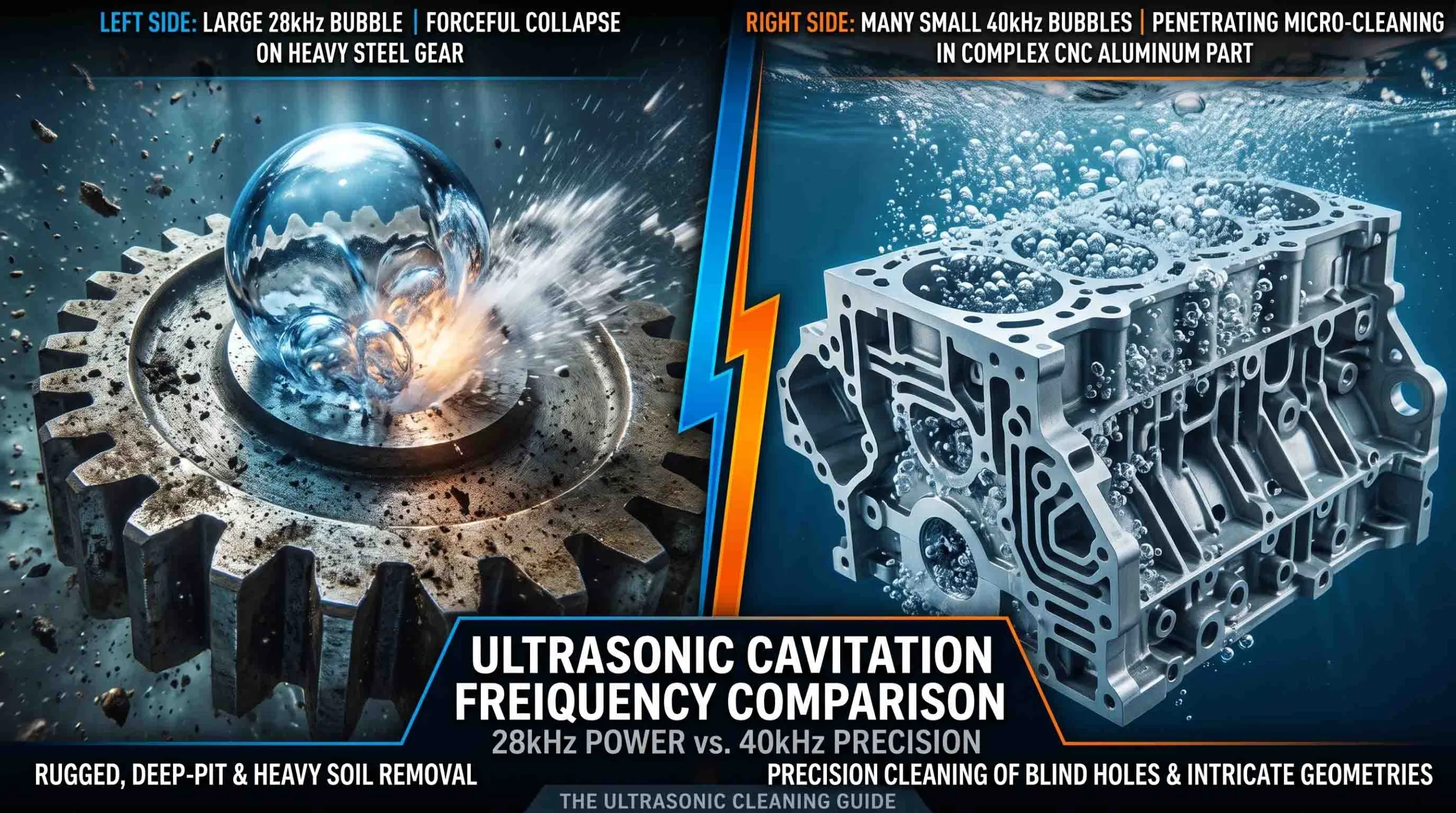
- Lower frequencies, such as 28kHz, create larger cavitation bubbles with stronger collapse energy. This can help remove heavy contamination from durable parts, but it can also be more aggressive.
- Higher frequencies, such as 40kHz, create smaller and more evenly distributed cavitation bubbles. This can be better for detailed geometry, internal features, and parts that need a gentler cleaning action.
The goal is not to choose the “strongest” frequency. The goal is to choose the frequency that matches the part material, contamination, geometry, and required cleaning result.
When to Choose a 28kHz Ultrasonic Cleaner
A 28kHz ultrasonic cleaner is usually selected for heavier-duty industrial cleaning.
It may be suitable for:
- cast iron parts
- steel components
- heavy machinery parts
- molds and tooling
- large durable metal parts
- parts with heavy grease, oil, carbon, or stubborn contamination
The main advantage of 28kHz is stronger mechanical cleaning action. For robust parts with heavy contamination, this can be useful.
However, that strength also creates risk. 28kHz may be too aggressive for:
- soft aluminum
- brass
- thin parts
- polished surfaces
- coated parts
- precision-machined surfaces
- parts with tight surface finish requirements
Before using 28kHz in production, test it with the actual part material, contamination, cleaning solution, temperature, time, and loading method.
When to Choose a 40kHz Ultrasonic Cleaner
A 40kHz ultrasonic cleaner is often used as a general-purpose industrial frequency because it provides a more balanced cleaning action.
It may be suitable for:
- CNC precision machined parts
- aluminum and brass components
- stainless steel parts
- parts with blind holes, internal threads, and grooves
- carburetors, fuel injectors, and valve bodies
- medical, optical, laboratory, or electronic components when the process and chemistry are compatible
40kHz does not mean weak. It means a different cleaning action.
For many industrial users, 40kHz is a practical starting point when the parts are varied, the material is not extremely robust, or the cleaning process needs to balance cleaning performance and surface safety.
28kHz vs. 40kHz by Cleaning Scenario
Cleaning Scenario | Better Starting Point | Why |
|---|---|---|
Heavy carbon on cast iron | 28kHz | Stronger cavitation can help with stubborn contamination |
Heavy grease on steel parts | 28kHz | More aggressive cleaning action may help remove bulk soil |
Aluminum CNC machined parts | 40kHz | Lower risk of aggressive surface attack |
Brass or polished parts | 40kHz or higher | Gentler cleaning is usually safer |
Blind holes and fine threads | 40kHz | Smaller bubbles can better support detailed geometry cleaning |
Heavy injection molds | 28kHz or dual-frequency | Depends on material, residue, and surface finish requirement |
Mixed workshop or mixed production | 40kHz or dual-frequency | Provides a safer starting point and more process flexibility |
These are starting points, not universal rules. Always check material compatibility, chemistry, temperature, time, loading, and cleaning result before finalizing the process.
What About Dual-Frequency Ultrasonic Cleaners?
If your facility cleans heavy steel parts one day and aluminum or precision parts the next, one fixed frequency may be limiting.
A dual-frequency ultrasonic cleaner, such as a 28kHz / 40kHz system, allows operators to choose the frequency based on the part and contamination.
For example:
- Use 28kHz when stronger cleaning action is needed for durable parts.
- Use 40kHz when the part has finer geometry, softer material, or a more sensitive surface.
Dual-frequency equipment does not remove the need for process testing. It simply gives the user more flexibility when the workload changes.
Frequency Is Only One Part of the Cleaning Process
Choosing the right frequency is important, but it will not fix a poorly controlled cleaning process.
The final cleaning result also depends on:
- cleaning chemistry
- temperature
- cleaning time
- ultrasonic power
- tank size
- basket design
- part loading
- degassing
- filtration
- rinsing
- drying
- material compatibility
For example, heated cleaning solution can improve many degreasing processes, but the suitable temperature depends on the cleaning chemistry, material, and contamination. Overheating the wrong chemistry or cleaning sensitive materials at the wrong temperature can create new problems.
If you are also comparing process functions, see Degas and Sweep Functions in Ultrasonic Cleaners Explained.
Equipment Direction for Industrial Buyers
Choosing the right frequency is the first step toward building a reliable cleaning process. Depending on your throughput and part complexity, consider these product directions:
- For general industrial batch cleaning: Industrial Single Tank Ultrasonic Cleaner with Heating
- For oily parts or repeated cleaning cycles: Industrial Single Tank Ultrasonic Cleaner with Filtration System
- For mixed cleaning needs: Digital Dual-Frequency Benchtop Ultrasonic Cleaner
- For system selection: How to Choose the Right Industrial Ultrasonic Cleaner
FAQ
Is 28kHz too strong for aluminum?
It can be. Without proper control of time, chemistry, temperature, and loading, 28kHz may cause surface changes on some aluminum, brass, polished, or thin parts. 40kHz is usually a safer starting point for these materials.
Is 40kHz good for ultrasonic cleaning?
Yes. 40kHz is commonly used as a general-purpose ultrasonic cleaning frequency because it provides a balanced cleaning action for many industrial and commercial cleaning tasks.
What frequency is best for engine parts?
It depends on the engine part. Cast iron or steel engine parts with heavy carbon may use 28kHz, while aluminum cylinder heads, carburetors, and fuel injectors may be better suited to 40kHz. For more detail, see What Frequency is Best for Cleaning Engine Parts?.
Do I need a dual-frequency ultrasonic cleaner?
A dual-frequency cleaner may be useful if your facility processes a varied mix of parts, such as heavy steel components and more sensitive aluminum or precision parts. It provides flexibility, but the correct process still depends on the part and contamination.
Need Help Choosing the Right Ultrasonic Frequency?
If you are unsure whether your parts require 28kHz, 40kHz, or dual-frequency cleaning, send Sonixmax your application details:
- part material and dimensions
- contamination type
- surface finish requirements or critical tolerances
- daily batch quantity
- current cleaning bottleneck
- required cleaning result
- whether filtration, rinsing, drying, or automation is needed
Sonixmax can help evaluate a suitable ultrasonic frequency, cleaning process, and equipment configuration based on your parts, contamination, and required cleaning result.
- surface finish requirements or critical tolerances
- daily batch quantity
- current cleaning bottleneck
- required cleaning result
- whether filtration, rinsing, drying, or automation is needed
Sonixmax can help evaluate a suitable ultrasonic frequency, cleaning process, and equipment configuration based on your parts, contamination, and required cleaning result.