Oct 7, 2026Ultrasonic Cleaning Technology
Degas and Sweep Functions in Ultrasonic Cleaners Explained: Do You Need Them?
Learn how degas and sweep functions in ultrasonic cleaners eliminate dead zones, protect delicate parts, and improve industrial cleaning consistency.
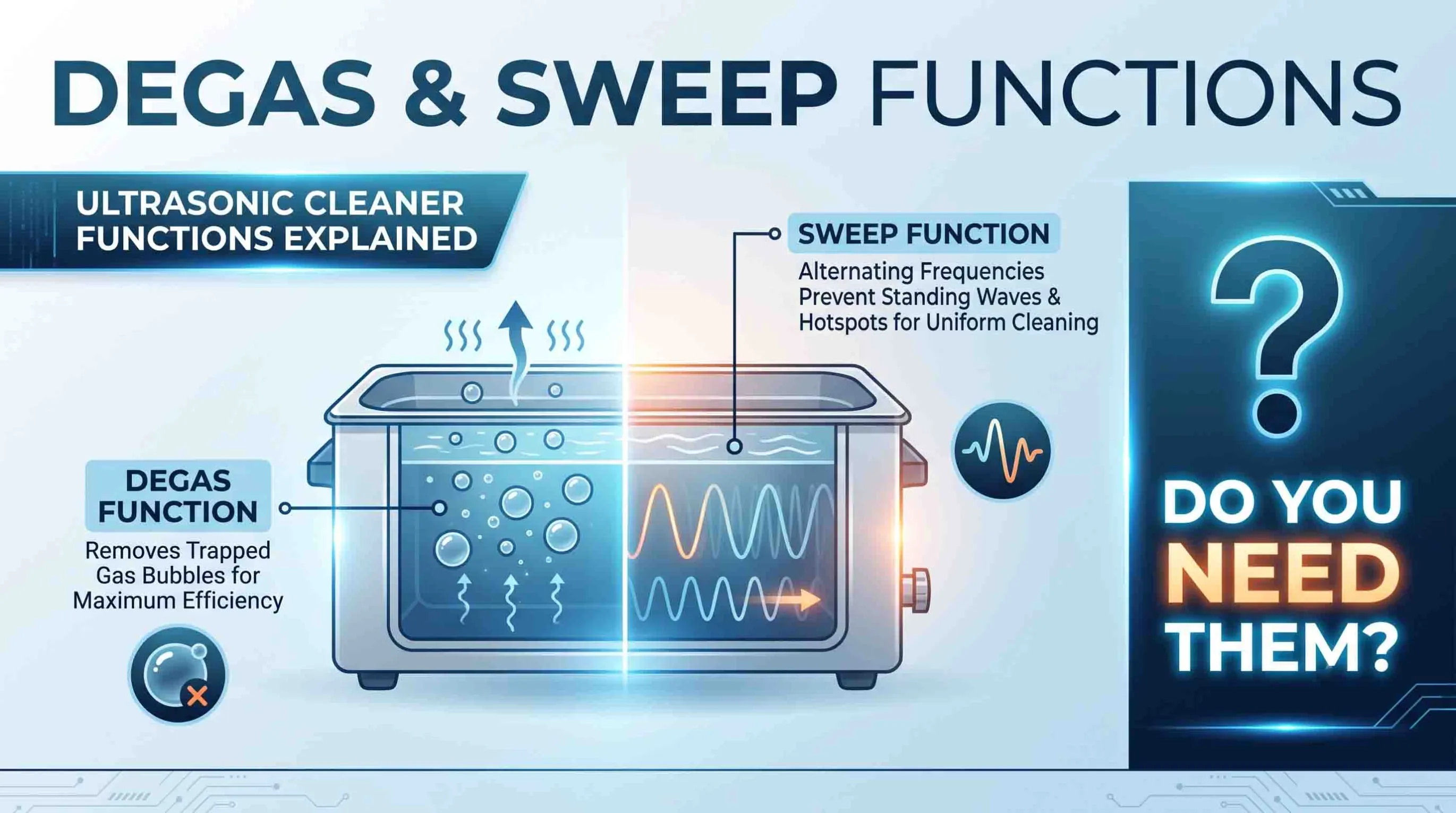
If you operate industrial or commercial ultrasonic cleaning equipment, you may have encountered two frustrating scenarios.
First, after mixing a fresh batch of cleaning solution, the cleaning performance drops significantly, leaving contaminants in blind holes. Second, when cleaning delicate components like printed circuit boards (PCBs) or machined aluminum parts, some areas suffer from surface erosion while other areas remain dirty.
These issues are rarely caused by a lack of ultrasonic power. Instead, they usually point to the absence of two critical generator technologies: Degas and Sweep functions.
For industrial manufacturers and equipment distributors, understanding these features is essential for configuring the right cleaning process. This guide explains the science behind these functions, how they impact your workflow, and how to determine if your application requires them.
Why It Happens: The Science Behind the Problems
To understand why degas and sweep functions exist, we must first look at the physics of ultrasonic cavitation and the challenges of fixed-frequency generators.
The Gas Problem: Cavitation Buffering
Ultrasonic cleaning relies on cavitation—the rapid formation and collapse of microscopic vacuum bubbles. However, fresh tap water and newly mixed cleaning solutions contain high levels of dissolved air.
When the ultrasonic transducers generate high-pressure waves, these dissolved gas bubbles act as shock absorbers. Instead of collapsing violently to scrub the part, the bubbles simply compress and expand, cushioning the cavitation energy. Furthermore, trapped air inside blind holes prevents the cleaning liquid from entering, leaving those specific areas completely uncleaned.
The Standing Wave Problem: Hot Spots and Dead Zones
Standard ultrasonic cleaners operate on a fixed frequency (e.g., exactly 40kHz). In a confined stainless steel tank, a fixed frequency creates "standing waves."
Think of standing waves as a fixed grid inside the liquid. At the nodes of this grid, the ultrasonic energy cancels out, creating dead zones where no cleaning occurs. At the antinodes, the energy doubles, creating hot spots. If a delicate part sits in a hot spot for too long, the concentrated energy can cause cavitation erosion (pitting) on the substrate.
Possible Solutions: Degas and Sweep Functions Explained
Advanced ultrasonic generators solve these physical limitations through specific frequency modulations. Here is how they work and the business value they provide.
The Degas Function
- Feature: The ultrasonic generator operates in intermittent pulses, turning the transducers on and off in rapid succession.
- Advantage: This pulsing action forces microscopic dissolved gas bubbles to coalesce (merge together), grow larger, and quickly float to the surface of the liquid.
- Business Benefit: Reduces fluid preparation time from hours to just 5–10 minutes. It ensures that your production line can resume immediately after a fluid change with consistent cavitation energy. It also enables the cleaning solution to penetrate deep blind holes and complex geometries without air-pocket interference.
The Sweep Function
- Feature: The generator continuously modulates the ultrasonic frequency back and forth around a central target (for example, sweeping between 38kHz and 42kHz).
- Advantage: This constant frequency shifting prevents standing waves from forming. It continuously moves the high and low-pressure zones throughout the tank.
- Business Benefit: Eliminates dead zones and hot spots, ensuring uniform cavitation energy across the entire tank. This protects delicate parts from localized surface damage while supporting more consistent cleaning across larger batches.
Selection Criteria: Do You Really Need Them?
Not every cleaning application requires advanced generator functions. Equipment selection should be based on your specific industry challenges and workflow requirements.
When to Choose the Degas Function:
- High-Turnover Environments: Laboratories or workshops that need to change cleaning fluids multiple times a day.
- Complex Geometries: Automotive or aerospace manufacturing where parts feature deep blind holes, internal channels, or threaded cavities (e.g., fuel injectors, manifolds).
When to Choose the Sweep Function:
- Delicate Substrates: Cleaning PCBs (flux removal), silicon wafers, precision optics, or highly polished jewelry where surface erosion is unacceptable.
- Medical & Dental: Pre-sterilization of surgical instruments, ensuring no dead zones compromise the biological safety of the tools.
- Batch Consistency: High-volume manufacturing where parts placed in the corners of the basket must be as clean as those in the center.
When Standard (Fixed Frequency) is Enough:
- Heavy-duty degreasing of cast iron engine blocks.
- Simple rust or carbon removal on robust steel tools.
- Applications where surface finish is not critical and parts are manually moved around during the cleaning cycle.
Recommended Equipment
Matching the right equipment to your production volume is critical for ROI.
For Laboratories, Clinics, and Light Manufacturing:
If you process smaller batches but require high precision, SonixMax Digital Benchtop Ultrasonic Cleaners are designed for these environments. These commercial units come standard with one-touch Degas and Sweep modes, allowing operators to prepare fluids quickly and protect delicate instruments without complex programming.
For High-Volume Industrial Production:
For continuous manufacturing lines, SonixMax Industrial Ultrasonic Cleaning Systems utilize advanced sweep-frequency generators. Whether configured as a single-tank heavy-duty cleaner or a multi-stage automated line, the industrial sweep technology ensures uniform cleaning across large baskets, supporting repeatable quality control for automotive, aerospace, and electronics manufacturers.
Common Mistakes in Ultrasonic Cleaning
Even with the right equipment, improper operation can hinder performance. Avoid these common errors:
- Skipping the Degassing Cycle:
Many operators add fresh water and detergent, drop the parts in immediately, and wonder why the cleaning is poor. Always run the degas function (or run the machine empty) for 5-10 minutes after every fluid change.
- Assuming "Louder" is Better:
Fixed-frequency machines often produce a harsh, loud screeching noise due to standing waves. Sweep frequency machines often sound smoother and quieter. Operators sometimes mistakenly believe the quieter sweep mode is less powerful, when in fact, it is distributing the energy more efficiently.
Optimize Your Cleaning Process
Understanding the technical parameters of ultrasonic cleaning is the first step toward improving your production efficiency. If you are experiencing inconsistent cleaning results, surface damage to delicate parts, or bottlenecks during fluid changes, upgrading to equipment with Degas and Sweep capabilities may resolve your workflow issues.
Not sure which configuration fits your industrial application?
FAQ
What does the degas function do in an ultrasonic cleaner?
The degas function helps remove trapped air and dissolved gas from fresh cleaning liquid. This matters because excessive gas in the bath can weaken cavitation and make ultrasonic cleaning less consistent at the beginning of a cleaning cycle.
Degassing is most useful after filling the tank with new liquid, adding fresh cleaning solution, or replacing the bath.
Do I need to use degas every time?
Not always. Degas is mainly useful when the bath is fresh or has recently been changed. If the same cleaning liquid has already been running for some time, the bath may already be partly degassed through normal ultrasonic operation.
What does the sweep function do in an ultrasonic cleaner?
The sweep function slightly varies the ultrasonic frequency during operation. This can help reduce fixed standing-wave patterns, hot spots, and weak zones in the tank.
Sweep does not replace proper tank size, part positioning, cleaning chemistry, or process testing. It is a supporting function for improving cleaning consistency.