Oct 20, 2026Ultrasonic Cleaning Technology
Can Ultrasonic Cleaning Remove Burrs? Cleaning vs. Deburring for Machined Parts
Compare ultrasonic cleaning and deburring, distinguish loose chips from attached burrs, and define cleanliness and edge requirements before choosing equipment.
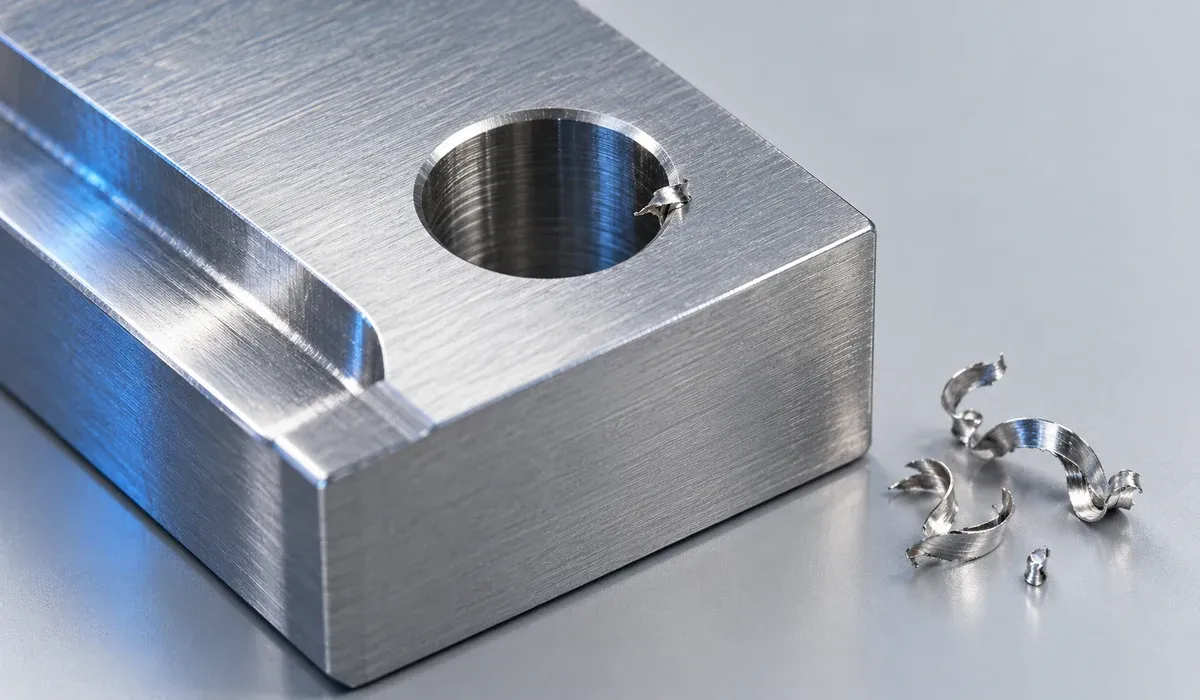
A machined component can come out of an ultrasonic cleaner free of visible oil and still have a metal burr at a drilled hole or milled edge. That does not automatically mean the cleaner has failed. The remaining feature may require a different manufacturing operation.
When comparing ultrasonic cleaning vs deburring, start by defining what must be removed. Loose chips, oily residue and metal still attached to the workpiece are different targets. A cleaning specification should not silently become a promise to change the part's edges.
Quick Answer: Cleaning and Deburring Need Different Proof
Do not specify a conventional ultrasonic cleaning tank as a replacement for deburring unless the proposed process has demonstrated repeatable burr removal and acceptable part condition under the relevant operating conditions.
Ultrasonic cleaning uses cavitation in a suitable liquid to assist contamination removal. Deburring addresses unwanted material remaining at a manufactured edge or feature. Some specialized processes use ultrasonic energy to assist deburring, but that does not establish the same capability in an ordinary cleaning tank.
What remains on the part? | What needs to be evaluated? | What a successful cleaning trial does not establish by itself |
|---|---|---|
Oil, coolant or process film | Compatible chemistry and removal to the required cleanliness level | That the edges meet the drawing |
Loose chips or detached debris | Release, access and removal from the relevant surfaces or passages | That attached burrs have been removed |
A burr still connected to the workpiece | A suitable burr-removal process and the resulting edge condition | That a higher-wattage cleaner can perform the operation |
Residue from a finishing operation | A cleaning process suited to the actual residue and part | That finishing and dimensional requirements have been met |
For the broader equipment decision, our industrial ultrasonic cleaner selection guide explains how parts, contamination and production requirements shape the configuration.
Loose Chips, Attached Burrs and Residue Are Different Problems
- Loose chips: Material already separated from the workpiece, although it may remain trapped in a recess or held by oil.
- Attached burrs: Material still connected to the workpiece at an edge or feature.
- Process residue: Films, particles or material left by an earlier operation.
Use that distinction to define the evaluation:
These are evaluation targets, not guaranteed results or a prescribed equipment combination. One part may require both.
These conditions can occur on the same component. For example, a drilled part may carry cutting fluid, detached chips and a burr around the hole. Removing the fluid does not demonstrate chip removal, and removing chips does not prove the hole edge is acceptable.
Describe the remaining condition before changing equipment settings. Useful evidence includes the feature location, a close-up image, the preceding operation and the applicable drawing requirement. Where a photograph cannot distinguish debris from an attached feature, appropriate inspection is needed.
A supplier receiving only “metal remains after cleaning” does not yet have enough information to recommend a process.
What a Conventional Ultrasonic Cleaning Process Can Be Evaluated For
For machined parts, a cleaning trial can evaluate whether the proposed combination of ultrasonic action, chemistry, temperature, time and loading removes the identified contamination.
The liquid must contact the relevant surfaces, and released contamination needs a way to leave them. A chip dislodged inside a passage is not necessarily a chip removed from the part. Geometry and the subsequent removal or rinsing arrangement therefore matter alongside the ultrasonic stage.
When the issue is access or trapped debris, review basket loading and liquid access. Better positioning or a different fixture may deserve evaluation before increasing power or extending the cycle.
A larger wattage figure is not proof of deburring capability. Our explanation of ultrasonic cleaner power ratings also shows why power labels need a defined basis before they can be compared.
For suitable applications, our industrial cleaner with controlled load movement offers an additional cleaning-process variable. Its load movement should be evaluated against the actual parts and loading arrangement. It should not be presented as evidence that the machine can remove attached burrs or produce a specified edge radius.
Why “Ultrasonic Deburring” Does Not Automatically Mean a Standard Cleaning Tank
The word “ultrasonic” describes an energy source or process element; it does not fully define the equipment, working medium or material-removal mechanism.
For example, a study by Kumar, Deb and Paul investigated an ultrasonic-assisted abrasive micro-deburring process using a probe sonicator. The reported mechanism involved abrasive impacts assisted by cavitation. That is a specific experimental process, rather than evidence that a standard ultrasonic cleaning bath provides equivalent deburring performance.
When a supplier proposes ultrasonic deburring, ask what the process actually uses and what evidence supports the claim:
- What equipment and working medium were used?
- Which burr locations and part materials were evaluated?
- What changed at the edge, surface and relevant dimensions?
- How was the result inspected against the requirement?
- Does the evidence apply to the proposed production load?
Do not transfer a specialized process's results to another machine simply because both use ultrasonic energy. Adding abrasive media to a conventional cleaning tank should not be treated as an approved conversion to deburring equipment.
Where Cleaning Fits After a Deburring Operation
A deburred part may still need cleaning. Depending on the preceding process, it can carry detached particles, processing liquid, abrasive residue or contamination introduced during handling.
The cleaning task should identify those residues and the condition required before assembly, coating, inspection or packaging. A process that removed machining oil before deburring may need reassessment if the later operation introduces a different residue.
An evaluation sequence might be:
This sequence illustrates separate responsibilities. It does not prescribe every production route. Some parts need cleaning before and after another operation; the actual sequence should follow the manufacturing and acceptance requirements.
A simpler cleaning arrangement may be sufficient when it achieves the required result. Load movement, filtration, additional tanks or automation should be justified by the contamination, handling and production need.
Define Two Acceptance Requirements: Cleanliness and Edge Condition
A part that looks clean has not necessarily passed an edge requirement. Equally, an acceptable edge does not demonstrate that the part is free of unwanted residue.
Keep the two requirements visible in the sample evaluation:
Evaluation | Define before the trial | Record afterward |
|---|---|---|
Cleanliness | Target contamination, critical surfaces and the applicable inspection method | Observed residue or measured result under the agreed method |
Burr and edge condition | Relevant locations and drawing or customer requirements | Remaining burrs and the resulting edge condition |
Part integrity | Relevant dimensional, finish and surface restrictions | Inspection results for those restrictions |
Production relevance | Representative parts, incoming condition and intended loading | Actual process settings, load and any differences from production |
Use inspection methods appropriate to the feature and requirement. An external photograph may help document a trial, but it cannot establish the condition of every internal surface or the absence of small burrs.
Prepare representative parts and agreed criteria before comparing equipment. Our guide to preparing sample parts for a cleaning trial supports that discussion.
If a trial demonstrates cleaning but does not assess burr removal, record exactly that. Do not expand a successful cleaning result into an untested deburring claim.
What to Send Before Requesting Equipment Advice
To evaluate cleaning within a machining or deburring workflow, provide:
- Part drawings, material, dimensions and relevant surface details.
- Photos identifying the burr, debris or residue, including its location.
- The preceding machining, deburring or finishing operation.
- Any processing liquids or media that may remain on the part.
- Burr, edge, dimensional and surface requirements, where applicable.
- The cleanliness requirement and agreed inspection method.
- Batch quantity, basket or fixture arrangement and production rate.
- Existing process settings and representative trial results, if available.
These details help establish whether the project needs a cleaning-process change, a separate deburring evaluation or coordination between both operations.
Technical References
Kumar, Deb and Paul — Research on ultrasonic-assisted abrasive micro-deburring. Journal of Manufacturing Processes; ScienceDirect article identifier S1526612521002565.
Contact us with your drawings and process requirements to discuss a cleaning configuration that can be evaluated against the actual workpiece and production task.