Oct 19, 2026Ultrasonic Cleaning Technology
Ultrasonic Cleaner Power Ratings Explained: Ultrasonic, Heating and Total Power
Understand ultrasonic, heating and total power ratings, compare peak and average claims, and check the information needed before choosing a cleaner.
Two ultrasonic cleaners can carry similar wattage claims and still describe different things. One number may refer to the ultrasonic system, another to the heater, and another to the electrical input of the complete machine. A peak rating may also be presented alongside an average rating without explaining the difference.
For buyers comparing catalogs or quotations, the first task is to identify what each number represents. Ultrasonic cleaner power ratings become useful comparison points when their definitions and operating conditions are clear.
Quick Answer: Compare the Same Type of Power Rating
Keep ultrasonic power, heating power and total electrical input separate. Confirm whether any ultrasonic rating is peak, average, or defined on another basis before comparing suppliers.
Specification | What it helps describe | What to confirm |
|---|---|---|
Ultrasonic power | A rating associated with the ultrasonic system | Where and how the value is defined or measured |
Heating power | The heater's rated power | The heating arrangement and conditions behind any warm-up claim |
Total input power | The electrical input rating of the complete machine | Which components and operating conditions the rating includes |
Peak or average power | The time basis of a stated power value | Measurement point, averaging period, operating mode and duty cycle, where applicable |
A larger number in one category does not establish stronger cleaning performance in another. Start with a complete specification, then assess the equipment against the intended parts and process.
Ultrasonic Power and Heating Power Perform Different Jobs
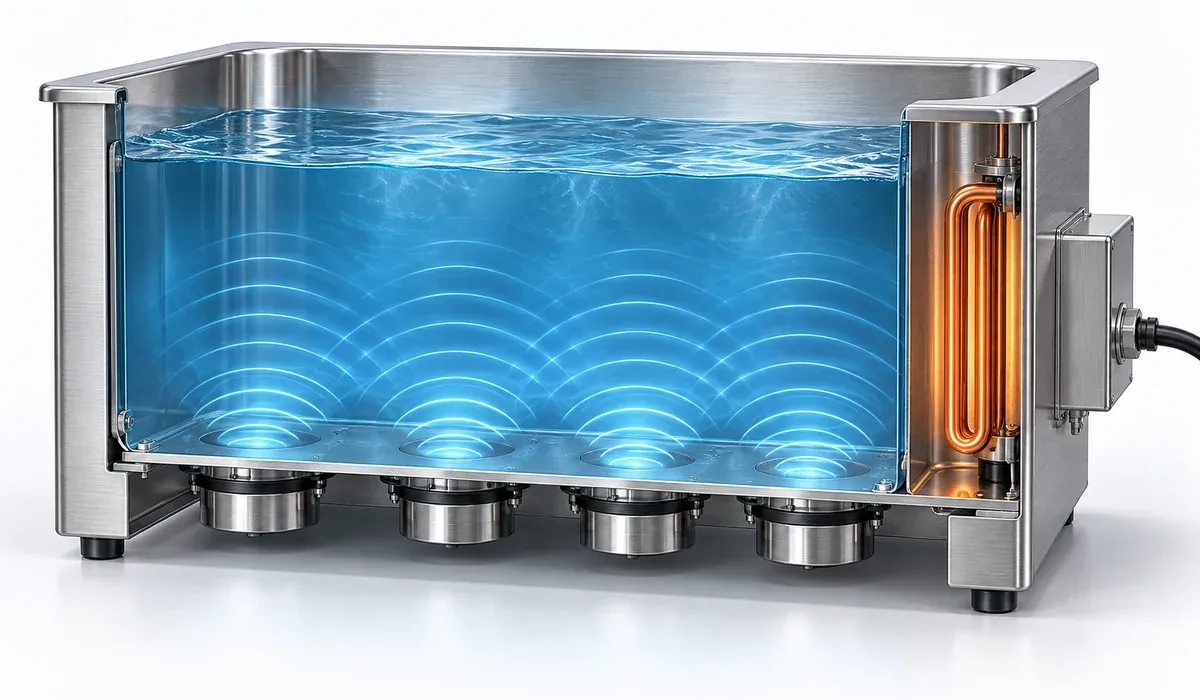
The ultrasonic system produces mechanical vibration in the cleaning liquid to support cavitation. The heater supplies heat to bring the bath toward its temperature setting. Both can matter to the process, but their wattage figures describe different functions.
A functional overview helps separate these roles:
This diagram shows functions, not a measured power balance. The associated ratings and measurement points still need to be defined by the manufacturer.
A cleaning task may need an appropriate combination of ultrasonic action, chemistry, temperature and time. The heater rating alone does not describe ultrasonic capability, and the ultrasonic rating alone does not establish that the process will remove a particular contaminant.
Read Each Field in the Product Table
- Ultrasonic power: 180W.
- Heating power: 300W.
Adding those figures gives an arithmetic sum of 480W. That does not make the machine a 480W ultrasonic cleaner. It also does not independently verify a complete-machine input rating or its electrical supply requirements.
If a quotation states only “480W,” ask which field it represents. Keep the manufacturer's confirmed ultrasonic, heating and electrical-input information as separate entries in your comparison.
Check Heating Claims Separately
When warm-up time matters to production, ask for the conditions behind the claim. The fill volume, starting temperature, target temperature and loading arrangement should be identified so the comparison reflects the intended workflow.
For installation planning, request the manufacturer's confirmed electrical requirements for the destination market. A sum taken from a marketing table should not replace that information.
Peak, Average and Input Power: Ask for the Definition
Peak and average describe how a power value is considered over time. Input and output describe different points in the system. These distinctions need to be resolved before two values can be treated as comparable.
Peak and Average Need a Time Basis
A peak value may describe a brief maximum under specified conditions. An average value describes power averaged over a defined interval. For an operating mode that varies over time, duty cycle may also matter.
Ask whether the figures refer to the same measurement point and operating mode. Do not apply a universal multiplier to convert a peak claim into an average value; the necessary relationship must come from the system's documented operation.
If a supplier uses the label “RMS power,” request its calculation and measurement basis. Do not assume the label is interchangeable with average power.
A supplier should also identify whether the rating represents normal operation or a particular test condition. Two values measured under different loads or settings may answer different questions.
Electrical Input Does Not Directly Describe Cleaning at the Part
The electrical power entering a complete machine may supply the ultrasonic system, heater, controls and other fitted equipment. That input reading does not, by itself, establish the acoustic conditions at a particular surface inside the basket.
Likewise, a catalog field labeled “Ultrasonic Power” should not automatically be interpreted as a calibrated measurement of acoustic power delivered into the liquid. Ask how the manufacturer defines the field.
Where that definition is unavailable, record it as an unresolved comparison point. Filling the gap with an assumed peak, average or measured acoustic value can make a comparison look more precise than the evidence allows.
Why Watts per Liter Needs Context
Watts per liter can help organize a specification comparison, provided the numerator and denominator are defined consistently:
Check which power rating is being used and which liquid volume it is divided by. A ratio calculated from nominal tank capacity should not be silently compared with one calculated from operating fill volume.
The ratio also leaves out important differences between systems. Tank geometry, transducer arrangement, part loading and the cleaning process affect how the equipment performs. A single W/L figure cannot establish that two machines will produce equivalent results.
Avoid using one universal power-density target for every tank size and application. Use the manufacturer's system information and representative-part testing to evaluate the proposed configuration.
If parts overlap or prevent liquid from reaching the relevant surfaces, increasing the quoted wattage may leave the underlying problem unresolved. Review basket loading and ultrasonic shadowing as part of the assessment.
Fixed or Adjustable Power: What Does Your Process Need?
A fixed-power model may be suitable when it meets a defined, repeatable task. Adjustable power deserves consideration when the process needs a controllable setting across different validated operating conditions.
For example, the SNX-DMF-6L model in our digital multi-functional benchtop cleaner range lists an ultrasonic power range of 70–180W and a separate 300W heating rating.
That range describes a product feature. It does not establish that every setting is appropriate for every material, or that a control percentage corresponds linearly to measured acoustic power at the workpiece.
When adjustment matters, ask how the setting is controlled, how it can be recorded, and what operating conditions were used during evaluation. Confirm the selected setting with the intended parts, cleaning solution, loading and acceptance requirement.
For distributors, this distinction helps explain why a customer might choose a particular configuration. It also helps avoid treating the model with more control features as the automatic choice for every buyer. Our guide to building a commercial ultrasonic cleaner product range places those decisions within a broader portfolio.
How to Compare Supplier Specifications and Sample Results
Use two parts of the evaluation: establish what the specifications mean, then check the result the proposed machine produces.
Comparison item | Ask each supplier | Record in the evaluation |
|---|---|---|
Power definition | What does each stated wattage represent? | Separate ultrasonic, heating and complete-machine input fields |
Time basis | Is the ultrasonic value peak, average or another defined rating? | Measurement conditions and any relevant operating mode |
Tank and load | What fill level, basket and load were used? | The arrangement relevant to your intended process |
Process conditions | What chemistry, temperature, time and settings were used? | Conditions that explain the sample result |
Acceptance | How was the cleaned part assessed? | Agreed inspection method and observed outcome |
For a sample comparison, keep the workpiece, contamination and acceptance requirement consistent. Ask each supplier to document its proposed process. If operating conditions differ, retain those differences in the assessment rather than attributing the outcome to wattage alone.
A successful trial should provide evidence for the intended load. One isolated part passing inspection does not automatically establish that a fully loaded production basket will achieve the same result.
What to Send Before Requesting a Model Recommendation
To compare suitable ultrasonic cleaner configurations, provide:
- Part drawings or photos, dimensions, material and relevant surface details.
- The contamination and current cleaning chemistry.
- Basket or fixture layout, batch quantity and required production rate.
- The complete specification or quotation being compared, including the labels attached to power figures.
- Current process settings and any observed cleaning problems.
- The required result and the method used to inspect it.
- Destination voltage, frequency and any documented installation requirements.
These details help separate a specification-label question from an actual cleaning-process requirement and give the supplier a basis for recommending a suitable model.
Contact our team at Sonixmax with your parts and complete equipment specifications to discuss a configuration that can be evaluated against your production needs.