Oct 20, 2026Ultrasonic Cleaning Technology
304 vs 316 Stainless Steel Ultrasonic Cleaner Tanks: What Should Buyers Check?
Compare 304 and 316 ultrasonic cleaner tank materials and learn what chemistry, temperature and wetted-component information to confirm before ordering.
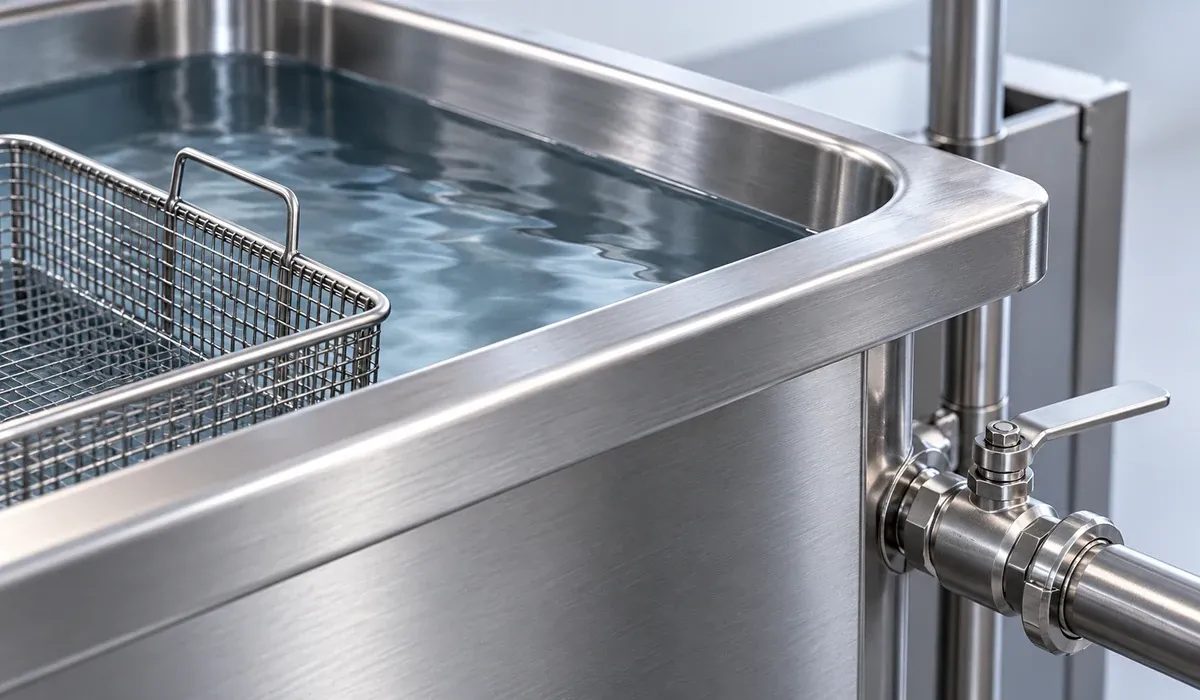
Two quotations may offer similar tank dimensions, ultrasonic power and heating capacity, while specifying different stainless steel grades. One lists 304; the other offers 316. Choosing between them requires more than assuming the higher number means a better cleaning machine.
For a 304 vs 316 ultrasonic cleaner tank comparison, the useful question is whether the proposed material suits the actual cleaning environment. The cleaning liquid, concentration, water supply, contamination, temperature and operating routine belong in that discussion.
Quick Answer: Choose for the Cleaning Environment
304 may be sufficient where its suitability for the intended process is confirmed. Evaluate 316 when the environment warrants greater corrosion resistance, but do not treat either grade as universally corrosion-proof.
The material grade does not establish cleaning performance, compatibility with every chemical, or the service life of a completed tank.
Specification | What it helps identify | What still needs confirmation |
|---|---|---|
304 stainless steel tank | The stated material of the tank | Suitability for the actual liquid and operating conditions |
316 stainless steel tank | A different alloy grade for evaluation | Whether its properties address the identified exposure |
Stainless steel housing | The stated exterior construction | The material of the inner tank and other liquid-contact parts |
Maximum operating temperature | An equipment temperature limit | Chemical compatibility at the intended working temperature |
Material selection is one part of the wider industrial ultrasonic cleaner selection process. Part fit, contamination removal, loading and production requirements still need their own evaluation.
What 304 and 316 Tell You—and What They Do Not
304 is a chromium-nickel austenitic stainless steel. The 316 family includes molybdenum, which can improve resistance to localized corrosion in certain environments. However, neither grade is universally suitable for every cleaning solution or operating condition.
Stainless steel can still suffer corrosion. Chlorides, temperature, chemical concentration, surface condition and fabrication can affect corrosion risk. Tank material should therefore be evaluated against the actual cleaning environment.
A 316 tank therefore does not automatically clean parts faster, deliver stronger cavitation or last a fixed number of years longer than a 304 tank. Those conclusions need evidence beyond the grade label.
Confirm the Exact Material Designation
Ask which material designation and specification the quotation actually covers. If a requirement calls for 316L, do not assume a line reading only “316” resolves it. The L designation identifies a low-carbon variant; the specified material should be confirmed rather than silently substituted.
Similarly, a general “stainless steel” description is not enough to establish the inner tank grade. Record the agreed material clearly in the equipment specification.
Chemistry, Concentration and Temperature Belong Together
A cleaning product name or a single pH reading does not fully describe the environment inside the tank.
Provide the chemical supplier's product information, intended working concentration and operating conditions. Include available information about the make-up water and contaminants carried into the bath by the parts. A fresh solution and a production bath receiving repeated loads may present different conditions.
A useful review brings these inputs together:
Review these inputs together. Neither the water-source label nor a single pH value selects the grade automatically.
Separate Equipment Limits from Chemical Approval
A heater capable of reaching a stated temperature does not establish that every cleaning solution is suitable at that temperature. Likewise, a chemical approved for the workpiece does not automatically establish compatibility with every component of the cleaning machine.
Confirm the proposed combination with the equipment and chemical suppliers. If the cleaning product, concentration or operating routine changes, review whether the earlier material assessment still applies.
A material-compatibility review should consider the chemical environment, concentration, impurities and temperature. Laboratory corrosion data may differ from actual service conditions. Where uncertainty remains, ask what further evaluation is needed instead of treating a reference table as a tank-life guarantee.
Confirm Which Parts Actually Contact the Liquid
An exterior stainless steel panel and an inner cleaning tank perform different roles. A quotation should make their material scope clear.
The review may also need to cover components beyond the tank wall:
Component or area | What to clarify |
|---|---|
Inner tank | Specified grade and the intended cleaning environment |
Basket or fixture | Material and compatibility where it contacts the bath |
Heater surfaces exposed to liquid | Material and chemical restrictions for the fitted arrangement |
Drainage and circulation components | Materials of fitted valves, pipework and pump wetted parts |
Seals and other non-metallic wetted components | Compatibility with the liquid and working conditions |
This is a review checklist, not a statement that every machine includes all these components or uses the same material throughout.
Ask for the confirmed liquid-contact scope in the quotation rather than inferring it from an exterior-housing description. Specifying a 316 tank does not independently confirm the compatibility of a valve, seal or basket. Ask the supplier to identify the scope of the material selection and any remaining restrictions.
Tank Construction Still Matters
Grade selection does not replace an assessment of the completed tank. Weld condition, surface condition and the way the equipment is fabricated can influence corrosion resistance and suitability for service.
Keep three construction questions separate:
- Weld and surface condition: Ask how the proposed fabrication and finishing suit the intended service.
- Plate thickness and design: Evaluate thickness within the equipment design. A single figure does not establish chemical compatibility or ultrasonic cleaning performance.
- Documentation: Agree any required material or inspection documents during quotation rather than assuming they are included with every machine.
The same caution applies when investigating an existing tank problem. A photograph of a mark or pit is not enough to establish whether its cause is corrosion, erosion or another condition. Provide the liquid history, operating conditions and affected location for assessment before choosing a replacement material.
When Standard Material May Be Enough—and When to Evaluate Further
A standard material can be appropriate when the complete proposed configuration is suitable for the intended environment. There is no need to specify a different grade simply because it appears more premium in a catalog.
For example, our industrial single-tank cleaner with filtration lists a standard SUS304 inner tank. The filtration feature and the tank material answer separate questions: managing suspended contamination does not establish chemical compatibility.
Our rectangular ultrasonic cleaner with SUS304/SUS316 options explicitly offers both tank materials, with selection based on the cleaning chemistry and operating environment. This is an example of a model with documented material options, not evidence that every Sonixmax series has identical options. A project requirement for 316L would still need separate confirmation; the listed SUS316 option should not be silently relabeled.
Further evaluation is appropriate when the proposed chemistry is uncertain, the exposure differs from a previously assessed process, or the buyer has specific material requirements. Depending on the assessment, the answer may involve the material, the process conditions, another configuration or additional technical review—not simply changing “304” to “316” on a quotation.
Tank dimensions and the rest of the cleaning process must still suit the parts. A documented material option does not make a particular model the correct size or configuration for every project.
What to Send Before Confirming Tank Material
Before requesting a material recommendation, provide:
- Cleaning-product name, technical information and safety data sheet where available.
- Intended working concentration and any other chemicals entering the process.
- Make-up water information and relevant measured impurities, if known.
- Contamination carried by the parts, including residues from preceding operations.
- Working temperature, contact time and the expected operating routine.
- Part dimensions, batch loading and required cleaning result.
- Materials or documentation specifically required by the project.
- Details of any previous tank issue, including its location and process history.
Unknown information should be identified as unknown rather than replaced with an assumed value. The supplier can then clarify what must be resolved before confirming the configuration.
Include the agreed material scope and operating basis when preparing an ultrasonic cleaner RFQ. This makes the comparison more useful than requesting a grade or price without explaining the intended exposure.
Technical References
Outokumpu — Corrosion resistance: technical guidance on stainless steel corrosion.
Outokumpu — Corrosion tables: technical guidance on chemical exposure, material selection and limitations of laboratory data.
Contact Sonixmax with your cleaning chemistry and process details to discuss tank material and equipment configuration for your application.