Oct 19, 2026Ultrasonic Cleaning Technology
DI Water Rinsing After Ultrasonic Cleaning: When Do You Need It?
Compare tap, RO and DI water for rinsing after ultrasonic cleaning, including carryover, water quality checks and final part acceptance requirements.
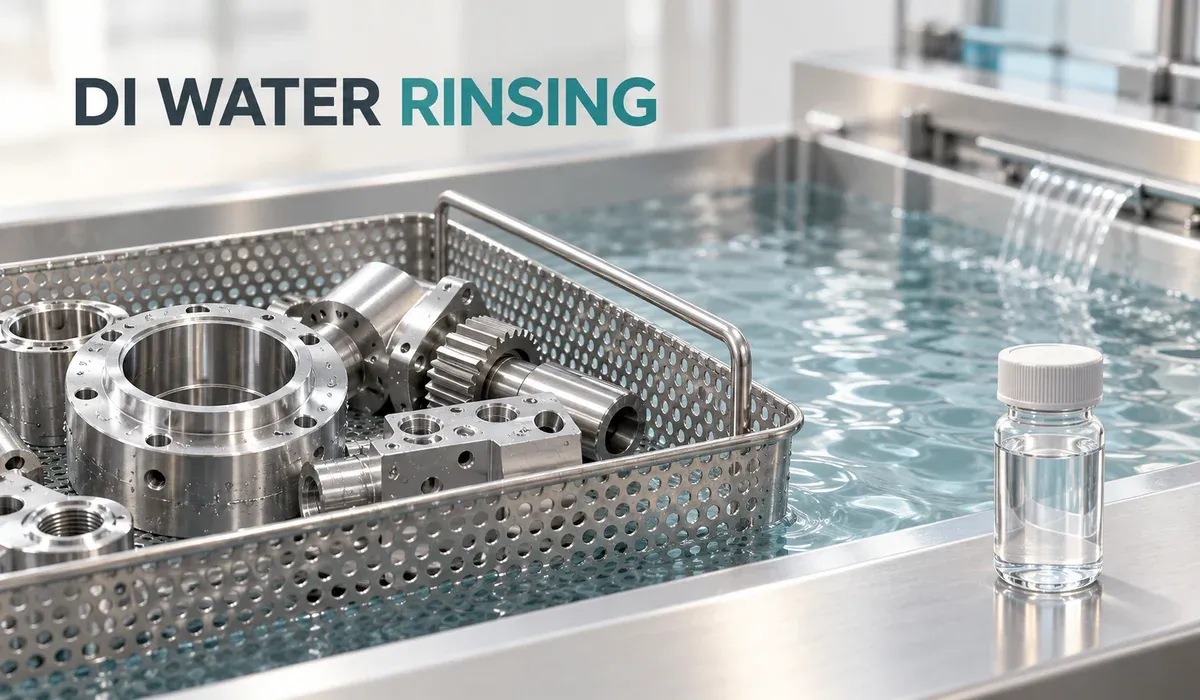
A part can leave an ultrasonic wash visibly clean and still fail the next operation because of what remains after rinsing and drying. Detergent carryover, minerals in the rinse water, or liquid retained in a recess can all affect the result.
A deionized (DI) water rinse after ultrasonic cleaning deserves consideration when dissolved ions and mineral deposits matter to the final part requirement. The decision starts with the required surface condition, the existing water supply, and the way the rinsing process operates.
Quick Answer: Start with the Final Part Requirement
Evaluate DI water for the final rinse when the process needs tighter control of dissolved ions or mineral deposits than the existing water supply and rinsing arrangement can provide. A customer specification may also define the required rinse-water quality.
Ordinary water or RO water may be sufficient where a validated process meets the agreed requirement. Specifying DI water for every application adds a water-quality requirement that may not improve the result the buyer actually needs.
The useful question is: what must the part be ready for after cleaning—assembly, coating, inspection, or packaging—and how will that condition be checked?
What DI Water Changes in the Rinsing Process
Deionized water has been treated to reduce dissolved ions. This can reduce the mineral burden introduced by the water used for rinsing.
However, a DI supply does not establish that the rinse bath is clean or that the finished part meets its acceptance requirement. Once water enters the process, it can receive detergent, contamination from the parts, or material carried over from an earlier stage.
Treat these as three separate checks:
The first check establishes the water supplied to the process. The second checks what contacts the workpiece during production. The third verifies the result against the agreed part requirement.
Dissolved Ions Are One Part of Water Quality
Deionization addresses ionic contamination. It does not, by itself, demonstrate control of every particle, organic contaminant, or microorganism that may matter to a particular application.
This distinction affects equipment selection. A process concerned with mineral deposits needs a different evaluation from one concerned with particles inside a passage. Some applications require attention to both.
DI water also does not replace a suitable cleaning chemistry for oily or greasy parts. The wash must address the contamination; the rinse must then remove the remaining wash solution and contaminants to the required level.
Separate Wash-Water and Final-Rinse Decisions
Water used to prepare the cleaning solution and water used for the final rinse perform different jobs.
The cleaning-chemical supplier's instructions help define suitable make-up water for the wash. The final rinse must be evaluated against the condition required before the next operation.
A requirement for DI final rinsing therefore does not automatically mean that every preceding tank must use the same water quality. Specify each stage according to its purpose and validate the complete sequence.
Tap Water, RO Water, or DI Water: What Should You Evaluate?
These water descriptions identify a source or treatment method. The actual water delivered to the process still needs to suit the application.
Water option | When to evaluate it | What to confirm |
|---|---|---|
Tap water | The existing supply may meet the part's rinse requirement | Supply variation, mineral deposits, and the result after drying |
RO water | A treated supply may provide sufficient reduction in dissolved contaminants | Actual delivered quality, consistency, and performance in the intended process |
DI water | Dissolved-ion control or mineral-deposit limits justify closer control of the final rinse | Quality at the point of use, contamination during rinsing, and the final part result |
RO treatment and deionization operate differently. Their names alone do not define a universal acceptance level, and the required treatment arrangement should follow the incoming supply and the process specification.
Before selecting a water system, establish whether the concern is a visible mark, ionic residue, retained detergent, particles, or another defined requirement. That prevents a general request for “purer water” from replacing a clear process brief.
Why a Clean Water Supply Can Still Produce a Poor Rinse
The water entering the machine is only the starting condition. What happens during production determines the water that contacts the part.
Detergent Carryover Changes the Rinse Bath
When parts and fixtures leave a wash tank, they carry some wash solution with them. That solution enters the next stage unless the transfer and drainage arrangement limits it.
As production continues, a rinse supplied with DI water can accumulate detergent and contamination. Reviewing only the incoming-water reading can miss this change.
Assess the rinse under the intended production load. Consider the amount carried over, the way fresh water reaches the parts, and how contaminated water leaves or is replaced. Additional rinse stages may help in some applications, but their number should follow the required result and process trial.
Geometry and Loading Affect Rinse Contact
Blind holes, threads, overlapping surfaces, and fixtures can retain solution or restrict the exchange of rinse water.
A clean supply cannot compensate for a rinsing arrangement that fails to reach the relevant feature. Review part orientation, loading, drainage, and whether the proposed immersion or spray arrangement contacts the locations that matter.
If pale deposits are already appearing, use our guide to white residue after ultrasonic cleaning to investigate the cause before attributing every mark to water quality.
How to Specify and Check Rinse Water Quality
A useful rinse specification connects the water supply, the operating process, and the finished part. Each needs its own check.
Define Where the Water Will Be Measured
An incoming-water measurement answers a different question from a sample taken from a rinse bath after production has started.
Specify the sampling location and timing. If a measurement is used for process control, define the relevant operating condition and response to a result outside the agreed range. Follow the instrument's measurement and calibration requirements so readings can be interpreted consistently.
Conductivity and resistivity are useful indicators of ionic conditions. They do not provide a complete measurement of particles, organic residues, or overall part cleanliness. A satisfactory water reading should not automatically release a batch whose part-level requirement has not been checked.
There is no single conductivity or resistivity target that should be applied to every ultrasonic-cleaning application. Use the customer's requirements and the validated process to establish the relevant limit.
Check the Part After the Intended Process
Use representative parts and the planned loading arrangement. Include the features known to retain solution and the normal production conditions that may change rinse performance.
For a water-quality comparison, keep the preceding cleaning process, loading, rinsing arrangement, and drying conditions as consistent as practical. Otherwise, several changes may obscure which factor improved the result.
Agree what will be inspected, when it will be inspected, and how acceptance will be established. A visual check may address an appearance requirement, while a specified residue or cleanliness requirement needs an appropriate method.
Record the water condition alongside the observed part result. This creates a basis for choosing a water supply and operating arrangement that can be maintained during production.
How Rinsing Fits the Equipment Configuration
A suitable rinsing process may be a separate operation following an existing wash tank. A production line may instead need dedicated washing, rinsing, and drying stages with coordinated handling.
For a process where a DI final rinse has been justified, an illustrative sequence is:
This example does not prescribe the number of rinse tanks, the water used in earlier stages, or ultrasonic treatment in the final rinse. Select those features according to the application and confirm them through process evaluation.
Our through-type ultrasonic cleaning line provides an example of spray rinsing positioned after ultrasonic treatment and before dewatering and drying. The reference configuration illustrates the sequence; DI-water generation, water-quality monitoring, and any required treatment equipment must be confirmed separately for the project.
Water quality and drying should be evaluated together. A part must reach the required condition after the whole process, including any retained liquid and the planned handling step. Our comparison of air-knife dewatering and hot-air drying explains the different roles of those stages.
Choose the arrangement that meets the workpiece and production requirements. A more complex line should be justified by the process, throughput, or handling need.
What to Send Before Requesting a Rinsing Configuration
To evaluate rinsing after ultrasonic cleaning, provide:
- Part drawings or photos, material, coatings, and relevant assembly details.
- The contamination and cleaning chemistry, including its intended concentration.
- The current water source and any available water-quality measurements, with sampling locations.
- The existing wash, rinse, drainage, and drying sequence.
- Basket or fixture layout, batch quantity, and required production rate.
- Locations where liquid or residue remains.
- The downstream operation, customer requirements, and acceptance method.
These details help determine whether the process needs a different water supply, improved rinse contact, better carryover control, additional stages, or changes elsewhere in the sequence.
Contact our team at Sonixmax with your parts and rinsing requirements to evaluate a configuration around the result your production process needs.