Oct 7, 2026Buying Guides
How to Choose a Commercial Ultrasonic Cleaner: Configuration Comparison and Buying Guide
Learn how to choose a commercial ultrasonic cleaner by comparing different configurations, functions, and applications for professional cleaning requirements.
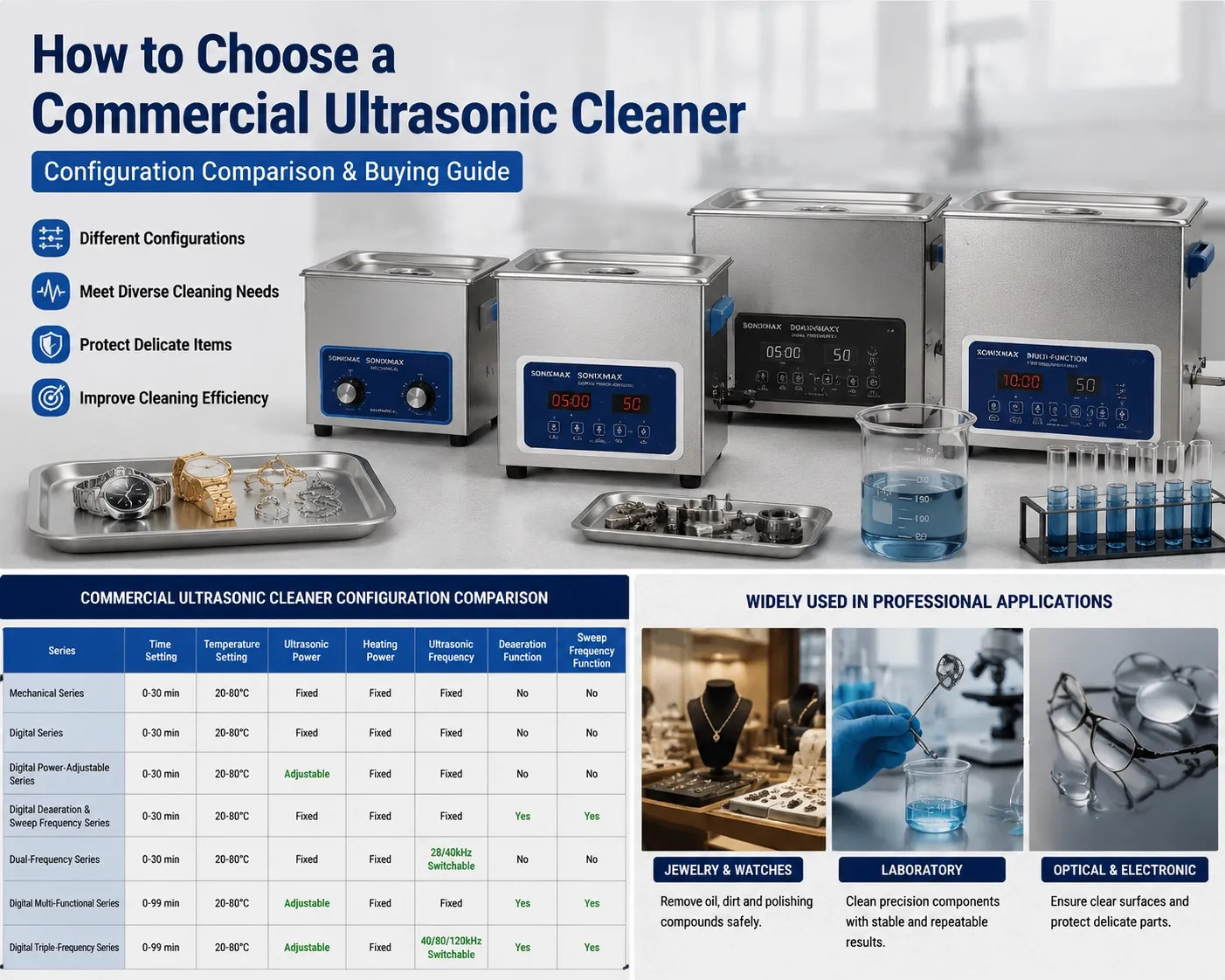
Commercial ultrasonic cleaners are essential tools for jewelry stores, optical shops, dental clinics, laboratories, and professional repair workshops. However, when buyers look at an equipment catalog, they are often faced with multiple configurations: mechanical, digital, adjustable power, degas, sweep frequency, dual-frequency, and triple-frequency models.
The problem is that many buyers select a machine based only on tank capacity and price. This can lead to inefficient cleaning cycles, inconsistent cleaning results, or increased risk of damage to delicate components.
This guide explains the technical differences between commercial ultrasonic cleaner series and how to select the right configuration for your specific workflow.
3 Questions to Answer Before Comparing Machines
Before comparing different machine series, start with your actual cleaning requirements.
The first question is the material. Are you cleaning robust steel tools, or delicate items such as optical lenses, jewelry, dental instruments, laboratory parts, or sensitive electronic components?
The second question is the contamination. Are you removing heavy grease, carbon buildup, polishing compound, dust, flux residue, or fine particles?
The third question is part geometry. A flat metal tool is very different from a component with blind holes, internal passages, fine threads, or delicate surface details.
These answers help determine whether you need a basic fixed-power machine or a more advanced configuration with adjustable power, degas, sweep frequency, or multiple frequency options.
Commercial Ultrasonic Cleaner Configuration Comparison
The following table compares common commercial ultrasonic cleaner configurations available in the SonixMax commercial lineup.
Series | Time Setting | Temperature Setting | Ultrasonic Power | Heating Power | Ultrasonic Frequency | Degas Function | Sweep Frequency Function | Recommended Applications |
|---|---|---|---|---|---|---|---|---|
Mechanical Series | 0-30 min | 20-80°C | Fixed | Fixed | Fixed | No | No | Hardware, general workshop cleaning |
Digital Series | 0-30 min | 20-80°C | Fixed | Fixed | Fixed | No | No | Professional medical and dental cleaning |
Digital Power-Adjustable Series | 0-30 min | 20-80°C | Adjustable | Fixed | Fixed | No | No | Delicate jewelry, mixed materials |
Digital Degas & Sweep Frequency Series | 0-30 min | 20-80°C | Fixed | Fixed | Fixed | Yes | Yes | PCBs, parts with blind holes |
Dual-Frequency Series | 0-30 min | 20-80°C | Fixed | Fixed | 28/40kHz switchable | No | No | Workshops dealing with mixed contamination |
Digital Multi-Functional Series | 0-99 min | 20-80°C | Adjustable | Fixed | Fixed | Yes | Yes | Advanced laboratory process control |
Digital Triple-Frequency Series | 0-99 min | 20-80°C | Adjustable | Fixed | 40/80/120kHz switchable | Yes | Yes | Precision components, optical parts |
These configurations are not ranked from “bad” to “best.” The right choice depends on the material, contamination, cleaning sensitivity, and operating workflow.
Decoding the Features: What Do They Actually Do?
Instead of looking only at specifications, it is more useful to understand what each configuration helps solve.
Basic Professional Cleaning: Mechanical & Digital Series
The Mechanical series provides simple manual control for users who need reliable and straightforward cleaning operation. It is suitable for general workshops where operators need a robust, easy-to-use machine for stable cleaning tasks.
The Digital series uses electronic controls for repeatable time and temperature settings. This makes it useful for professional environments where operators need more consistent parameter control than a purely mechanical interface.
Flexible Cleaning Control: Power-Adjustable Series
Standard machines operate at a fixed ultrasonic output. The Power-Adjustable series allows the operator to reduce or increase ultrasonic intensity according to the cleaning task.
This is useful when one machine needs to handle both robust parts and more sensitive items. Lower power may be preferred for delicate jewelry, optical parts, or mixed-material components, while higher power can be used for more durable items when appropriate.
Improved Cleaning Stability: Degas & Sweep Frequency Series
When cleaning parts with blind holes, internal cavities, or delicate areas, trapped air and standing waves can affect cleaning consistency.
The degas function helps remove dissolved gas from fresh cleaning liquid, especially after the bath is newly filled or the solution is changed. This supports more stable cavitation before parts are loaded.
The sweep frequency function continuously modulates the ultrasonic frequency to help reduce fixed dead zones and hot spots, supporting more uniform cavitation energy across the tank.
Multiple Applications: Dual-Frequency Series
Different ultrasonic frequencies create different cavitation characteristics.
A 28/40kHz switchable machine allows users to apply a lower-frequency mode for heavier contamination and switch to 40kHz for a gentler cleaning process on finer details.
This type of configuration is useful for workshops that clean different types of parts and do not want to rely on one fixed frequency for every application.
Advanced Process Control: Multi-Functional Series
The Multi-Functional series combines adjustable power, degas, and sweep functions in one unit.
This type of machine is useful for laboratories, technical workshops, and professional cleaning processes that need more control over cleaning intensity, bath preparation, and cleaning consistency.
It does not mean every user needs all functions. It is most valuable when the cleaning process changes frequently or when the parts require careful process control.
Maximum Flexibility: Triple-Frequency Series
For precision components, optical parts, and advanced laboratory applications, a single frequency may not provide enough flexibility.
The Triple-Frequency series, such as 40/80/120kHz switchable models, allows users to select different frequency modes for different cleaning requirements. A lower frequency may be used for initial cleaning, while higher-frequency cleaning may be more suitable for finer particle removal or more delicate surfaces where appropriate.
The final selection should still be based on material compatibility, contamination, cleaning liquid, part geometry, and required cleaning result.
Which Commercial Ultrasonic Cleaner Configuration Should You Choose?
Use the following guidance as a practical starting point.
Choose Mechanical or Digital Series if you have stable cleaning requirements and need simple, reliable operation for basic professional cleaning.
Choose Power-Adjustable Series if you process sensitive parts, such as delicate jewelry, optical parts, or mixed-material components, where fixed ultrasonic output may not always be ideal.
Choose Degas & Sweep Frequency Series if you frequently change cleaning solution, clean parts with blind holes or internal channels, or need more stable cavitation distribution in the tank.
Choose Dual-Frequency or Triple-Frequency Series if you handle multiple applications and need different frequency options for heavier contamination, finer details, or more delicate cleaning requirements.
For Distributors: Build a Product Portfolio, Not Just a Catalog
For distributors, importers, and equipment dealers, choosing a commercial ultrasonic cleaner is not only about selecting one machine for one application.
A stronger product range usually covers several buyer needs, such as basic workshop cleaning, jewelry and optical care, laboratory use, delicate parts, and applications that require degas, sweep, or multi-frequency control.
A practical commercial ultrasonic cleaner range may include:
- entry-level models for basic workshops, clinics, and general cleaning
- core professional models with adjustable power, degas, or sweep functions for more specialized buyers
- technical models with dual-frequency or triple-frequency options for laboratories, optics, electronics, and precision applications
Instead of stocking only one tank size or one control type, distributors should consider how different models work together as a portfolio. Entry-level mechanical or digital models may serve basic professional cleaning, while power-adjustable, degas and sweep, dual-frequency, or triple-frequency models can support more specialized applications.
For a deeper distributor-focused planning guide, see How to Build a Profitable Commercial Ultrasonic Cleaner Portfolio.
3 Common Purchasing Mistakes to Avoid
One common mistake is buying only based on tank volume. A machine may be large enough to hold the part but still be unsuitable if the frequency, power control, or cleaning stability does not match the application.
Another mistake is ignoring degas when the cleaning solution is changed frequently. Fresh liquid contains dissolved gas, which can weaken cavitation at the beginning of a cleaning cycle. In these applications, a degas function may help prepare the bath more efficiently.
A third mistake is assuming that more functions always mean a better machine. A simple mechanical or digital unit may be enough for stable, low-risk cleaning tasks. More advanced features are most useful when they solve a real cleaning or workflow problem.
Configure Your Commercial Cleaning Process
Selecting the right commercial ultrasonic cleaner can help improve cleaning consistency, protect sensitive components, and make daily operation easier for your team.
Whether you are a laboratory manager evaluating a higher-frequency machine, a professional workshop comparing power-adjustable models, or an equipment distributor building a commercial benchtop ultrasonic cleaner portfolio for your regional market, SonixMax can help match the product configuration to your application and buyer segment.
Contact the SonixMax engineering team with your cleaning requirements, target application, preferred tank size, and wholesale or distribution needs. We can help evaluate a suitable commercial ultrasonic cleaner configuration for your business.