Oct 5, 2026Buying Guides
How to Build a Profitable Commercial Ultrasonic Cleaner Portfolio: A Guide for Distributors
Learn how distributors and importers can build a commercial ultrasonic cleaner product range by capacity, control type, application, OEM options, and buyer segment.
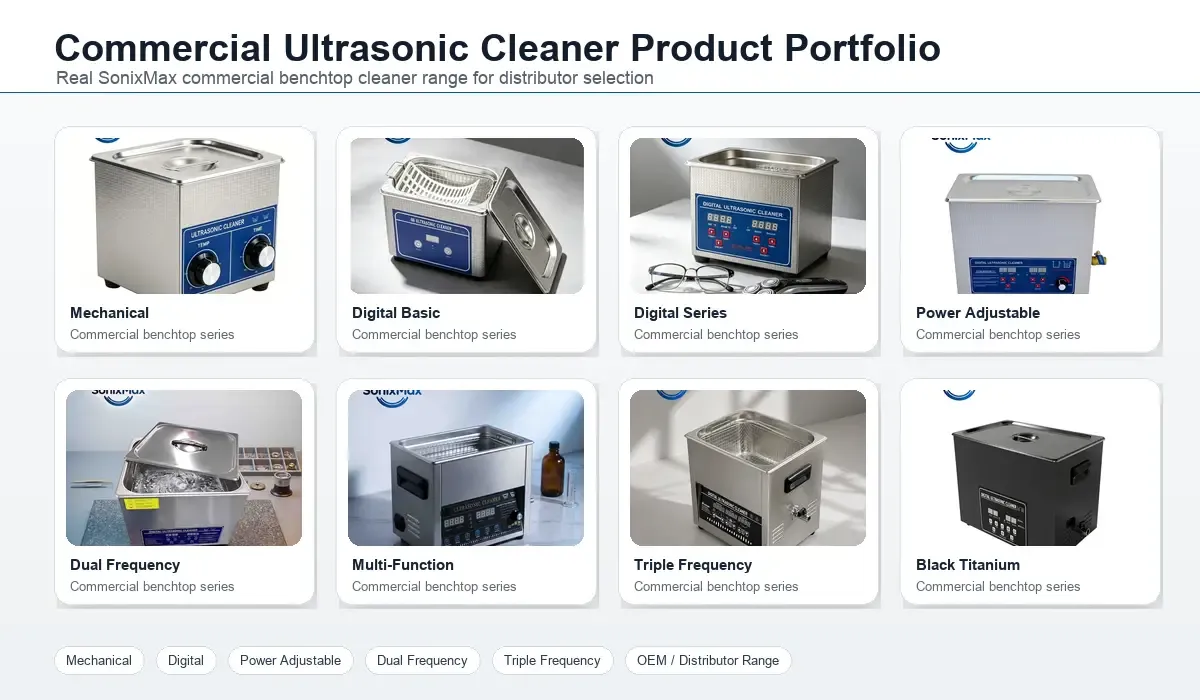
For equipment distributors, importers, and wholesalers, building a commercial ultrasonic cleaner portfolio is not only about finding one good model. It is about creating a scalable product line that covers different buyer groups, price levels, and technical expectations without creating unnecessary inventory risk.
A jewelry store, an automotive repair workshop, a laboratory, and an electronics service provider may all search for a "commercial ultrasonic cleaner," but they may require different capacities, control systems, and cleaning flexibility.
The most important question is not:
"What is the best ultrasonic cleaner?"
It is:
"Which product range can serve my local market, support repeat sales, and avoid slow-moving inventory?"
This guide explains how distributors can plan a commercial ultrasonic cleaner product line by capacity, control type, application, OEM/private label needs, and buyer segment.
Quick Answer: What Should a Distributor Include in a Commercial Ultrasonic Cleaner Range?
A practical distributor portfolio usually includes several product tiers rather than one universal model. For a balanced commercial range, the product mix may include:
- Entry-level models: mechanical or basic digital cleaners for price-sensitive buyers and small shops
- Core mid-range models: digital cleaners with timer and heating controls for general professional use
- Advanced control models: adjustable-power cleaners for buyers cleaning delicate, complex, or mixed parts
- Technical models: dual-frequency or triple-frequency cleaners for laboratories, optics, electronics, and other technical applications
- OEM/private label options: customized branding, packaging, or market-specific configurations when the distributor wants brand differentiation
A strong distributor range should make it easy for your sales team to answer three buyer questions:
- Which model fits my cleaning application?
- Which configuration matches my budget and daily workflow?
- Can I get reliable support, accessories, and repeat supply?
Why Distributors Should Not Compete on Price and Capacity Alone
Many new distributors select ultrasonic cleaners mainly by tank capacity and unit price.
That approach is understandable because buyers often ask first about liters, watts, and cost. But for long-term B2B distribution, price-only selection can create several problems.
- Generic positioning: your product range may look similar to low-cost online options.
- Lost higher-value sales: professional buyers may not find the control type or configuration they need.
- Slow-moving inventory: too many similar machines may compete with each other instead of serving different customer groups.
For B2B distribution, every model in the product line should have a clear reason to exist.
A 3L mechanical cleaner, a 10L digital cleaner, and a 30L adjustable-power cleaner are not simply different sizes. They serve different workflows, buyer budgets, and application requirements.
If a product cannot be clearly positioned, it may be difficult to sell, support, and reorder consistently.
Step 1: Start with Your Target Market, Not the Supplier Catalog
A supplier catalog may contain many configurations, but not every model deserves a place in your inventory. The right product range starts with defining your local customer base.
If your buyer is choosing one machine for daily professional use, this separate guide explains how to choose a commercial ultrasonic cleaner.
Jewelry, Optical, and Retail Shops
These buyers often need compact machines that are easy to operate and simple to explain.
Typical priorities include:
- small to medium capacity, often around 2L to 6L
- clean appearance
- simple operation
- reliable timer and heating functions
- baskets and basic accessories
- packaging suitable for professional or retail sale
For this segment, distributors do not always need the most advanced model first. Reliability, ease of use, and clear application guidance are often more important than offering every technical function.
Automotive and Repair Workshops
Repair workshops may clean carburetors, tools, small metal parts, greasy components, and maintenance parts.
Typical priorities include:
- medium to large capacity, often around 10L to 30L or larger
- stronger cleaning capability for oil, grease, and carbon-related contamination
- heating
- durable stainless steel construction
- baskets and accessories
- possibly adjustable power or dual-frequency options
This segment may ask practical questions: Will the part fit? Can the machine handle oily contamination? Is heating available? Can it support repeated daily use?
A distributor selling to workshops should avoid positioning small retail-style cleaners as a solution for heavy parts or high-volume shop use.
Laboratories, Clinics, and Technical Users
Laboratories, clinics, and technical users often care more about process control, repeatability, and documentation.
Typical priorities include:
- digital controls
- stable digital time and temperature control
- degas or sweep functions when needed
- higher-frequency options for delicate items
- technical specifications
- stable product availability
For this segment, the sales conversation is less about "cheap and powerful" and more about control, repeatability, and suitability for the intended task.
Avoid making compliance claims unless the exact product configuration and destination-market requirements have been confirmed.
Electronics and Precision Cleaning Buyers
Electronics repair, precision components, optics, and delicate parts require more careful positioning.
Typical priorities include:
- adjustable ultrasonic power
- higher frequency or multi-frequency options
- degas and sweep functions
- careful cleaning chemistry selection
- material and component compatibility guidance
- clear application limitations
Distributors should avoid promising that any ultrasonic cleaner is automatically safe for all electronics or precision parts. The part design, materials, seals, coatings, cleaning liquid, frequency, power, and drying process all matter.
Step 2: Build the Product Range by Capacity Tier
Capacity planning is one of the most important decisions for distributors.
The goal is not to stock every size. The goal is to cover common buyer needs without spreading inventory too thin.
Compact Benchtop Models: 2L to 6L
Compact models are useful for small shops, retail counters, and light professional use.
They may serve:
- jewelry shops
- optical stores
- small repair benches
- clinics or beauty-related professional users
- customers testing ultrasonic cleaning for the first time
These models can help distributors capture entry-level demand, but they should not be the entire product range. If a distributor only stocks compact models, larger workshops and technical buyers may quickly outgrow the offering.
Mid-Range Commercial Models: 10L to 15L
Mid-range commercial ultrasonic cleaners are often the core of a distributor portfolio.
They can serve:
- repair workshops
- clinics
- laboratories
- tool maintenance users
- general professional cleaning tasks
This segment is usually where digital timer control and heating become more important. Buyers in this range often expect more stable operation than a very basic cleaner, but they may not yet need multi-frequency or advanced control.
For many distributors, mid-range digital models are the workhorse category.
For this core range, SonixMax offers Digital Benchtop Ultrasonic Cleaners for Wholesale with digital timer and temperature control.
Large Benchtop Models: 22L to 30L
Larger benchtop models are useful when buyers need to clean bigger parts or several items per batch.
They may serve:
- automotive workshops
- industrial maintenance teams
- hardware repair businesses
- small production environments
- service departments with repeated cleaning tasks
At this stage, distributors should ask whether the buyer truly needs a benchtop cleaner or whether the application is moving toward an industrial ultrasonic cleaning system.
Large parts, heavy loads, continuous production, filtration, rinsing, drying, lifting, or automation may require a different equipment category.
When Benchtop Is No Longer Enough
A commercial benchtop ultrasonic cleaner is not the right answer for every cleaning problem.
If the buyer needs to clean heavy parts, process many batches per day, control residue after cleaning, remove large amounts of oil, or integrate cleaning into a production workflow, a standard benchtop unit may be too limited.
In those cases, the better path may be:
- an industrial single-tank ultrasonic cleaner
- a system with filtration
- a multi-tank cleaning, rinsing, and drying process
- a customized industrial ultrasonic cleaning system
For distributors, this distinction is important. Recommending an undersized benchtop cleaner may win a quick sale but create poor customer satisfaction later.
For larger parts, heavier workflows, or customized production cleaning, this guide explains how to evaluate an industrial ultrasonic cleaning system.
Step 3: Match Control Types to Buyer Segments
Offering multiple control types allows distributors to serve different buyer expectations without forcing every customer into the same configuration.
Mechanical Controls
Mechanical ultrasonic cleaners are simple to operate and easy to explain.
They may fit:
- basic professional cleaning
- small shops
- price-sensitive buyers
- users who prefer fewer electronic controls
- markets where simplicity is more important than advanced features
Mechanical models can be useful as entry products, but distributors should be clear about their limitations. Buyers who need repeated process control, precise settings, or more advanced applications may prefer digital models.
Digital Timer and Heating
Digital commercial ultrasonic cleaners are suitable for buyers who need more consistent operation.
They may fit:
- laboratories
- repair shops
- clinics
- professional service counters
- users repeating similar cleaning tasks
Digital control makes it easier for buyers to set cleaning time and temperature consistently. This does not guarantee cleaning results, but it helps users control the process more clearly.
For many distributors, digital models should form the core commercial range.
Adjustable Power
Adjustable-power ultrasonic cleaners help users reduce or increase cavitation intensity according to the part and contamination.
They may fit:
- electronics repair
- delicate parts
- mixed applications
- precision components
- users who clean different materials or items
This category can help distributors sell beyond basic cleaning needs. It is especially useful when buyers worry that ultrasonic cleaning may be too aggressive for some parts but still need stronger cleaning for others.
Dual-Frequency and Triple-Frequency Models
Dual-frequency and triple-frequency models are not necessary for every buyer, but they can create a higher-value technical tier.
They may fit:
- laboratories
- optics
- electronics
- precision cleaning
- professional users with varied applications
- buyers who want one machine to support different cleaning conditions
For distributors, these models can help differentiate the product range from generic low-cost cleaners.
However, multi-frequency machines should not be sold as universal solutions. Buyers still need to evaluate part material, contamination, cleaning chemistry, loading method, and drying requirements.
Distributor Portfolio Matrix: A Strategic Example
The following example shows how a distributor might organize a commercial ultrasonic cleaner range by business role rather than simply listing capacities.
Product Tier | Target Buyer | Product Type | Role in Portfolio |
|---|---|---|---|
Entry / Volume | Small retail, basic repair, light professional users | Mechanical or basic digital cleaners, often 2L to 6L | Customer acquisition and common demand coverage |
Core / Anchor | Clinics, repair shops, labs, general professionals | Digital cleaners with timer and heating, often 10L to 15L | Main sales range with broad application coverage |
Advanced | PCB repair, optics, delicate parts, mixed applications | Adjustable-power cleaners, often 10L to 30L | Higher-value option for users needing more control |
Technical | Labs, R&D, optics, precision users | Dual-frequency or triple-frequency cleaners | Premium niche product for differentiated offering |
Project-Based | Manufacturing, heavy repair, industrial maintenance | Industrial ultrasonic cleaning systems | Custom solution path beyond benchtop models |
This table is not a universal stocking plan. A distributor focused on jewelry stores may need a different mix from a distributor serving laboratories or repair workshops.
The purpose is to make sure each product tier has a clear customer, sales role, and reorder logic.
Step 4: Use OEM and Private Label Options Strategically
For distributors, OEM or private label is not only about adding a logo.
It can support market positioning, repeat sales, and channel differentiation. But it should be introduced at the right stage.
Logo and Branding
Logo customization can help distributors build recognition in their local market.
This may be useful when the distributor has a clear customer base, a stable product selection, and confidence that the models will be reordered.
Packaging and Manuals
Custom packaging and manuals may be important for retail channels, regional sales, and customer experience.
For commercial ultrasonic cleaners, packaging should do more than look attractive. It should also communicate the model, capacity, voltage, plug type, basic usage information, and application limitations clearly.
Voltage, Plug, and Market Requirements
Commercial ultrasonic cleaners should match the destination market's voltage, plug type, labeling expectations, and documentation needs.
Before placing bulk orders, distributors should confirm:
- voltage
- plug type
- language requirements
- product labels
- user manual needs
- available documents for the selected configuration
- whether any local compliance review is required
Do not assume that documentation for one model automatically applies to every customized version.
When Private Label Makes Sense
Private label makes more sense when the distributor has:
- stable repeat demand
- a clear sales channel
- confidence in selected models
- enough order volume to justify customization
- a plan for after-sales support
- a reason to build brand differentiation
For early market testing, standard models may be more practical.
A distributor can begin with standard commercial ultrasonic cleaners, identify which models sell consistently, and then move selected models into private label or OEM cooperation.
If your project is focused on consumer household products rather than commercial benchtop cleaners, read the private label ultrasonic cleaner sourcing guide.
What to Check Before Confirming a Supplier
A distributor should evaluate the supplier beyond the quoted price.
The best supplier is not always the one with the longest model list or the lowest price. For distribution, stability, communication, and repeat support matter.
Product Range Stability
Can the supplier provide a stable range over time?
If models change frequently, distributors may struggle with replacement orders, spare parts, product images, manuals, and customer support.
A stable product range makes it easier to build a catalog, train sales staff, and maintain customer confidence.
Sample Evaluation
Samples should be tested with realistic customer applications before bulk orders.
A sample should not only be checked for appearance. Distributors should review:
- tank size and usable space
- control panel operation
- heating function
- cleaning behavior with representative items
- basket fit
- noise and user experience
- packaging condition
- manual and labeling
- power plug and voltage configuration
The goal is to confirm whether the model is suitable for the intended market before inventory is committed.
Documentation and Market Requirements
Depending on the market, distributors may need:
- product specifications
- user manuals
- product images
- packaging information
- available compliance documents
- spare parts information
- application guidance
Documentation should match the actual product configuration. If branding, voltage, plug, packaging, or functions change, documents may need to be reviewed again.
Spare Parts and After-Sales Support
Distributors should clarify support for accessories and service-related parts.
This may include:
- baskets
- lids
- power cords
- heaters
- control boards
- transducers
- switches or other service-related components
- packaging replacements
Not every distributor needs to stock all parts, but the support path should be clear before selling the product range.
Application Communication
A good supplier should help explain what each machine can and cannot do.
This matters because ultrasonic cleaners are often misapplied when buyers only compare size, power, and price.
Distributors need practical guidance on:
- suitable applications
- unsuitable applications
- material compatibility
- cleaning chemistry limitations
- heating and time considerations
- when rinsing or drying is required
- when industrial systems are more appropriate
This helps distributors sell more responsibly and reduce after-sales problems.
Common Mistakes Distributors Should Avoid
Stocking Too Many Overlapping Models
Too many overlapping models can confuse customers and increase inventory pressure.
A better range has clear steps: entry, core, advanced, technical, and project-based.
Selling Only the Cheapest Configuration
Low price may help initial sales, but it can limit access to professional and technical buyers.
If the product range is too basic, buyers with higher-value applications may look elsewhere.
Ignoring Application Differences
Jewelry, electronics, automotive parts, laboratory tools, and small industrial components do not always need the same configuration.
A distributor should map products to applications instead of treating all ultrasonic cleaners as interchangeable.
Treating OEM as the First Step
OEM and private label can be valuable, but they are not always the best starting point.
New distributors often benefit from testing standard models first, then customizing the models that prove suitable for their market.
Ignoring Cleaning Chemistry and Process Limits
Cleaning chemistry affects results, even if the ultrasonic cleaner itself is the main product being sold.
Distributors should understand that performance depends on the part, contamination, cleaning liquid, temperature, time, loading method, and rinse/dry process.
Promising Universal Cleaning Results
Never present one cleaner as suitable for every application.
A machine and chemistry suitable for heavy metal parts may be unsuitable for fragile jewelry, delicate coatings, sealed components, or sensitive electronics.
Clear limitations build more trust than exaggerated promises.
How SonixMax Supports Commercial Ultrasonic Cleaner Distributors
SonixMax provides commercial benchtop ultrasonic cleaners for distributors, wholesalers, importers, and professional equipment sellers.
Commercial product directions include:
- mechanical benchtop ultrasonic cleaners
- digital ultrasonic cleaners
- adjustable-power ultrasonic cleaners
- dual-frequency ultrasonic cleaners
- triple-frequency ultrasonic cleaners
- commercial wholesale product ranges
- OEM and private label support
For distributors serving more demanding industrial users, SonixMax can also help evaluate whether a buyer needs an industrial ultrasonic cleaning system instead of a standard benchtop model.
This is important when the application involves larger parts, repeated production cleaning, filtration, rinsing, drying, lifting, or custom workflow requirements.
Request a Distributor Product Range Recommendation
A good distributor portfolio should not be a random list of machines. It should be a structured product range that helps your customers choose confidently, supports repeat sales, and reduces product-selection risk as your business grows from entry-level commercial cleaners to higher-value technical and industrial cleaning solutions.