Oct 19, 2026Ultrasonic Cleaning Technology
Air Knife vs Hot Air Drying After Parts Cleaning: Do You Need Both?
Compare air-knife dewatering and hot-air drying after parts cleaning, including residual moisture, part geometry, heat limits, and when to combine stages.
After washing and rinsing industrial parts, removing the remaining water becomes a separate process decision. A part may leave the rinse visibly wet, or appear dry while liquid remains in a recess or threaded hole.
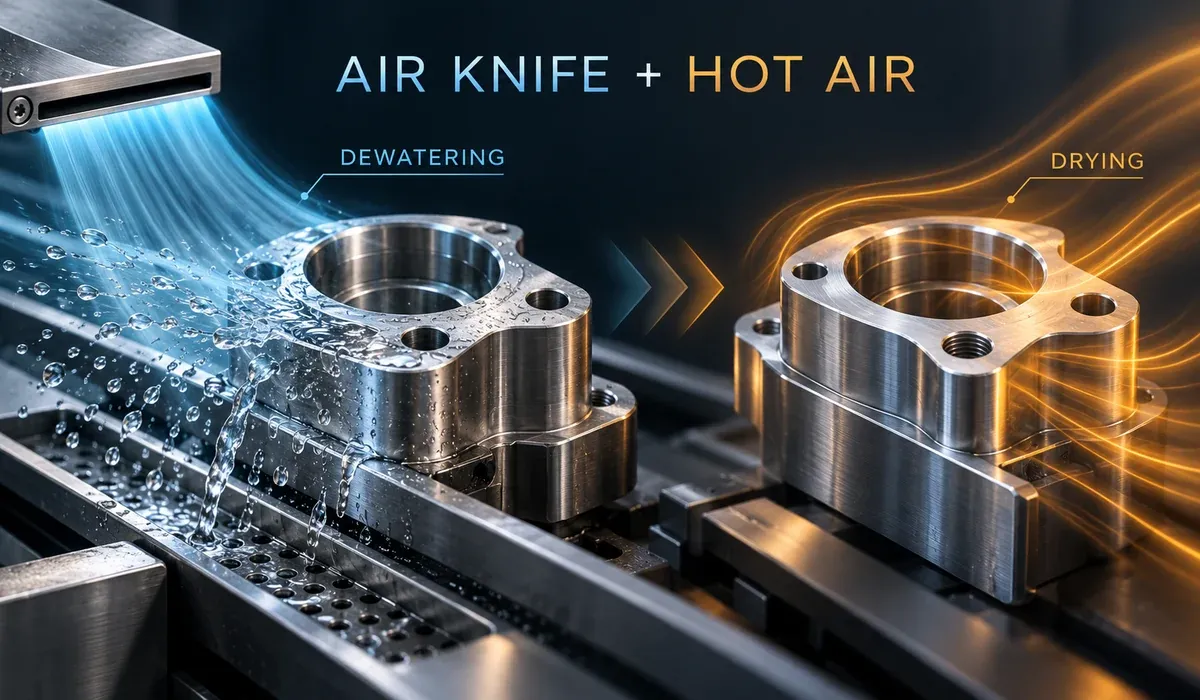
An air knife and a hot-air dryer address this problem through different mechanisms: an air knife mainly displaces liquid, while hot-air drying supplies heat and airflow to support evaporation. Choosing between them starts with where water remains, how the parts are presented, and what the next production step requires.
Quick Answer: Removing Water vs Evaporating Moisture
An air knife uses a directed sheet of air to move liquid off accessible surfaces. Hot-air drying uses heated airflow to support evaporation of remaining moisture.
You may need both when a blow-off stage can remove surface water but the parts still require further drying before assembly, coating, inspection, or packaging. You may need only one method when it meets the agreed drying requirement within the available process time.
A combined process may follow this sequence:
This is an example, not a mandatory process for every part. Neither method guarantees that every cavity will be dry. Part geometry, orientation, airflow access, loading, and operating conditions all affect the result.
For the complete wash–rinse–dry sequence, see our guide to multi-stage ultrasonic cleaning systems.
What an Air Knife Does After Rinsing
An air knife directs airflow through a narrow outlet to form an air curtain across a surface. In a parts-cleaning process, its main purpose is to displace surface liquid and give that liquid a route away from the workpiece.
This is dewatering rather than a promise of complete drying. Removing a visible film from an exposed panel is a different task from removing liquid held inside a pocket.
The useful result is liquid leaving the part, rather than simply being pushed into another recess or onto an adjacent component.
Airflow Access and Drainage Matter
The air must reach the wet area, and the displaced liquid must be able to leave. A useful arrangement therefore depends on the relationship between the air knife, the workpiece, and the loading fixture.
For example, an upward-facing recess may retain water after the surrounding surfaces have cleared. Changing the part orientation may improve drainage, but the revised position must also suit the cleaning process and handling arrangement.
Air-knife length, position, coverage, and air supply should be evaluated together. Air knives may use blower air or compressed air; the appropriate supply depends on the design and operating duty. The term “air knife” alone does not specify pressure, airflow, or whether the air is heated.
For applications with defined cleanliness requirements, the quality of the supplied air also belongs in the specification.
What Hot-Air Drying Adds
Hot-air drying introduces heat and airflow to support the removal of residual moisture by evaporation. Its role can be useful after visible surface water has drained or been blown away.
This diagram shows the process principle. It does not establish a temperature, drying time, or guaranteed result for a particular feature.
However, a higher heater rating does not by itself establish that the parts will leave dry. The workpiece must receive an appropriate combination of airflow, temperature, and time.
Residual Moisture Needs a Suitable Process
Where water remains matters as much as how much remains. A thin surface film, liquid inside a threaded feature, and water trapped between touching parts present different drying conditions.
If a loaded basket restricts airflow, increasing the temperature alone may leave the underlying problem unresolved. Loading, orientation, and the path for moisture removal should be reviewed before treating additional heat as the answer.
Hot air is also not a universal solution for blind holes or enclosed spaces. The actual geometry, drainage route, airflow arrangement, and available drying time need to be assessed with representative parts.
Check the Part’s Temperature Limit
The drying process must respect the workpiece and any coatings, seals, adhesives, or assembled components. An acceptable temperature for one metal component may be unsuitable for another assembly.
Specify the allowable part temperature and any cooling requirement before the next operation. A part that leaves dry but too hot for immediate handling or processing may still create a workflow problem.
Which Part Features Change the Decision?
Broad, Exposed Surfaces
For relatively open surfaces with accessible drainage paths, an air knife may remove much of the visible water. The remaining question is whether the result meets the next process requirement at the intended production rate.
A simple blow-off arrangement may be sufficient for one application. Another may need further drying because small remaining droplets or films are unacceptable. This distinction should come from the required result, rather than assuming that every cleaning line needs a heated dryer.
Recesses, Threads, and Blind Holes
Complex features need closer inspection. A part can look dry from above while retaining water in a recess, threaded opening, or contact area.
Neither “the air knife will reach it” nor “the heat will dry it” should be accepted without checking the actual feature. Depending on the application, the evaluation may involve changing orientation, improving drainage, adjusting airflow access, allowing more dwell time, or considering a different drying arrangement.
If bare steel rusts after washing, review the causes of flash rust after ultrasonic cleaning before changing the drying equipment alone. Rinse condition, chemistry, and the wider process may also require attention.
Basket Loading and Production Variation
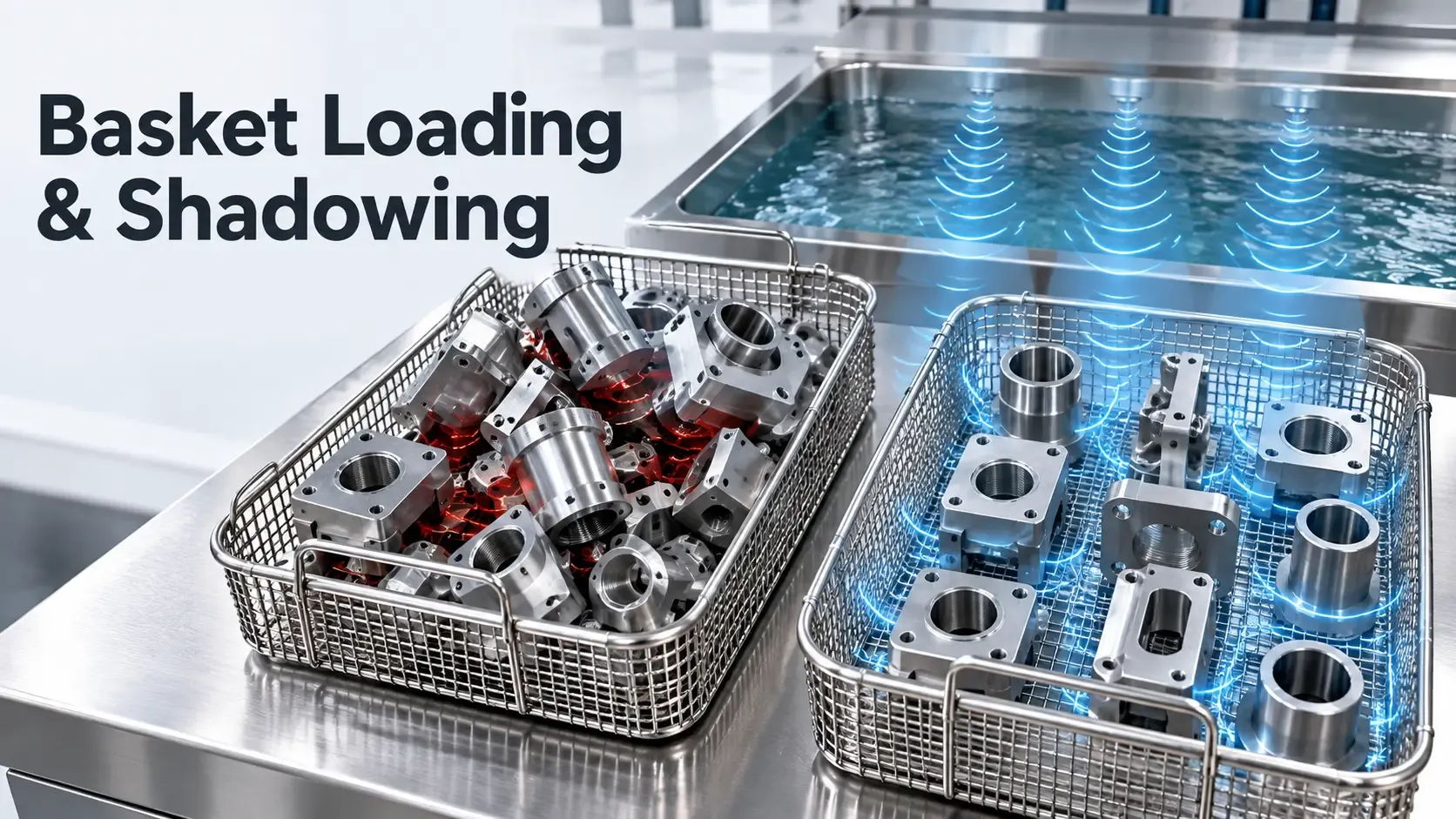
Evaluate the loaded process, rather than only an isolated workpiece. Parts that dry individually may behave differently when fixtures obstruct airflow or a full basket retains more liquid.
The drying arrangement should accommodate the intended batch size and normal variation in part orientation. For conveyor systems, the available exposure time also needs to fit the production rate.
When Should You Evaluate One Stage or Both?
Use the following comparison to frame a process trial. It is a starting point for evaluation, not a fixed equipment-selection rule.
Process condition | Configuration to evaluate | What to confirm |
|---|---|---|
Parts drain readily and the remaining moisture is acceptable | Drainage without a dedicated drying stage | Whether the next operation permits that condition |
Accessible surfaces carry visible water after rinsing | Air-knife dewatering | Coverage, drainage route, and the result at production speed |
Residual moisture remains after drainage | Hot-air drying | Airflow access, allowable part temperature, and required dwell time |
Surface water can be blown off, but further drying is required | Air knife followed by hot-air drying | The contribution of each stage and the final acceptance result |
Water remains in complex or obstructed features | Review loading and the drying arrangement together | Which locations retain water and whether the proposed process reaches them |
A combined sequence can separate two tasks: remove surface water first, then treat remaining moisture. It deserves consideration when those tasks both matter, but it should not be specified automatically.
An example of separate dewatering and heated-drying stages is our through-type ultrasonic cleaning line. That reference configuration places air-knife dewatering before hot-air circulation drying. The final arrangement should follow the workpiece and production requirements.
How to Check the Drying Result
Define the acceptance requirement before comparing equipment. “Dry enough” for transfer to another wet-process stage may be different from the requirement before coating, assembly, or packaging.
Agree where to inspect, when to inspect, and which method will establish acceptance. Exterior appearance alone may not answer the question when internal features are important.
Use representative parts with the intended loading arrangement, including the upper end of the planned production load rather than an overloaded basket. Check the locations known to retain water, and evaluate the result at the proposed cycle time or conveyor speed. Include the planned temperature limit and any cooling or handling step.
Record the inspected locations, load arrangement, operating conditions, and observed result. If a part passes individually but fails in a production basket, review airflow access and loading before adding another drying stage.
Inspection methods should suit the part and its cleanliness requirements. A wipe or blow-out check should not be treated as proof of a numerical residual-moisture limit unless the method has been agreed and validated for that purpose.
Where practical, compare drainage alone, blow-off, heated drying, and the combined sequence under controlled conditions. Keeping the preceding wash, rinse, and loading conditions consistent makes the contribution of each drying stage easier to assess.
This provides a basis for selecting equipment without relying on a generic drying-time claim or assuming that more stages always produce a better process.
What to Send Before Requesting a Drying Configuration
To evaluate drying after ultrasonic cleaning or another aqueous parts-washing process, provide:
- Part drawings or photos, material, dimensions, and relevant assembly details.
- Photos or descriptions of the locations where water remains.
- The rinse process and current drainage arrangement.
- Basket or fixture layout, batch quantity, and production rate.
- Allowable part temperature and downstream handling requirements.
- The required drying result and how it will be checked.
- Available air supply, installation space, and existing equipment.
These details help determine whether the process needs improved drainage, air-knife dewatering, hot-air drying, a combined sequence, or further application testing.
Contact our team at Sonixmax with your part drawings and drying requirements to discuss a configuration matched to your cleaning process.