Oct 21, 2026Ultrasonic Cleaning Technology
Ultrasonic Cleaner Tank Size: Nominal Capacity, Working Volume and Basket Space
Compare nominal capacity, working liquid volume and basket dimensions before choosing an ultrasonic cleaner for your parts and batch load.
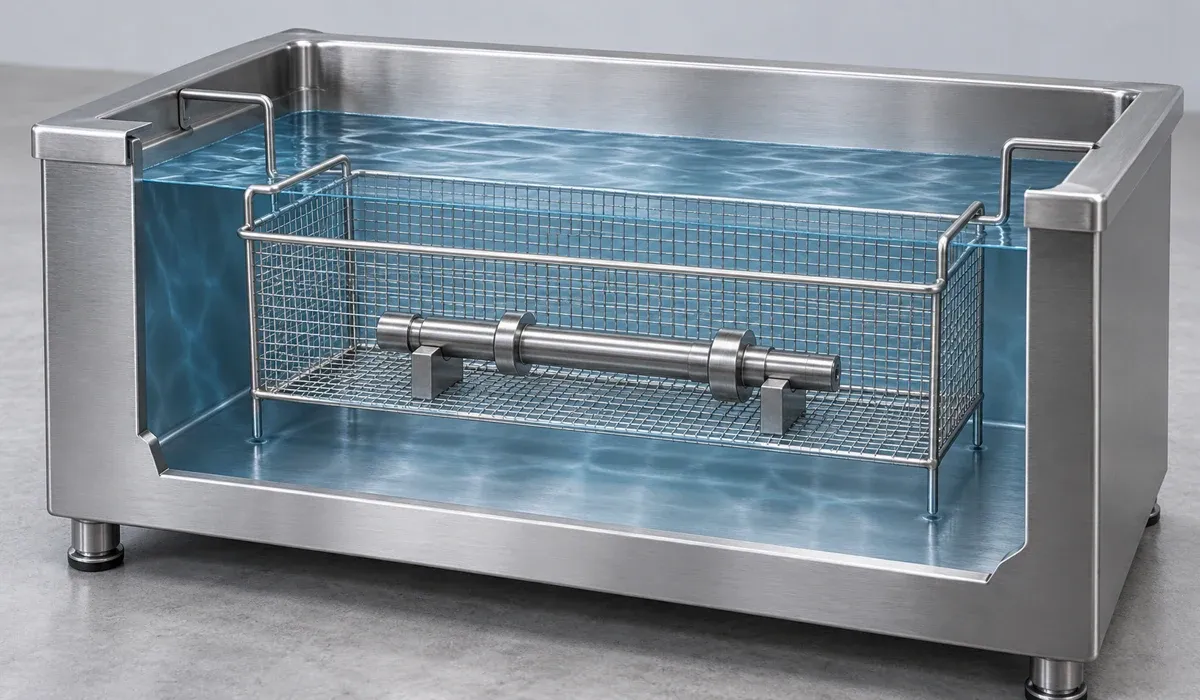
Two ultrasonic cleaners can have the same listed capacity and still accommodate very different loads. A long shaft may fit one tank but not another. A batch that fits inside an empty tank may no longer fit once the basket and fixture are installed.
When comparing ultrasonic cleaner tank size, start with the parts and their intended loading arrangement. The number of liters is useful, but it does not independently establish the available cleaning space or production capacity.
Quick Answer: Choose for the Load, Not Liters Alone
Confirm the tank dimensions, basket or fixture dimensions, operating liquid level and permitted load before choosing a machine. A catalog capacity alone cannot tell you whether a particular batch can be immersed, supported and cleaned as intended.
For the wider equipment decision, use our industrial ultrasonic cleaner selection guide. This article focuses on interpreting size specifications and checking physical fit before ordering.
Separate the Size Specifications Before Comparing Machines
The terms “capacity” and “working volume” are not always used consistently. Ask what each figure means in the supplier's specification.
This conceptual side view separates the tank boundary, liquid level and loading space; it is not a dimensional drawing:
The drawing shows spatial relationships only. Actual supports, liquid levels, freeboard and required clearances depend on the equipment and the proposed load.
Specification | What it describes | What it does not establish |
|---|---|---|
Listed or nominal capacity | The capacity stated for the model | Operating fill quantity, basket space or permitted batch load |
Inner tank dimensions | The stated internal length, width and depth | The dimensions available inside an installed basket or fixture |
Operating liquid quantity or level | The specified liquid condition for operation | How many parts can be cleaned successfully in one batch |
Usable load envelope | The space available for the proposed parts in the agreed arrangement | Cleaning performance or throughput without process evaluation |
Geometric Volume Is a Calculation, Not a Loading Approval
For an ideal rectangular space, length × width × depth gives its geometric volume. Dimensions measured in millimeters can be converted to liters by dividing their product by 1,000,000.
That calculation can help interpret a drawing. It does not establish the recommended fill level, account for every corner or internal feature, or identify the space available for parts.
Do not automatically interpret a difference between a model's capacity label and a dimensional calculation as a specification error. First confirm how the supplier defines the figures and where the dimensions are measured.
Clarify What “Working Volume” Means
A supplier may use “working volume” for an operating liquid quantity or for an effective cleaning space. These are different things. Ask for liquid quantities in liters and load dimensions in millimeters, with the operating level shown on a drawing.
The volume of liquid added can also depend on displacement by immersed parts and fixtures. Follow the equipment's specified filling procedure rather than treating an empty-tank quantity as the correct amount for every loaded batch.
Check the Parts in Their Actual Cleaning Arrangement
A part's overall length, width and height are only the starting point. Its position during cleaning determines the space it occupies and whether its target surfaces can be wetted.
A component that fits diagonally in an empty tank may not fit that way in the supplied basket. A fixture may hold it above the basket floor, reducing the available immersion depth. Handles or supports may also affect insertion and removal.
Use this sequence for a fit review:
Check the complete batch, including supports, rather than a single loose part placed wherever it happens to fit. Consider:
- Loaded dimensions: the envelope occupied by the parts and fixture together.
- Liquid access: whether the proposed arrangement permits wetting and air release.
- Weight: the relevant limits for the basket, supports and any handling equipment.
- Access: the opening and movement needed to load and remove the assembly.
Our basket loading and ultrasonic shadowing guide covers spacing and orientation in more detail. Physical fit is necessary, but it does not prove that a tightly packed load will clean acceptably.
The Same Liters Can Have Different Shapes
A capacity figure does not describe tank proportions. A long, narrow tank and a shorter, wider tank can have the same geometric volume while serving different part shapes.
For example, the Sonixmax 96L rectangular ultrasonic cleaner lists an inner tank size of 800 × 300 × 400 mm. Multiplying those dimensions gives 96 liters of rectangular geometric volume.
The 800 mm tank length is relevant when assessing elongated workpieces. It does not mean an 800 mm part is automatically an approved load. Basket dimensions, supports, operating liquid level and the intended handling arrangement still need confirmation.
Similarly, the 400 mm tank depth is not a promise of 400 mm usable part height. A suspended basket, a raised fixture and the specified liquid level affect the available immersed height.
Use the published dimensions to identify a candidate configuration, then confirm the proposed load against its drawing. Do not infer an unpublished basket size, weight rating or operating fill quantity from the 96L label.
More Tank Volume Does Not Automatically Mean More Parts per Hour
A larger tank may provide room for a larger batch, but throughput depends on the complete process.
Loading, washing, temperature recovery where relevant, draining, rinsing, drying and unloading can all affect the production cycle. A larger batch may require a different fixture or take longer to handle. Adding parts until the basket is full may also change cleaning consistency.
Compare configurations against a defined batch and required result. Separate three questions:
- Does the proposed load physically fit?
- Can that load meet the cleaning requirement under the evaluated conditions?
- Can the complete process meet the required production rate?
If the existing tank already accommodates a suitable batch, the next improvement may be in handling or another process stage. A larger tank is not automatically the most useful upgrade.
What to Confirm on a Sizing Drawing Before Ordering
A drawing connects catalog dimensions to the actual loading arrangement. Ask for the details needed to resolve your application, rather than assuming every quotation includes them.
Item to confirm | Practical question |
|---|---|
Tank and access opening | Can the loaded assembly enter and leave in the intended orientation? |
Basket or fixture internal space | Which dimensions remain available after supports and locating features are installed? |
Operating liquid level | Will the required surfaces be immersed in the proposed loaded condition? |
Permitted load | Which weight limit applies, and which parts, basket, fixture or handling components does it include? |
Required clearances | What clearances apply to this equipment and loading arrangement? |
Handling path | Can operators or the proposed lifting arrangement move the load as intended? |
Avoid applying one universal clearance or fill percentage to every ultrasonic cleaner. Use the instructions and agreed configuration for the actual machine.
If a dimension or rating is absent, identify it as unresolved. Do not replace missing basket dimensions with an estimate based on a product photograph.
What to Send Sonixmax for a Fit Review
Before requesting a tank-size recommendation, provide:
- A part drawing or dimensioned photographs showing the largest relevant features.
- Part material, individual weight and intended batch quantity.
- Proposed cleaning orientation and any existing basket or fixture details.
- Contamination, cleaning requirements and any sensitive surfaces.
- Required production rate and the steps before and after washing.
- Available loading space and the intended handling method.
Tank sizing should end with an agreed load arrangement and operating basis, not just a larger liter figure. Contact us with your part dimensions and batch requirements to discuss a suitable tank, basket or fixture configuration and what still needs evaluation.