Aug 17, 2026Ultrasonic Cleaning Solutions
The Ultimate Guide to Industrial Ultrasonic PCB Cleaning: Remove Flux & Prevent Short Circuits
Learn how to safely remove flux from PCBs using an industrial ultrasonic cleaner. Discover the best 40kHz frequency, aqueous solutions, and DI water rinsing.
If you manage an Electronics Manufacturing Service (EMS) facility or a high-end SMT assembly line, you know that leftover solder flux and rosin are silent killers.
Manual brushing with solvents is incredibly inefficient. It fails to clean underneath tightly packed SMD components and BGA chips, and aggressive brushing can easily snap delicate component pins. Worse, if flux residue is left behind, it absorbs moisture over time, leading to dendritic growth, corrosion, and catastrophic short circuits on boards that might be worth thousands of dollars.
The ultimate non-destructive solution is an industrial ultrasonic PCB cleaner. However, electronic components are fragile, and using the wrong equipment can cause irreversible damage. In this guide, we will show you exactly how to use ultrasonic technology to achieve IPC-standard cleanliness, ensure component safety, and optimize your workshop's workflow.
Is Ultrasonic Cleaning Safe for PCBs?
Is ultrasonic cleaning safe for PCBs?
Yes, absolutely. In fact, it is the standard cleaning method for aerospace, medical, and military electronics manufacturing.
Unlike manual scrubbing, ultrasonic cavitation creates millions of microscopic vacuum bubbles that gently implode. These bubbles can penetrate the tiniest gaps—such as the 0.1mm space underneath a BGA chip—pulling the sticky flux residue out without applying any physical mechanical stress to the solder joints.
However, safety depends entirely on the ultrasonic frequency. Never use a 28kHz industrial cleaner for delicate PCBs. The 28kHz frequency creates large, aggressive cavitation bubbles that can shatter fragile quartz crystals and break internal wire bonds in microchips. You must use a 40kHz or 80kHz frequency. These higher frequencies produce smaller, gentler bubbles. Additionally, professional PCB cleaners should feature a "Sweep" function, which constantly varies the frequency slightly to prevent "standing waves" that could create localized hot spots of damaging energy.
How to Remove Flux Residue Effectively
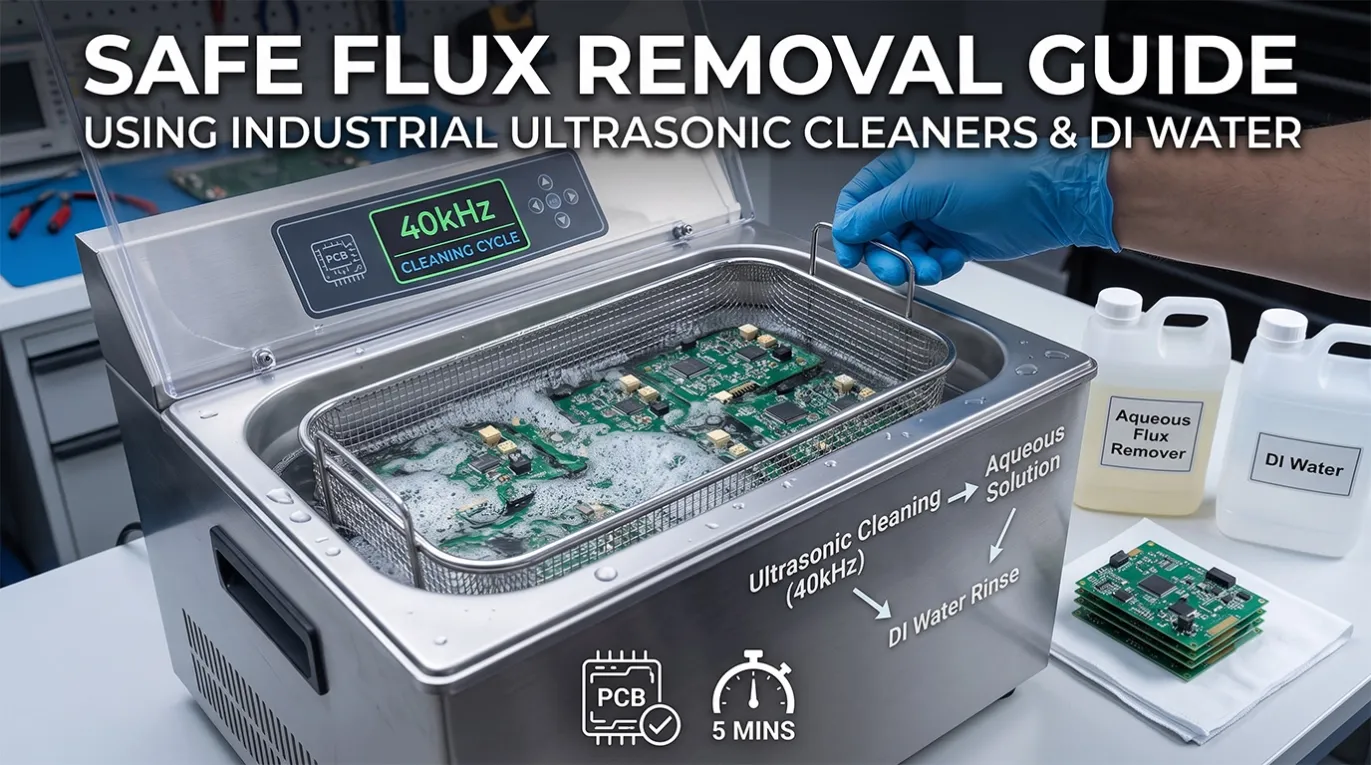
How do you remove flux residue from a circuit board? The secret lies in combining the right chemistry with precise temperature and time controls.
Many technicians make the dangerous mistake of filling their heated ultrasonic tank with 100% Isopropyl Alcohol (IPA). Never put flammable solvents directly into an open ultrasonic tank. The transducers generate heat, and the cavitation process will vaporize the alcohol, creating a highly explosive cloud.
Instead, use a specialized aqueous (water-based) flux remover. These alkaline solutions are non-flammable and chemically engineered to saponify (turn into soap) rosin and no-clean fluxes.
- Optimal Temperature: Set your ultrasonic cleaner's thermostat to 50°C - 60°C (122°F - 140°F) to activate the chemicals.
- Optimal Time: Keep the cleaning cycle short. A standard PCB should only need 3 to 5 minutes in the ultrasonic bath.
Workflow Integration: The Wash, Rinse, and Dry Cycle
Cleaning the flux off is only step one. To meet strict IPC cleanliness standards, your workflow must include proper rinsing and drying.
If you simply wash the board and let it air dry, the dissolved flux and detergent will settle back onto the PCB. You must transfer the boards into a dedicated rinsing tank. For high-volume EMS facilities, integrating a Multi-Stage Ultrasonic Cleaning System ensures a seamless, automated workflow from washing to dual-rinsing, and finally to a hot air drying chamber, helping reduce trapped moisture.
Environmental & Safety: Disposing of PCB Cleaning Solutions
How to dispose of ultrasonic cleaning solution? This is a major concern for factory owners facing strict environmental regulations.
Traditional solvent cleaning (using IPA or VOC-heavy chemicals) requires expensive hazardous waste disposal services. By switching to an aqueous ultrasonic cleaning process, you drastically reduce your environmental footprint. Most water-based flux removers can be neutralized and disposed of safely according to local regulations.
Furthermore, by equipping your ultrasonic tank with a 10μm circulation and filtration system, you can continuously filter out solid particulates and suspended residues. This extends the bath life of your cleaning solution by up to 5 times, significantly lowering your chemical purchasing and disposal costs, resulting in a massive boost to your ROI.
2 Costly Mistakes to Avoid in Electronics Assembly
Mistake 1: Using Tap Water for Rinsing
Why are my PCBs turning white after cleaning? This is the most common troubleshooting question we receive. White residue on a PCB is usually caused by using regular tap water for rinsing, or not rinsing thoroughly enough. Tap water contains dissolved minerals (calcium and magnesium). When the water evaporates, these conductive minerals are left behind, causing the board to turn white and potentially short-circuit. Always rinse PCBs in Deionized (DI) water or Reverse Osmosis (RO) water.
Mistake 2: Ignoring Component Compatibility
While ultrasonic cleaning is suitable for many compatible components, certain parts should never be submerged. Always remove or seal MEMS sensors, microphones, unsealed relays, and certain optical lenses before placing the motherboard into the ultrasonic bath, as the liquid and vibrations can destroy their internal structures.
Sonixmax Ultrasonic Solutions for EMS Facilities
At Sonixmax, we engineer precision ultrasonic cleaning equipment designed specifically for the rigorous demands of the electronics industry.
For mobile phone and computer repair shops, our Benchtop Ultrasonic Cleaners feature digital timers, precise temperature controls, and safe 40kHz transducers perfect for small batches of PCBs.
For large-scale SMT assembly lines, we manufacture custom Industrial Multi-Tank Ultrasonic Cleaners that integrate ultrasonic washing, DI water rinsing, and hot air drying into one seamless, controlled low-residue workflow.
Stop risking short circuits and rejected batches.Contact our engineering team today to find the perfect PCB cleaning solution for your facility!