Oct 7, 2026Buying Guides
How to Source a Private Label Ultrasonic Cleaner for Your Brand
Learn how to source private label ultrasonic cleaners, compare OEM and ODM options, and evaluate MOQ, customization, packaging, samples, and sourcing risks.
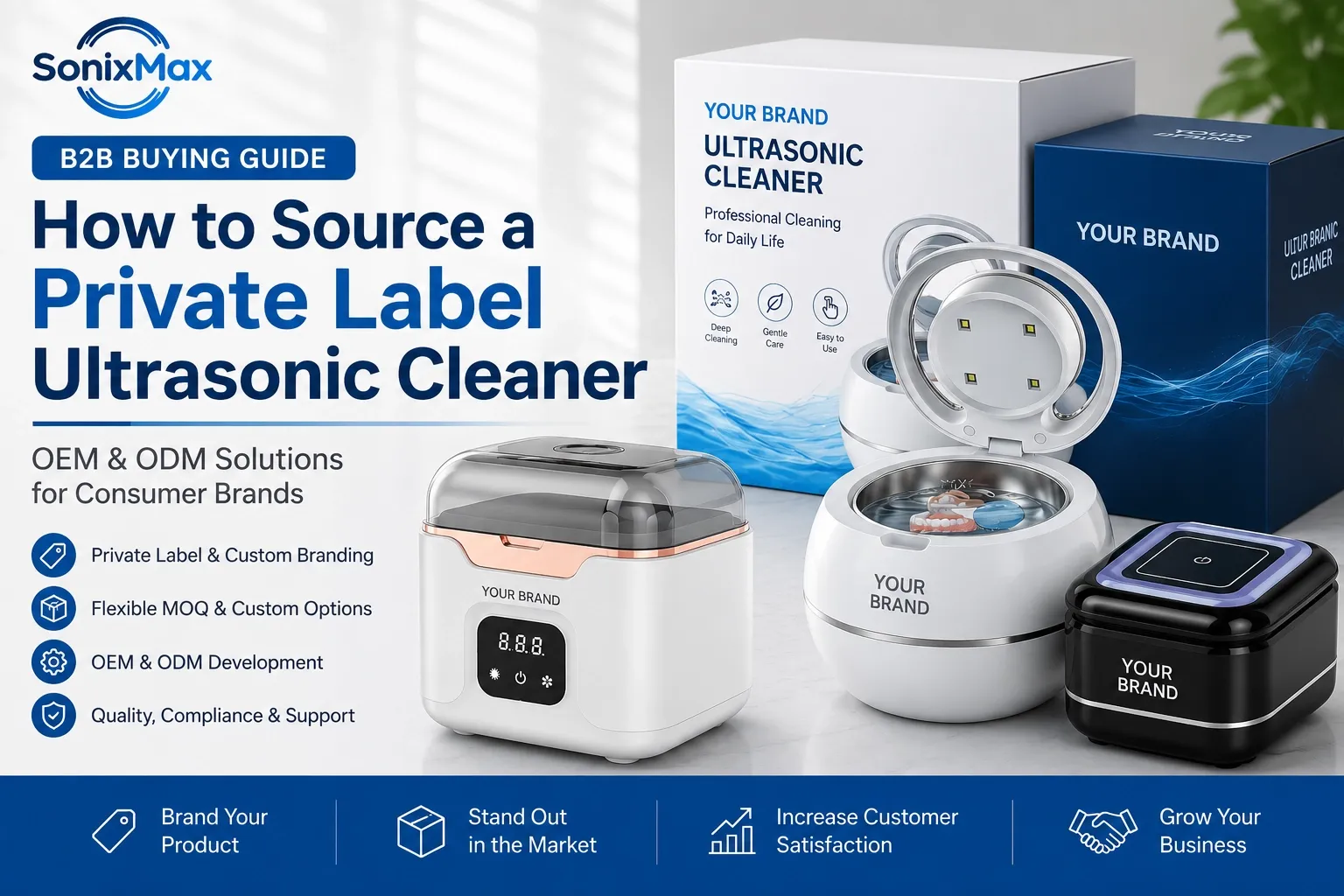
For a brand owner, sourcing a private label ultrasonic cleaner involves much more than selecting a standard machine and adding a logo.
The product needs to fit your target customer, price positioning, sales channel, packaging strategy, and expected order volume. A configuration that works well for a jewelry-care brand may not be the right choice for an oral-care brand, eyewear company, retailer, or general lifestyle brand.
Choosing the wrong product platform—or going too far with customization at the beginning—can create unnecessary inventory, development costs, packaging problems, and customer-experience issues.
This guide explains how D2C brands, retailers, importers, distributors, and other consumer-product companies can evaluate household ultrasonic cleaners from a product-development and sourcing perspective, including private label, OEM and ODM options, customization, MOQ, packaging, sample evaluation, and common sourcing mistakes.
Is a Household Ultrasonic Cleaner a Good Fit for Your Product Line?
Before discussing MOQ or technical specifications, determine whether an ultrasonic cleaner makes sense within your existing product ecosystem.
The strongest fit usually exists when customers already own products that require regular cleaning or maintenance.
A jewelry brand, for example, can position an ultrasonic cleaner as an aftercare product alongside rings, bracelets, necklaces, and other accessories. An eyewear company may offer it as an additional care product, while an oral-care brand may develop a cleaner around retainers, aligners, dentures, or similar daily-care items.
For retailers, distributors, and broader lifestyle brands, the opportunity may be different. Instead of focusing on one specific object, they may prefer a versatile household ultrasonic cleaner that can serve several everyday cleaning scenarios.
The commercial question is therefore not simply:
"Can we sell an ultrasonic cleaner?"
It is:
"Does this product solve a recognizable problem for our customers, and does it fit naturally into our existing product portfolio?"
If the answer is yes, the next step is defining the use case before selecting the machine.
Start With the Customer Use Case Before Choosing a Product
A common sourcing mistake is selecting a household ultrasonic cleaner based primarily on appearance, capacity, or a supplier's standard specification sheet.
Instead, start with what the end customer is expected to clean and how the product will be used in everyday life.
Jewelry & Daily Accessories
For jewelry-care applications, compact dimensions and easy operation are usually more important than maximizing tank capacity.
The cleaner may be used on a vanity, bathroom counter, or dressing table, so the overall appearance becomes part of the consumer experience. Housing finish, controls, lid design, operating noise, and ease of emptying the tank can all influence how the product feels to the customer.
For a jewelry brand, this means the ultrasonic cleaner should be evaluated not only as cleaning equipment but also as an accessory that sits alongside the brand's core products.
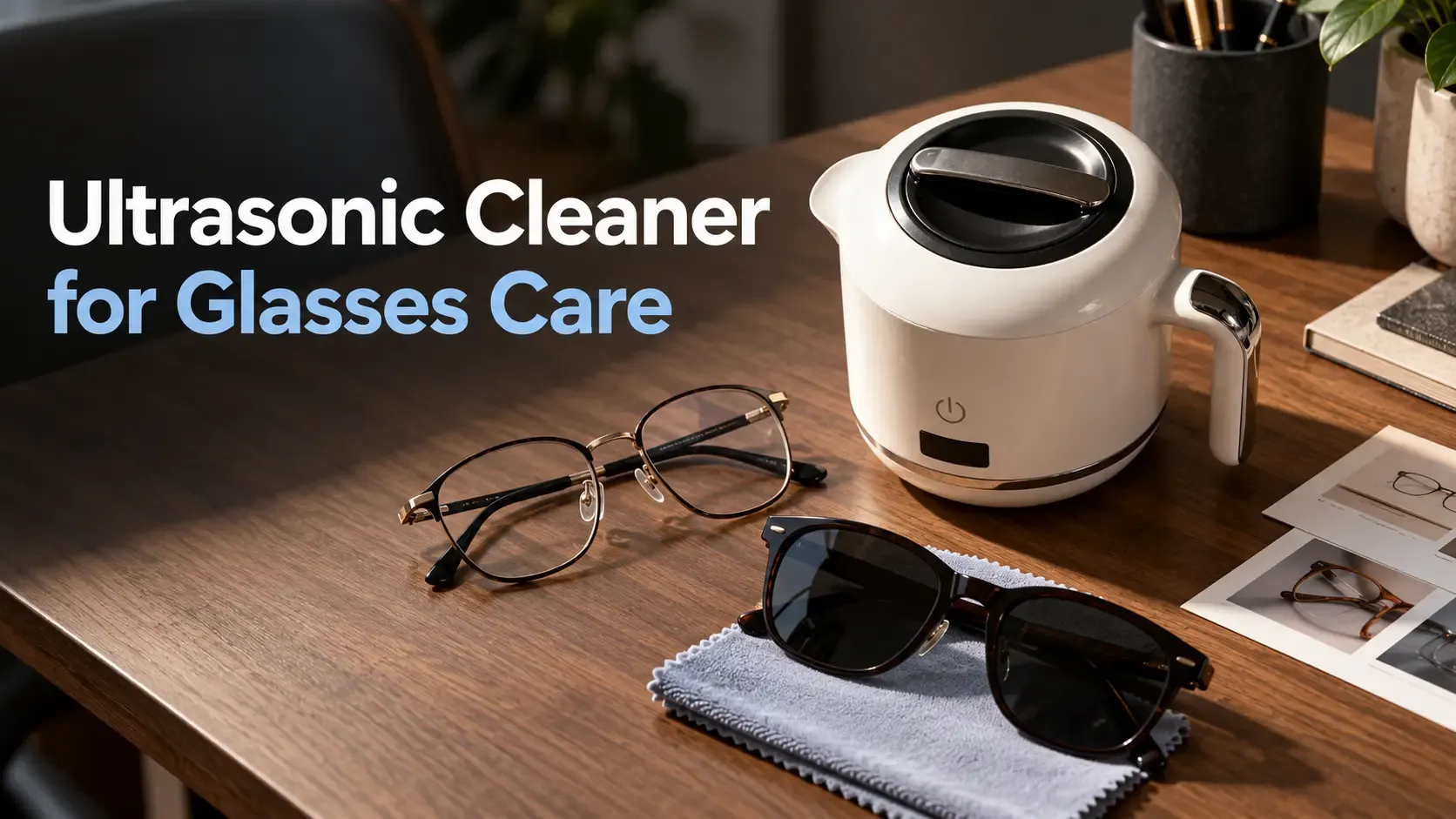
Eyeglasses & Optical Care
For eyewear applications, usable internal tank dimensions can matter more than nominal tank volume.
A cleaner may have sufficient liquid capacity but still be inconvenient if the internal tank is too short or poorly shaped for common eyeglass frames.
Brand buyers should therefore compare actual internal dimensions with the products their customers are expected to clean rather than judging suitability from tank volume alone.
Retainers, Aligners & Oral-Care Products
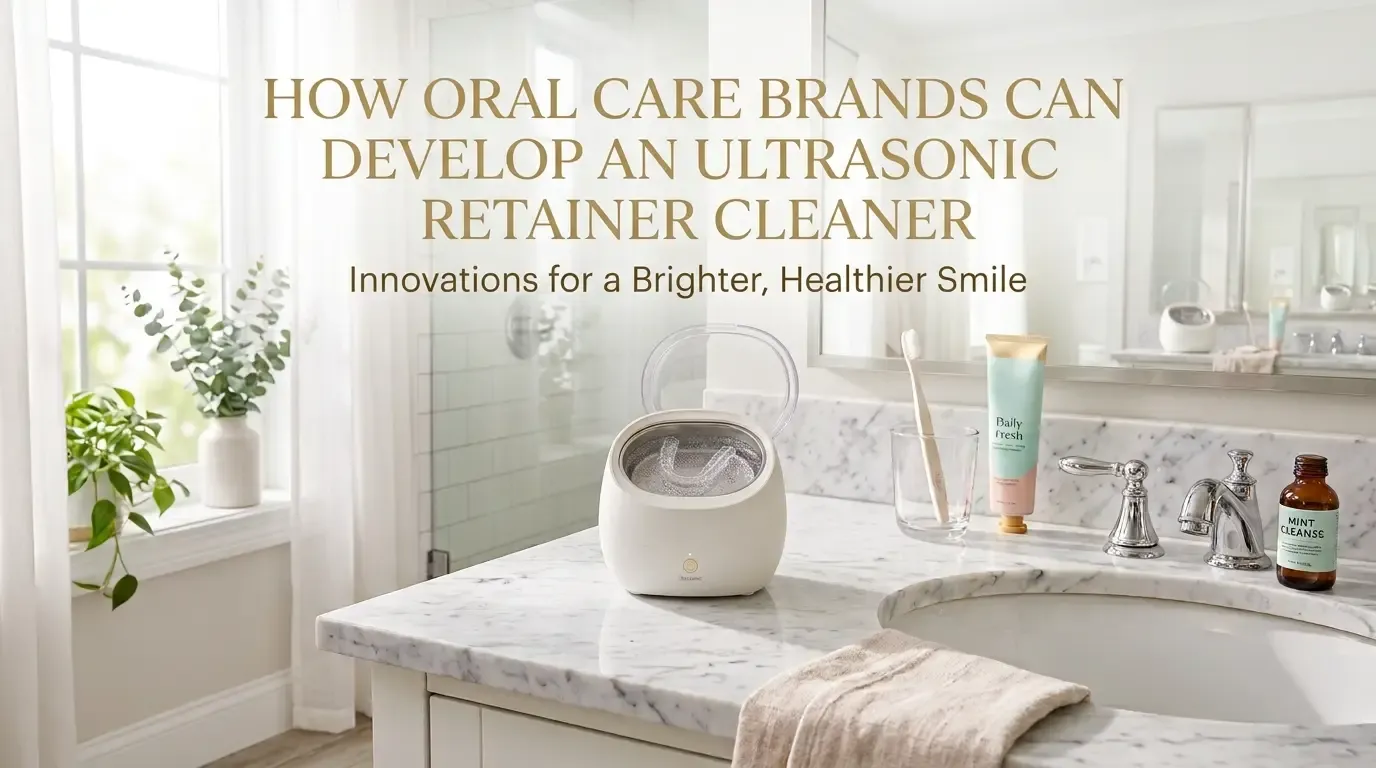
For oral-care applications, compactness, simple operation, water management, and an easy-to-clean tank are particularly important to the daily user experience.
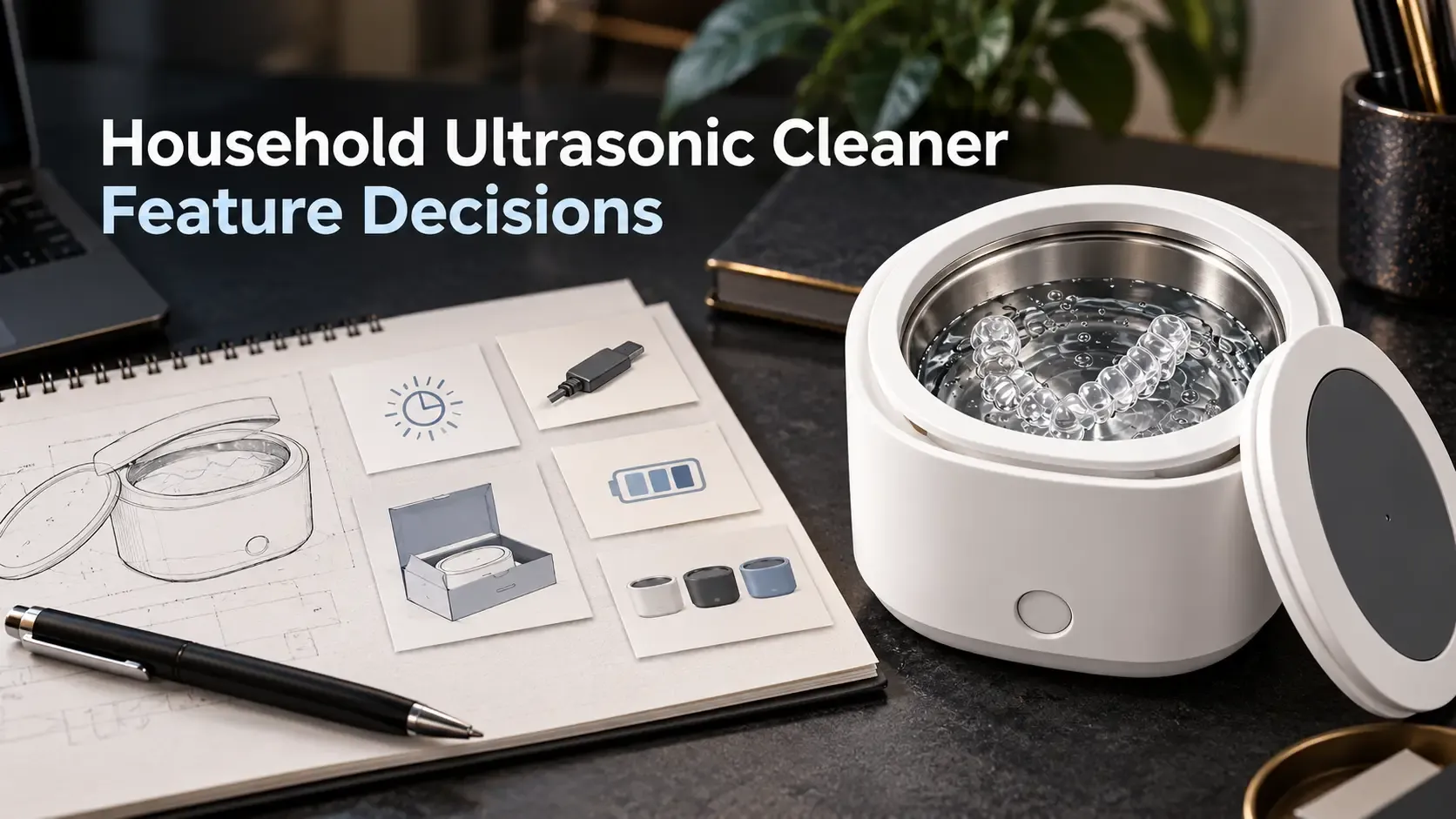
Depending on the intended positioning, a brand may also evaluate different power-supply designs, accessories, cleaning-cycle options, or other functions.
The key is to build the product specification around the intended cleaning routine rather than adding features simply because they are available.
Multi-Purpose Household Cleaning
General lifestyle brands, ecommerce sellers, retailers, and distributors may prefer a broader-use product capable of accommodating suitable small items such as jewelry, watch bands, eyeglasses, and other personal accessories.
In this case, versatility can be more valuable than specialization.
Tank geometry, accessories, cleaning modes, and overall product footprint should work together to create a product that is easy for consumers to understand and use across several common scenarios.
OEM, Private Label or ODM: Which Development Route Fits Your Brand?
Not every brand needs the same level of product development.
A company testing ultrasonic cleaners as a new category has very different requirements from an established brand developing an exclusive long-term product line.
The following framework helps distinguish the main sourcing routes.
Development Route | Branding | Packaging | Product Color | Product Design | Relative Investment | Best Fit |
|---|---|---|---|---|---|---|
Private Label / Standard Platform | Custom logo | Customizable | Usually standard | Existing platform | Lower | Market testing, new product extensions, ecommerce brands |
OEM / Customized Platform | Custom | Custom | Customizable | Existing platform with selected modifications | Medium | Established brands requiring stronger brand consistency |
ODM / Product Development | Custom | Custom | Custom | Existing platform development or new product design | Higher | Brands requiring greater differentiation or exclusive product concepts |
These routes are not rigid definitions for every project. The exact scope depends on what needs to change and how much engineering, tooling, or product development is required.
For many new brands, an existing product platform with customized branding and packaging provides a lower-risk entry point.
Deeper product development becomes more reasonable once the market, expected order volume, and long-term product strategy are better understood.
Which Product Specifications Actually Matter to Consumer Brands?
Technical specifications matter, but a brand buyer should always translate them into the customer experience.
The objective is not to choose the machine with the longest specification sheet. It is to identify which specifications affect usability, product positioning, customer satisfaction, packaging, fulfillment, and overall commercial performance.
Tank Size Should Follow the Use Case
Tank capacity and internal dimensions determine what users can actually place inside the machine.
For an eyewear product, usable tank length may matter more than total volume. For a jewelry cleaner, a compact footprint may be more valuable than additional capacity that most customers will never use.
A larger tank can also affect external dimensions, packaging size, shipping weight, and countertop footprint.
For D2C and ecommerce brands in particular, product dimensions should therefore be considered together with fulfillment and packaging requirements.
Frequency Is Part of the Cleaning System, Not a Standalone Marketing Claim
Ultrasonic frequency influences cavitation characteristics, but it should not be evaluated in isolation.
Household ultrasonic cleaners are generally designed around smaller, everyday cleaning applications where cleaning effectiveness needs to be balanced with the intended materials and user scenarios.
Material compatibility, cleaning liquid, exposure time, item condition, ultrasonic output, and frequency all contribute to the final cleaning result.
For brand buyers, the important question is not simply:
"Which machine has the better frequency?"
It is:
"Is the complete cleaning configuration appropriate for the items our customers are expected to clean?"
Cleaning Cycles Should Reduce User Guesswork
Consumer products benefit from simple and understandable operation.
Multiple controls can look impressive on a specification sheet but may create unnecessary complexity for everyday users.
Depending on the target customer, a small number of clearly defined cleaning cycles or simple one-button operation may provide a better experience than adding functions that customers rarely use.
The appropriate design depends on whether the product is positioned as a simple household appliance, a premium care accessory, or a more specialized cleaning device.
Noise, Product Size and Water Management Affect Everyday Use
An ultrasonic cleaner is not experienced by the consumer only through its cleaning result.
Users also notice how much space it occupies, how it sounds during operation, how easily the lid opens, how convenient it is to fill and empty, and whether water can be handled without creating an awkward interaction with the power connection.
These details rarely dominate a supplier specification sheet, but they can influence the perceived quality of a consumer product.
Power Supply Design Should Match the Sales Scenario
Plug-in adapters, detachable cables, and other power configurations create different user experiences and may also affect packaging and destination-market requirements.
A travel-oriented product may prioritize compactness and cable management, while a countertop product may prioritize simplicity and stability.
Power configuration should therefore be selected together with the intended use environment and destination market rather than treated as a minor final detail.
How Much Customization Does Your Brand Actually Need?
Customization should be treated as an investment ladder rather than an all-or-nothing decision.
A new brand does not necessarily need a completely new product design to launch a differentiated household ultrasonic cleaner.
The appropriate level of customization depends on expected order volume, brand positioning, sales channel, and how important product exclusivity is to the business.
For SonixMax household ultrasonic cleaner projects, customization can progress from basic branding to deeper product development.
Customization Level | MOQ | What Can Be Customized | Best For |
|---|---|---|---|
Logo Printing | 500 units | Free logo printing on the machine | New brands, market testing, branded product extensions |
Custom Color Box | 1,000 units | Customized retail color box and brand artwork | D2C, ecommerce and retail brands |
Custom Machine Color | 2,000 units | Machine housing color customized to brand requirements | Established brands requiring stronger visual differentiation |
Private Mold Development | Project-based | Product appearance, structure and other project-specific development | Brands requiring deeper differentiation or exclusive product development |
This creates a practical development path:
Standard Product → Logo Branding → Custom Packaging → Custom Machine Color → Private Mold Development
For a new D2C brand testing ultrasonic cleaners as a new category, logo printing may provide enough initial brand differentiation without requiring a large customization commitment.
Once the product has demonstrated market demand, custom packaging can create a stronger retail identity and a more complete branded customer experience.
At higher volumes, custom machine colors can make the physical product itself more consistent with the brand's visual identity.
Private mold development represents a deeper level of differentiation. It is more appropriate when the product is expected to become an important long-term SKU and the expected commercial volume can justify additional development, tooling, and validation.
The objective is not to customize as much as possible from the first order.
The objective is to choose the level of differentiation that matches the commercial stage of your brand.
MOQ vs. Product Differentiation: How Should a New Brand Start?
MOQ should be considered together with the commercial value created by each level of customization.
For SonixMax household ultrasonic cleaner projects, brands can begin with machine branding from 500 units, move to customized retail packaging from 1,000 units, and introduce a custom machine color from 2,000 units.
This allows product differentiation to increase progressively rather than requiring a brand to commit immediately to a deeply customized product.
For example, a new ecommerce or D2C brand testing the category may begin with:
500 units → Standard product + custom logo
Logo printing on the machine is free at this order level, providing basic brand identity while keeping the project relatively simple.
A brand preparing a more complete D2C or retail launch may move to:
1,000 units → Custom logo + custom color box
At this stage, packaging becomes an important part of the customer-facing brand experience and can communicate product positioning more effectively across ecommerce and physical retail channels.
For an established brand seeking stronger visual differentiation:
2,000 units → Custom logo + custom packaging + custom machine color
The physical product can then align more closely with the brand's visual identity rather than relying primarily on the logo and packaging.
For projects requiring a more exclusive product concept, private mold development is also available. These projects should be evaluated individually because tooling, structural changes, development work, and expected production volume depend on the specific product concept.
The key sourcing question therefore changes from:
"What is your minimum MOQ?"
to:
"What level of product differentiation makes sense at our expected sales volume?"
That distinction helps brands balance customization, inventory commitment, development cost, and market risk.
Packaging, Retail Channels and D2C Fulfillment
For household ultrasonic cleaners, packaging is part of the product strategy.
The same machine may require different packaging priorities depending on how it reaches the customer.
A D2C or ecommerce brand needs packaging that protects the machine through parcel delivery while avoiding unnecessary dimensional volume. Internal protection, accessory placement, instructions, and the unboxing experience all matter.
A physical retail program may place greater emphasis on shelf presentation, product photography, clear application messaging, barcodes, labeling, and multilingual information.
Importers and distributors may have additional requirements related to carton quantities, regional labeling, language versions, or downstream retail requirements.
Packaging decisions should therefore begin early in the sourcing process—not after the product itself has already been finalized.
For brands that require a fully customized retail presentation, SonixMax supports custom color boxes from 1,000 units.
Compliance and Documentation Before Market Launch
Compliance requirements depend on the destination market, exact product configuration, power design, materials, labeling, and applicable regulatory framework.
Brand buyers should not assume that documentation associated with one standard configuration automatically applies to every customized version.
Before placing a bulk order, confirm which documents apply to the exact model being purchased and whether proposed modifications affect existing testing or documentation.
Important items to review can include:
- Product and electrical documentation
- Applicable safety and EMC requirements
- Material-related requirements where applicable
- Power adapter and plug configuration
- Product labels
- Packaging markings
- User manual requirements
- Destination-market language requirements
The exact list should be determined according to the product and market rather than treated as a universal checklist.
For projects involving deeper customization or private mold development, documentation requirements should be reviewed again based on the final product configuration.
How to Evaluate Samples Before Placing a Bulk Order
Testing whether the machine produces ultrasonic cleaning action is only the beginning of sample evaluation.
A brand buyer should review the sample from the perspective of the final customer.
Start with the physical product. Examine the housing finish, assembly gaps, tank finish, lid fit, buttons, display, accessories, cable arrangement, and overall visual quality.
Then run the product as a customer would.
Check whether the intended items fit naturally, whether the controls are easy to understand, whether filling and emptying are convenient, and whether the sound and vibration are appropriate for the intended use environment.
If the product is being developed specifically for eyeglasses, test representative frame sizes. If it is positioned for jewelry, test the types of items the target customer is likely to own. For oral-care applications, evaluate the product around the intended daily-use routine.
Finally, review everything surrounding the machine:
- Packaging
- Labels
- Accessories
- Instructions
- Product presentation
- Carton protection
A technically functional product can still create a poor customer experience if these details have not been properly considered.
What Does a Low Unit Price Really Cost Your Brand?
Unit price matters, but it is only one part of the commercial cost of a consumer product.
A lower purchase price can be offset by other costs such as higher return or replacement rates, inconsistent production batches, packaging damage during fulfillment, weak instructions, limited product differentiation, additional customer-service workload, or poor coordination when repeat orders are required.
For D2C brands, returns and negative reviews can be particularly expensive because they affect more than the individual transaction.
For distributors and retailers, inconsistent batches or packaging problems can create additional operational costs across multiple customers and sales channels.
The more useful comparison is therefore not simply:
Supplier A unit price vs. Supplier B unit price
but:
Product cost + packaging + logistics + customer experience + supply consistency + support
A lower unit price is not necessarily a better commercial decision if it creates greater costs elsewhere.
Mistakes to Avoid When Sourcing Private Label Ultrasonic Cleaners
Over-Customizing the First Order
Developing custom tooling and extensive product modifications before validating demand can increase both development cost and inventory exposure.
A new brand should begin with the level of differentiation that is commercially necessary rather than assuming a completely unique product is required from day one.
Choosing a Supplier Based Only on Unit Price
Product quality, consistency, packaging, documentation, communication, customization capability, and repeat-order coordination should all be considered alongside price.
The lowest quotation does not automatically represent the lowest total commercial cost.
Treating Packaging as an Afterthought
For consumer products, packaging influences protection, fulfillment, retail presentation, and brand perception.
It should be included in the product-development process from the beginning.
Ordering Bulk Production Before Proper Sample Validation
Photos, specifications, and videos cannot fully represent the customer experience.
Representative samples should be evaluated before confirming bulk production.
Assuming Documentation Applies to Every Customized Version
Changes to product configuration can affect which documents or tests are relevant.
Confirm the exact configuration and applicable requirements before market launch.
Adding Features Without a Clear Customer Benefit
More functions do not automatically create a better consumer product.
Every added feature should answer a simple question:
"What meaningful problem does this solve for our target customer?"
If the answer is unclear, the feature may add complexity without adding meaningful commercial value.
FAQ
OEM vs. ODM Ultrasonic Cleaner: Which Is Better for a New Brand?
For many new brands, starting from an existing product platform is a lower-risk approach because it reduces development complexity and allows the market to be tested before committing to deeper customization.
OEM customization becomes useful when the brand requires stronger visual or functional differentiation while still working from an established product platform.
ODM or private mold development becomes more relevant when a brand requires deeper product differentiation or a more exclusive product concept and has sufficient expected volume to support the additional development.
What is the difference between private label, OEM, and ODM ultrasonic cleaners?
A private label ultrasonic cleaner usually starts from an existing product platform and adds brand elements such as logo, packaging, or product presentation.
OEM ultrasonic cleaner projects usually involve more customization based on an existing platform, such as machine color, control panel, accessories, packaging, or selected functional changes.
ODM ultrasonic cleaner projects involve deeper product development or a more exclusive product concept. This route is more suitable when the brand has clearer market validation, higher expected volume, and a stronger need for product differentiation.
What Should I Test Before Approving a Household Ultrasonic Cleaner?
Evaluate both cleaning performance and customer experience.
Use representative items from the intended application and review tank fit, controls, operating experience, water handling, product finish, accessories, packaging, labels, and instructions before approving bulk production.
For brand customers, sample approval should reflect how the final consumer will actually experience the product—not only whether the ultrasonic function operates.
Build the Product Around Your Market, Not the Supplier's Catalog
Successful private-label sourcing begins with the market, not with a list of available machines.
Define your target customer, cleaning application, price positioning, sales channel, expected volume, and required level of differentiation first.
Then determine whether the project needs a standard private-label product, an OEM customization program, or deeper ODM/private mold development.
For a new D2C brand, the right strategy may be a proven product platform with custom branding and packaging.
For an established consumer brand, higher order volumes may justify custom machine colors or deeper product development.
For an importer, distributor, or retailer, portfolio coverage, packaging requirements, and repeat-order stability may be more important than creating an entirely new housing design.
SonixMax supports household ultrasonic cleaner projects for consumer brands, D2C businesses, retailers, importers, distributors, and ecommerce sellers, including private-label and OEM/ODM requirements.
Explore our Household Ultrasonic Cleaners or contact SonixMax with your target application, destination market, expected order quantity, and customization requirements so we can evaluate a suitable product-development route for your brand.