Oct 12, 2026Ultrasonic Cleaning Technology
Why Do Parts Rust After Ultrasonic Cleaning? Flash Rust Causes and Process Fixes
Learn why parts rust after ultrasonic cleaning and how to prevent flash rust by checking drying speed, rinse water, trapped moisture, cleaning chemistry, rust inhibitors, and process setup.
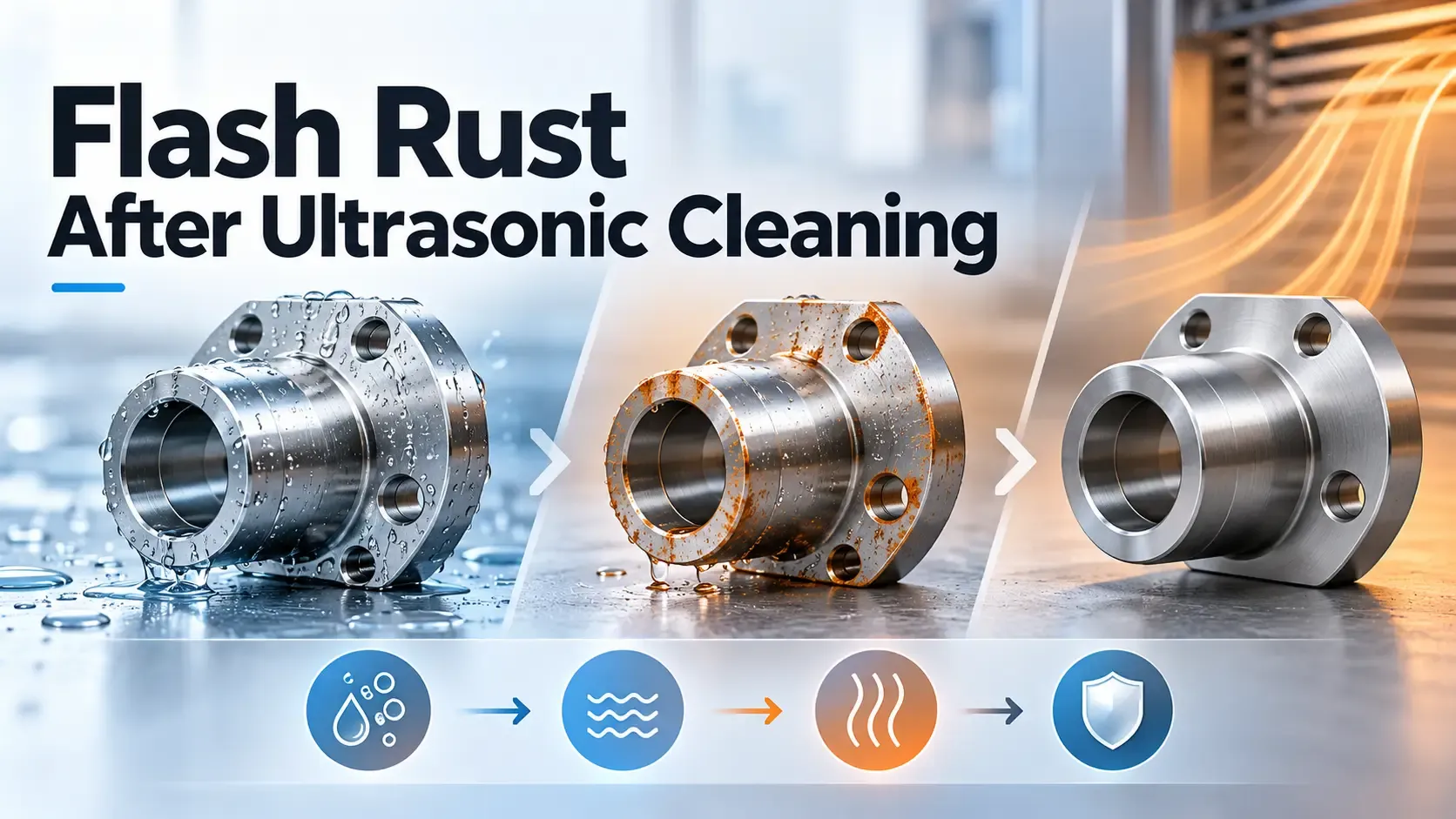
Parts may look clean immediately after ultrasonic cleaning, but a short time later, orange rust, brown stains, or dull oxidation marks begin to appear.
This is a common post-cleaning problem, especially with steel, cast iron, machined parts, engine components, tools, fasteners, and other ferrous metals.
In many cases, the ultrasonic cleaner itself does not cause rust directly. Ultrasonic cleaning removes protective oils, grease, coolant, or temporary rust-preventive film, leaving bare metal exposed to moisture and oxygen. If parts are not rinsed, dried, or protected correctly, flash rust can develop quickly.
This guide explains why parts rust after ultrasonic cleaning and how to prevent flash rust through better process control.
Quick Answer
Parts may rust after ultrasonic cleaning because:
- cleaning removed the temporary protective oil film
- bare steel or cast iron was left wet
- drying was too slow or inconsistent
- water remained trapped in blind holes, threads, or internal crevices
- rinse water quality was poor
- detergent residue remained on the surface
- cleaning chemistry was incompatible or too aggressive for the metal
- no rust inhibitor or protective step was used
- parts were stacked while damp or stored in a humid environment
- the process lacked a controlled wash, rinse, dry, and protect workflow
If rust appears after cleaning, do not assume the machine is defective. Evaluate material, chemistry, water retention, drying speed, rinse quality, and post-cleaning protection.
First Identify: Existing Rust, Flash Rust, or Surface Staining?
Before modifying the process, confirm what kind of mark is appearing.
Ask these diagnostic questions:
- Was the part already rusty before cleaning?
- Did rust appear immediately after cleaning or later during storage?
- Is the mark orange, reddish-brown, black, or dull gray?
- Does it wipe off, or is it bonded to the surface?
- Does it appear on all surfaces, or only around holes, edges, threads, and contact points?
- Does it occur primarily on steel or cast iron components?
- Are parts stacked while still warm or damp?
- Does the problem change after improving drying or storage?
Existing rust means corrosion was present before cleaning.
Flash rust is rapid oxidation of freshly exposed bare metal after contact with water and oxygen.
Surface staining may come from dirty rinse water, detergent residue, mineral deposits, or contamination transfer rather than true rust.
Do not treat all brown, yellow, or orange marks as the same problem.
1. Cleaning Removed the Protective Oil Film
Many steel and cast iron parts are coated with cutting fluids, machining oil, grease, coolant, or temporary rust preventives before cleaning.
Ultrasonic cleaning is designed to remove these contaminants.
Once the oil film is removed, the bare metal surface becomes more reactive to surrounding moisture and air.
The machine may have cleaned successfully, but if no post-cleaning protection is applied, ferrous metals can oxidize quickly.
This is common on:
- machined carbon steel components
- cast iron engine parts
- fasteners and hardware
- stamped metal parts
- tools and maintenance parts
- parts stored before assembly
If downstream operations require parts to remain clean and oil-free, rapid drying and storage control become more important.
If an oil film or protective layer is acceptable, a rust inhibitor or protective dip may be needed after cleaning.
2. Water Left on Bare Steel Can Cause Flash Rust
Flash rust occurs when bare ferrous metal remains wet in the presence of air.
After ultrasonic washing or rinsing, a thin water film may remain on the part. Oxygen can react with the exposed metal surface through that water layer, causing rapid oxidation.
Flash rust is more likely when:
- parts are made from steel or cast iron
- parts are left wet after cleaning
- rinse water remains on the surface
- parts dry slowly at room temperature
- humidity is high
- rough or porous surfaces hold water
- parts are stored before being fully dry
The problem is often not the ultrasonic stage alone. It is the time between cleaning and drying.
The longer a wet ferrous part sits exposed, the higher the risk of rust.
3. Slow Drying Creates a Flash Rust Window
Drying speed is critical to rust prevention.
If drying takes too long, oxidation can begin before the surface is moisture-free.
A simplified risk window looks like this:
Wash or rinse stage ↓ Wet bare metal exposed to air ↓ Slow drying window ↓ Flash rust appears
This is especially risky for:
- cast iron
- carbon steel
- threaded parts
- blind holes
- rough surfaces
- stamped parts
- porous or textured surfaces
- parts with internal channels
Possible drying improvements include:
- draining parts at an angle
- using clean compressed air where appropriate
- blowing water out of holes and threads
- using controlled hot air drying when suitable
- reducing transfer time from rinse to dry
- drying parts before storage or packaging
- avoiding tightly stacked parts during drying
Drying should be treated as part of the cleaning process, not as an afterthought.
If parts rust repeatedly after cleaning, inspect where water remains longest.
4. Holes, Threads, and Crevices Trap Moisture
Even if external surfaces dry quickly, internal geometry can hold water.
High-risk areas include:
- blind holes
- threaded holes
- grooves
- keyways
- internal channels
- sharp corners
- overlapping surfaces
- porous cast surfaces
These areas can rust first because moisture remains trapped longer.
In some cases, visible rust appears at the edge of a hole or around threads because water evaporated slowly from that area.
Prevention may require:
- changing part orientation
- improving drainage
- using compressed air carefully
- adding a drying stage
- extending drying time for complex parts
- using fixtures that allow water to drain
- applying rust protection when needed
For parts with complex geometry, simply removing them from the tank and placing them on a tray may not be enough.
5. Rinse Water Quality and Residue Can Accelerate Rust
Water quality can influence corrosion risk.
If rinse water contains dissolved minerals, salts, chlorides, or contamination from previous batches, it may leave residues that accelerate rust or staining.
Detergent residue can also affect corrosion behavior if it remains on the part after cleaning.
This is why rust sometimes appears even after parts seem to be rinsed.
Possible issues include:
- dirty rinse water
- reused rinse water
- hard water deposits
- detergent residue
- dissolved salts or contaminants
- contaminated tanks or baskets
- parts drying with residue on the surface
For critical parts, a cleaner final rinse may be needed.
This does not mean every application requires deionized water, but if rust or staining is repeated, rinse water quality should be reviewed.
6. Wrong Chemistry Can Increase Corrosion Risk
Cleaning chemistry must match the part material.
A detergent that works well for one material may be risky for another.
Corrosion risk can increase when:
- chemistry is too aggressive for the metal
- concentration is too high
- exposure time is too long
- temperature is too high
- pH is not suitable for the material
- detergent residue is not rinsed away
- inhibitor is missing for rust-prone metals
Steel, cast iron, aluminum, zinc, brass, plated parts, and coated parts may all require different chemistry considerations.
If rust or discoloration appears after switching detergents, increasing concentration, or raising temperature, the chemistry should be reviewed.
Do not solve corrosion by simply shortening the cycle without checking chemical compatibility.
7. Rust Inhibitor or Protective Dip May Be Needed
Some parts need protection after cleaning.
If the part is ferrous metal and will be stored, shipped, handled, or assembled later, a rust inhibitor may be needed.
Rust prevention options may include:
- rust inhibitor in the cleaning or rinse process
- protective dip after washing
- corrosion-inhibiting final rinse
- water-displacing fluid
- light oil film when acceptable
- controlled drying and packaging
- humidity control during storage
The right method depends on the part material, downstream process, and whether the part must remain oil-free.
For example, a part going to painting, plating, welding, coating, or bonding may not be able to accept oily protection. In that case, drying, water quality, and process timing become more important.
A rust inhibitor should be selected according to material, process requirement, and supplier guidance.
8. When a Basic Process Is Not Enough
A basic process may work for simple cleaning, but repeated rust problems may require better control.
A more complete process may look like this:
Ultrasonic washing ↓ Rinsing ↓ Clean final rinse if needed ↓ Drying ↓ Rust inhibition or protected storage if needed
If rust appears repeatedly, review the full process instead of only changing ultrasonic time.
You may need a better process when:
- parts rust before inspection
- parts rust before assembly
- parts rust during storage
- rust appears inside holes or threads
- parts are made from cast iron or carbon steel
- humidity is high
- parts must stay clean but oil-free
- drying is inconsistent
- rinse water quality is unstable
For high-volume or precision cleaning, a controlled multi-stage process may be more reliable than a single wash tank.
Troubleshooting Guide
Symptom | Primary Cause | Recommended Action |
|---|---|---|
Rust appears quickly after cleaning | Flash rust on bare steel | Improve drying speed and consider rust inhibitor |
Rust appears around holes or threads | Trapped water in internal features | Improve drainage, orientation, and air blow-off |
Rust appears after storage | Moisture or lack of protection | Review packaging, humidity, and protective film |
Rust starts after switching detergent | Chemistry mismatch | Check material compatibility and concentration |
Brown or yellow marks appear after drying | Rinse residue or water quality issue | Improve rinse water and drying process |
Cast iron rusts faster than other parts | High rust sensitivity and porous surface | Dry immediately and review inhibitor options |
Parts rust in batches but not individually | Loading or drying issue | Avoid stacking, improve airflow, inspect contact areas |
Parts must remain oil-free but rust quickly | Missing controlled drying or final rinse | Improve rinse quality, drying method, and storage timing |
Summary Checklist to Prevent Flash Rust
To reduce rust risk after ultrasonic cleaning, control the full post-cleaning process.
Useful steps include:
- Chemistry: use a cleaning solution compatible with the part material.
- Rinsing: rinse parts properly to remove detergent and corrosive residue.
- Drainage: tilt parts and clear blind holes, threads, and channels.
- Fast drying: dry parts quickly and completely after rinsing.
- Protection: apply rust inhibitor or protective dip when downstream requirements allow it.
- Storage: avoid storing damp parts in closed bins or humid areas.
- Testing: confirm the process before production cleaning.
Rust prevention is not only about the ultrasonic cleaner. It depends on what happens immediately after cleaning.
Diagnosing Corrosion Issues with Sonixmax
If your parts rust or stain after ultrasonic cleaning, send Sonixmax your application details:
- part material and surface finish
- original part condition before cleaning
- cleaning chemical and concentration used
- rinsing water source and rinse method
- drying method and drying time
- time elapsed before rust appears
- storage condition after cleaning
- photos of parts before and after cleaning
Sonixmax can help evaluate whether the issue stems from chemistry mismatch, water retention, slow drying, poor rinse quality, missing rust inhibition, storage condition, or equipment process design.
The goal is not only to remove contamination. The goal is to build a cleaning process that keeps parts clean, dry, and protected until the next production step.