Oct 24, 2026Ultrasonic Cleaning Technology
Ultrasonic Cleaning vs UV-C: What Do They Do in a Household Cleaner?
Understand the different roles of ultrasonic cleaning and UV-C in household cleaners, and what brands should verify before making cleaning or hygiene claims.
A household cleaner may list both ultrasonic cleaning and UV-C light on the same product page. It is easy to read that combination as “two ways to clean” or assume that a completed cycle leaves every item disinfected.
Those conclusions need a closer look. Ultrasonic cleaning and UV-C use different mechanisms, and the presence of both features does not establish every result a brand might want to claim.
For consumer brands, retailers and private-label buyers, understanding the distinction helps connect product features with realistic instructions, suitable applications and supporting evidence.
Quick Answer: Different Functions Need Different Evidence
Ultrasonic cleaning helps remove contamination through activity in a liquid bath. UV-C is a light-based treatment whose effect depends on the radiation reaching the relevant target under suitable conditions.
The two functions answer different evaluation questions:
This diagram separates the questions to verify; it is not a prediction of cleaning or microbial performance.
An ultrasonic cleaning result does not automatically establish disinfection. Likewise, a UV-C light turning on does not prove that dirt has been removed or that every surface has received an effective treatment.
A household device combining the functions should be evaluated as a complete product. Its intended items, loading arrangement, operating sequence and supporting tests determine which claims can reasonably be made.
What the Ultrasonic Function Does
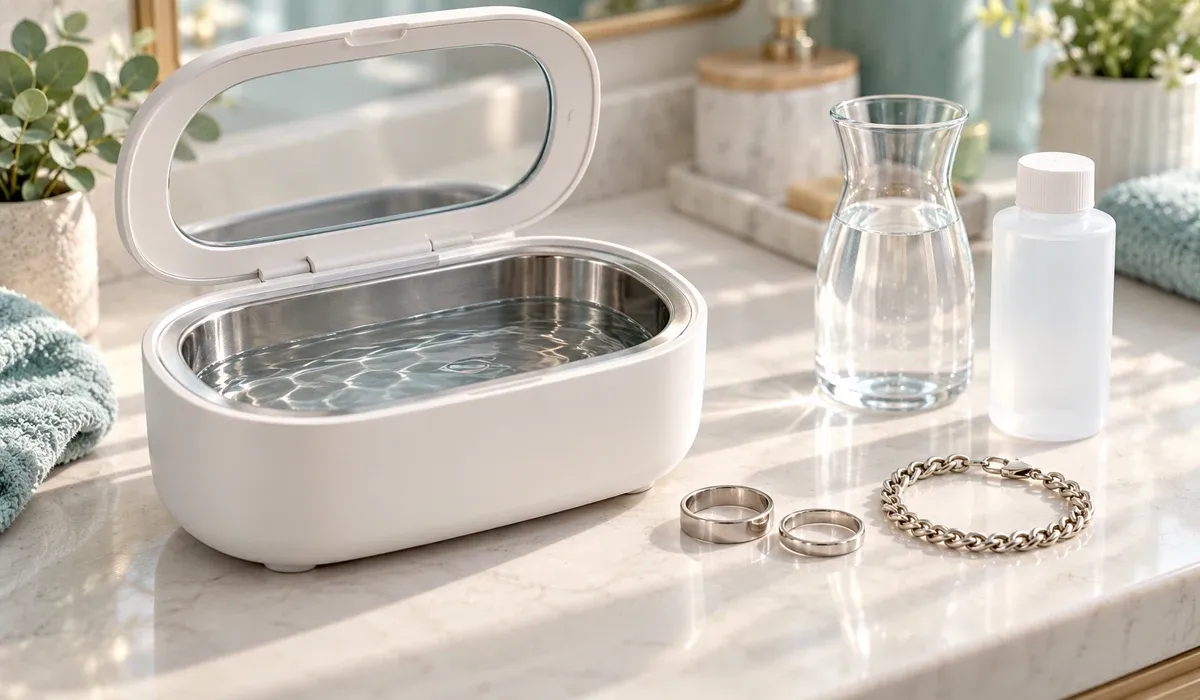
Ultrasonic cleaning uses cavitation in a liquid to help loosen contamination from surfaces the liquid reaches. With a suitable item, compatible chemistry and appropriate loading, it can assist with deposits around grooves, links and other detailed areas.
The result still depends on the process. An unsuitable cleaning liquid, tightly packed load or trapped air can affect access to the surfaces that need cleaning. A higher frequency figure or longer timer setting does not independently establish a better result.
The important distinction is the result being evaluated. Observing oil or dirt come away from an item provides information about contamination removal. It does not, by itself, demonstrate a particular reduction in microorganisms.
What the UV-C Function Depends On
UV-C radiation can inactivate microorganisms under appropriate exposure conditions. That general principle does not establish the performance of every household product containing a UV-C source.
The actual source specification, radiation reaching the target, exposure duration and loading arrangement matter. Surfaces hidden behind another object or otherwise shielded from the source may not receive the same exposure as an unobstructed surface.
A combined household cleaner therefore needs evaluation in the configuration in which it will be used. The liquid condition, item position, supports and operating sequence belong in that assessment rather than being assumed irrelevant.
A visible glow, illuminated indicator or count of UV lamps is not a performance test. Those observations do not establish the emitted wavelength, exposure at the item or achieved treatment result.
Before approving a claim, ask what was tested, which surfaces or samples were evaluated, and whether the documented conditions represent the final product instructions.
Compare the Claimed Result, Not Just the Feature Label
A useful comparison begins with the question each observation or test actually answers.
Feature or observation | What it can help establish | What it does not establish by itself |
|---|---|---|
Dirt or oily residue is removed during a cleaning cycle | The cleaning process addressed the evaluated contamination under those conditions | A specified disinfection or sterilization result |
The UV-C function switches on | The control activates the relevant function | Effective exposure across every item surface |
A UV source specification is supplied | Information about the stated source | The complete product's performance with real loading |
A test report documents a microbial result | Evidence for the reported endpoint and tested conditions | The same result for every organism, material, load or operating mode |
Ultrasound and UV-C are fitted in one housing | The product incorporates both functions | A verified combined benefit or permission to use stronger hygiene claims |
Cleaning, disinfection and sterilization describe different outcomes. They should not be treated as interchangeable words on packaging or ecommerce listings.
A visibly cleaner item and a documented microbial result also answer different questions. Where a brand wants to make both types of claim, it needs evidence appropriate to each one.
Why Item Placement and Operating Sequence Matter
A household cleaner is used with actual objects, rather than an empty tank and an unobstructed light source.
For ultrasonic cleaning, the load should allow the permitted liquid to reach the intended surfaces. For UV-C evaluation, the arrangement should represent the exposure conditions relevant to the proposed claim. One loading position should not be assumed optimal for both functions without assessment.
The operating sequence also needs clarification. Does the product run the functions together, separately or in a defined sequence? What liquid and loading conditions apply to each mode? Which combinations are permitted?
Follow the final product instructions rather than inventing a sequence from the control-panel labels. An independent button offers control flexibility; it does not demonstrate that every possible combination has been evaluated.
Item compatibility remains a separate question. A material suitable for one cleaning process is not automatically suitable for every liquid, light exposure or repeated-use routine.
Safety and Controls Belong in the Product Evaluation
UV-C exposure can harm eyes and skin. For a household appliance, the relevant enclosure, controls and operating restrictions therefore need to be understood and supported for the final configuration.
Ask how the product is intended to prevent unintended exposure and what documentation supports that design. Do not assume that a closed-looking lid, a viewing window or an advertised UV function establishes a particular protective feature.
Any lid-related behavior, warnings and permitted maintenance procedures should be clear in the instructions. Do not bypass the enclosure or operate the source in an unintended open configuration to check whether it works.
A light-safety assessment and a treatment-performance test address different questions. Evidence for one should not be presented as proof of the other.
What Brands Should Check Before Approving Claims
Before approving a dual-function household cleaner, align the intended use, final hardware and proposed wording.
A practical review should establish:
- The intended items and condition: materials, construction, relevant contamination and loading arrangement.
- The permitted process: liquid, filling requirements, selected functions, sequence and finishing steps.
- The evidence for the claimed result: what was measured, how it was tested and what limitations apply.
- The final configuration: whether the source, controls, enclosure and accessories match the documented product.
- The customer guidance: whether the manual, packaging, listing and support material describe the same permitted use.
If testing included preparation, repositioning or a separate cleaning step, those conditions should remain visible when the result is communicated. Do not attribute a complete process result to one feature while omitting the other steps.
For broader decisions about adding or omitting functions, our household ultrasonic cleaner feature guide covers the product-planning questions separately.
Evaluating a Sonixmax Household Platform
Sonixmax's household ultrasonic cleaner with independently controlled UVC provides one platform brands can evaluate for a dual-function product concept.
The listed independent control describes an operating feature. Any application-specific cleaning or UV-C performance claim still needs to correspond to the final configuration, permitted process and supporting documentation.
The purpose of evaluation is to select a product whose functions and instructions fit the intended use. Adding UV-C should not become a substitute for demonstrating the cleaning result or clarifying what customers can reasonably expect.
If you are developing a household cleaning product, contact us to discuss your private-label requirements. Share the intended items, required functions, target market and proposed product claims so the configuration and available evidence can be reviewed together.